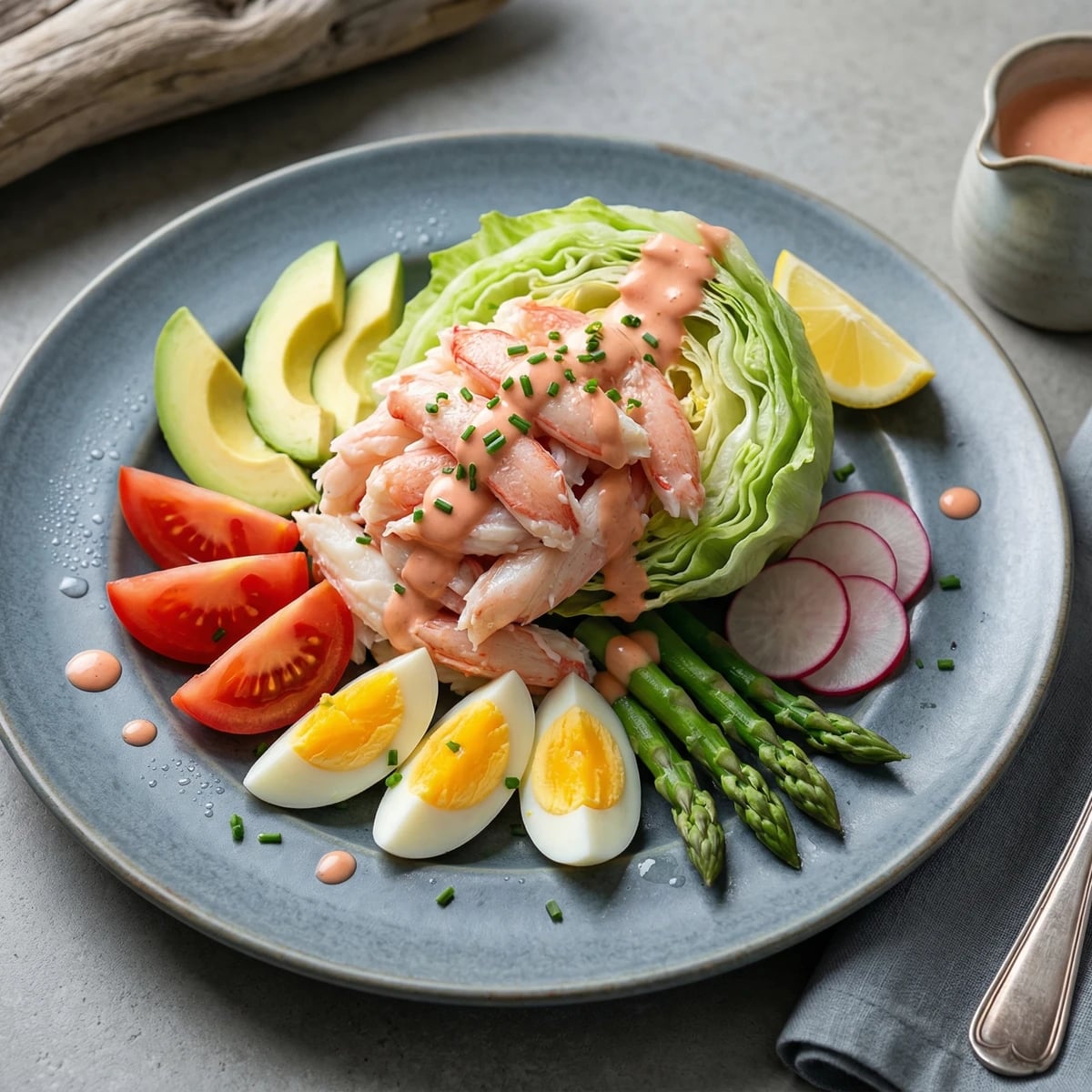
Sweet Dungeness crab piled high on a throne of crisp iceberg, surrounded by ripe tomatoes, creamy avocado, and perfectly cooked eggs, all brought together by a tangy-sweet Louie dressing that belongs in every Pacific cook's repertoire.
Salads
American
Dinner Party
40 min
Active Time
15 min cook•55 min total
Yield4 servings
The Crab Louie belongs to the Pacific Coast the way bouillabaisse belongs to Marseille. San Francisco and Seattle have argued over its birthright for a century. I say let them fight. What matters is that the dish exists, and that you make it properly.
Dungeness crab is the sweetest crustacean swimming in American waters. Named for a small Washington fishing village, these crabs have fed the peoples of this coast for thousands of years. The Makah, the Quinault, the Coast Salish tribes all harvested them long before European settlers arrived. Later, Chinese and Scandinavian fishermen built the commercial fleet that still supplies our markets today. When you eat Dungeness, you're tasting layers of history.
The Louie dressing deserves your attention. Most restaurants buy something from a jar that tastes of nothing but mayonnaise and food coloring. The real thing balances tangy and sweet, with enough heat to wake up your palate and enough richness to stand up to the crab. Make it from scratch. It takes ten minutes and transforms this salad from ordinary to memorable.
This is a composed salad, which means presentation matters. Each element gets its own place on the plate. The crab sits proud at the center. The accompaniments arrange themselves around it like courtiers. You eat with your eyes first, and a well-composed Louie is a beautiful sight.
The technique, the tradition, and the story behind every dish.
fresh Dungeness crab meatpicked over for shell fragments
1 pound
iceberg lettucecored and cut into wedges
1 large head
large eggs
4
ripe tomatoescut into wedges
2 medium
ripe avocadosliced
1
asparagustrimmed
12 spears
radishesthinly sliced
4
mayonnaise
1 cup
chili sauce
1/4 cup
heavy cream
2 tablespoons
fresh lemon juice
1 tablespoon
Worcestershire sauce
1 teaspoon
green onionsminced
2
hot sauce
1/4 teaspoon
kosher salt
to taste
freshly ground black pepper
to taste
fresh chives (optional)
for garnish
lemon wedges
for serving
Equipment Needed
•Medium mixing bowl for dressing
•Large pot for blanching asparagus
•Medium saucepan for eggs
•Two bowls of ice water
•Rimmed baking sheet for inspecting crab
•Sharp chef's knife
•Four large chilled plates
Instructions
1
Make the Louie dressing
Whisk together the mayonnaise, chili sauce, heavy cream, lemon juice, Worcestershire, minced green onions, and hot sauce in a medium bowl. The color should be a pale coral pink, not orange. Taste it. The dressing should be tangy first, then sweet, with a whisper of heat at the finish. Adjust the lemon juice and hot sauce until the balance pleases you. Season with salt and pepper. Cover and refrigerate while you prepare everything else. The flavors will marry and mellow.
Heinz chili sauce is traditional here. It's sweeter and more complex than ketchup, with visible onion and pepper pieces. Don't substitute cocktail sauce, which has too much horseradish.
2
Cook the eggs
Place eggs in a single layer in a saucepan and cover with cold water by one inch. Set over high heat and bring to a rolling boil. The moment you see large bubbles breaking the surface, cover the pan, remove it from the heat, and let it sit for exactly 10 minutes. Transfer eggs immediately to a bowl of ice water. Let them chill for at least 5 minutes before peeling. The yolks should be fully set but still bright yellow, not chalky gray-green around the edges.
Eggs that are 7 to 10 days old peel more easily than fresh ones. If you have a choice, don't use eggs you just bought.
3
Blanch the asparagus
Bring a large pot of heavily salted water to a boil. It should taste like the sea. Prepare a bowl of ice water. Drop the asparagus into the boiling water and cook for 2 to 3 minutes, depending on thickness. You want them bright green and crisp-tender, with just enough give when you bite through. Plunge immediately into ice water to stop the cooking. Drain and pat dry. Limp, olive-drab asparagus has no place on this plate.
4
Prepare the crab
Spread the crab meat on a rimmed baking sheet and examine it carefully under good light. Run your fingers through every piece, feeling for shell fragments. Even the best-picked crab contains the occasional shard, and nothing ruins a beautiful salad like biting down on shell. Keep the lumps intact as much as possible. The large body pieces should remain whole to show on the plate. Refrigerate until ready to compose the salad.
Fresh-cooked whole crab from a reputable fishmonger is ideal. If buying pre-picked meat, look for containers labeled 'fresh' rather than 'pasteurized.' The texture difference is noticeable.
5
Prepare remaining components
Cut the iceberg lettuce into four wedges through the core, keeping each wedge intact. The cold crunch of iceberg is essential here. Don't let anyone convince you to substitute fancy greens. Slice the tomatoes into wedges. Halve and slice the avocado. Peel and quarter the hard-boiled eggs lengthwise. Slice the radishes paper-thin. Arrange all components on a tray so you can compose each plate efficiently.
6
Compose the salads
Place a lettuce wedge slightly off-center on each chilled plate. Mound a generous quarter of the crab meat on top of and beside the lettuce, letting the largest lumps show. Arrange the tomato wedges, avocado slices, egg quarters, and asparagus spears around the crab in a composition that pleases your eye. Scatter the radish slices for color. Spoon a generous ribbon of Louie dressing over the crab and lettuce. Snip fresh chives over everything. Place a lemon wedge on the side of each plate.
Chill your plates in the refrigerator for 15 minutes before composing. A cold plate keeps this salad at its best longer.
7
Serve immediately
Bring the salads to the table at once, with extra dressing in a small pitcher for those who want more. The crab should be cold, the lettuce crisp, the avocado yielding. This is not a salad that waits. Every minute it sits, the lettuce loses crunch and the avocado browns. Pass crusty sourdough bread if you have it. San Francisco would approve.
Chef Tips
•Buy your Dungeness crab from a fishmonger who can tell you when it was caught. The season runs roughly November through June on the Pacific Coast, with peak sweetness in the colder months. Off-season, you're better off making a different salad than using inferior crab.
•Look for the Marine Stewardship Council blue label or ask your fishmonger about sourcing. The Dungeness fishery is generally well-managed, but not all suppliers follow best practices. Sustainable seafood is a matter of respect for the waters that feed us.
•If you must use pasteurized crab meat, add a squeeze of fresh lemon and a pinch of salt to brighten the flavor, which flattens during processing.
•The dressing improves overnight. Make it a day ahead if you're planning a dinner party. This gives you one less task when composing the salads.
•A crisp Albariño or dry Oregon Riesling pairs beautifully with this salad. The acidity cuts through the richness of the dressing while respecting the delicate sweetness of the crab.
Advance Preparation
•Louie dressing can be made up to 3 days ahead and refrigerated. The flavors develop and mellow nicely.
•Hard-boiled eggs can be cooked up to 2 days ahead. Store unpeeled in the refrigerator and peel just before composing.
•Asparagus can be blanched up to 1 day ahead. Store wrapped in damp paper towels in the refrigerator.
•Crab meat should be picked over and refrigerated no more than 1 day before serving for optimal freshness.
•Do not cut the avocado, tomatoes, or lettuce until just before serving. They don't hold.
Frequently Asked Questions
Nutrition Information
1 serving (about 650g)
Calories
935 calories
Total Fat
68 g
Saturated Fat
10 g
Trans Fat
0.5 g
Unsaturated Fat
52 g
Cholesterol
327 mg
Sodium
866 mg
Total Carbohydrates
16 g
Dietary Fiber
5 g
Sugars
4 g
Protein
55 g
Where cooking meets culture.
Culinary guides, cultural storytelling, and the editorial depth that makes cooking meaningful.