
Chef Lupita
Acitrón de Cidra Conventual
Puebla's convent-style acitrón, made from cidra peel instead of endangered biznaga, built through repeated syrup soakings until the cubes turn firm, translucent, and ready for rosca or chiles en nogada.
A cooking platform built around craft, culture, and the stories behind what we eat.
Created by
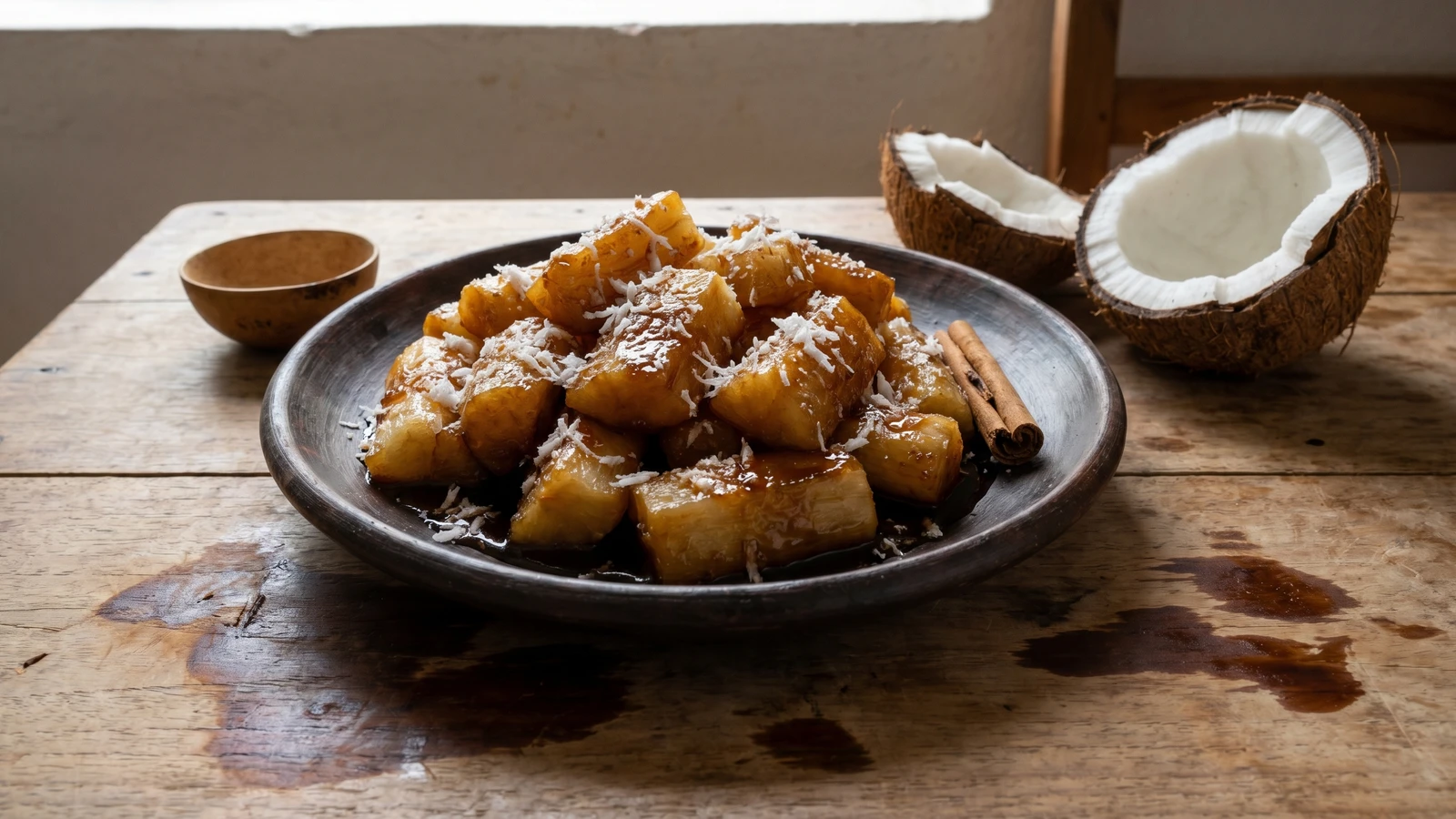
Guerrero's Costa Chica sweet of tender yuca, dark piloncillo syrup, canela, and freshly grated coconut, cooked the way Afro-Mexican home kitchens around Cuajinicuilapa still recognize as their own.
Guerrero, Costa Chica, Cuajinicuilapa. That is where this dulce belongs before anyone calls it just a Mexican dessert. The yuca comes from coastal soil and humid heat, the coconut from the same Pacific pantry, and the piloncillo gives the sweet its dark, mineral backbone. Esto no es comida de un solo Mexico.
I learned versions of this dulce from women who cooked it in wide cazuelas after market day, when the yuca was fresh and heavy and the coconut still had milk in it. You do not use desiccated coconut here. That bagged dust belongs nowhere near this pot. You crack a coconut, pry out the meat, grate it, and let it thicken the syrup with its own fat and perfume.
The work is not complicated, but it is exact. Peel the yuca deeply, remove the tough center vein, cook it until tender, then let it drink the piloncillo syrup slowly. Rush it and the outside gets sweet while the center stays dull. Give it time and the yuca turns amber at the edges, sticky with canela and coconut. Saber cocinar es saber vivir.
Yuca, also called cassava or mandioca, is native to tropical South America and moved through Caribbean and coastal trade routes long before becoming central to Afro-descendant foodways across the Americas. In Guerrero's Costa Chica, where African, Indigenous, and Spanish histories met after the colonial period through ranching, coastal agriculture, and maroon communities, yuca sweets became part of the regional pantry alongside coconut, plantain, piloncillo, and canela. Cuajinicuilapa, often called the heart of Afro-Mexican Guerrero, preserves this sweet not as a novelty but as ordinary household knowledge.
Quantity
2 pounds
peeled deeply, woody core removed, cut into 2-inch pieces
Quantity
1/2 teaspoon
for simmering the yuca
Quantity
2 cones, about 8 ounces total
chopped
Quantity
3 cups, plus more for simmering
Quantity
2
Quantity
3
Quantity
2 cups
from 1 mature coconut
Quantity
1 tablespoon
Quantity
1/4 teaspoon
for the syrup
| Ingredient | Quantity |
|---|---|
| fresh yucapeeled deeply, woody core removed, cut into 2-inch pieces | 2 pounds |
| kosher saltfor simmering the yuca | 1/2 teaspoon |
| piloncillo coneschopped | 2 cones, about 8 ounces total |
| water | 3 cups, plus more for simmering |
| Mexican canela sticks | 2 |
| whole cloves | 3 |
| freshly grated coconutfrom 1 mature coconut | 2 cups |
| fresh lime juice | 1 tablespoon |
| kosher saltfor the syrup | 1/4 teaspoon |
Cut the yuca crosswise into manageable lengths. Slice away the thick brown skin and the pinkish layer underneath until you reach clean white flesh. Split each piece lengthwise and remove the tough woody core. Do this carefully. That center fiber stays hard no matter how long you cook it, and a good dulce should not fight your teeth.
Put the yuca in a wide pot and cover with fresh water by two inches. Add 1/2 teaspoon salt. Bring to a steady simmer and cook 25 to 35 minutes, until the pieces split slightly at the edges and a knife slides through without force. Drain well. The yuca must be tender before it meets the syrup, because piloncillo tightens the surface and slows further softening.
In a wide clay cazuela or heavy pot, combine the chopped piloncillo, 3 cups water, canela, cloves, and 1/4 teaspoon salt. Bring to a simmer over medium heat, stirring until the piloncillo dissolves. Let it cook 10 minutes, until the syrup smells dark and warm from the canela. White sugar gives sweetness. Piloncillo gives character. Use the piloncillo.
Add the drained yuca pieces to the syrup and spoon the liquid over them. Simmer gently for 15 minutes, turning the pieces once or twice so they stain evenly. Stir in the freshly grated coconut. The coconut will loosen the syrup at first, then thicken it as it cooks. That is the coastal pantry doing its work.
Continue simmering 20 to 25 minutes, uncovered, until the syrup thickens enough to coat a spoon and the yuca looks glossy with amber edges. Shake the cazuela instead of stirring hard. Yuca breaks easily once tender, and you want generous pieces, not paste. Add the lime juice in the last two minutes to keep the sweetness from turning flat.
Pull out the canela sticks and cloves if you can find them. Let the dulce rest at least 30 minutes before serving, or chill it overnight. It is better when the yuca has absorbed the syrup all the way through. Serve warm or at room temperature in a dark clay dish, with extra coconut syrup spooned over the top. Recetas probadas y garantizadas.
1 serving (about 185g)
Culinary guides, cultural storytelling, and the editorial depth that makes cooking meaningful.
Discover Culinary ExplorerChef Lupita
Puebla's convent-style acitrón, made from cidra peel instead of endangered biznaga, built through repeated syrup soakings until the cubes turn firm, translucent, and ready for rosca or chiles en nogada.

Chef Lupita
Ciudad de México's Tulyehualco alegría is popped huautli folded into piloncillo honey, pressed with peanuts, pepitas, and raisins, then cut into the rectangular bars that built a pueblo's identity.

Chef Lupita
Oaxaca's pre-Columbian amaranth bar, popped on a hot comal and bound with piloncillo, honey, and the sacred Zapotec grain that the Spanish tried, and failed, to outlaw.

Chef Lupita
Querétaro's mercado candy of popped amaranto pressed with dark piloncillo syrup, pepitas, pecans, and cacahuate, a Bajío sweet that respects the seed before it decorates the table.