
Chef Lupita
Acitrón de Cidra Conventual
Puebla's convent-style acitrón, made from cidra peel instead of endangered biznaga, built through repeated syrup soakings until the cubes turn firm, translucent, and ready for rosca or chiles en nogada.
A cooking platform built around craft, culture, and the stories behind what we eat.
Created by
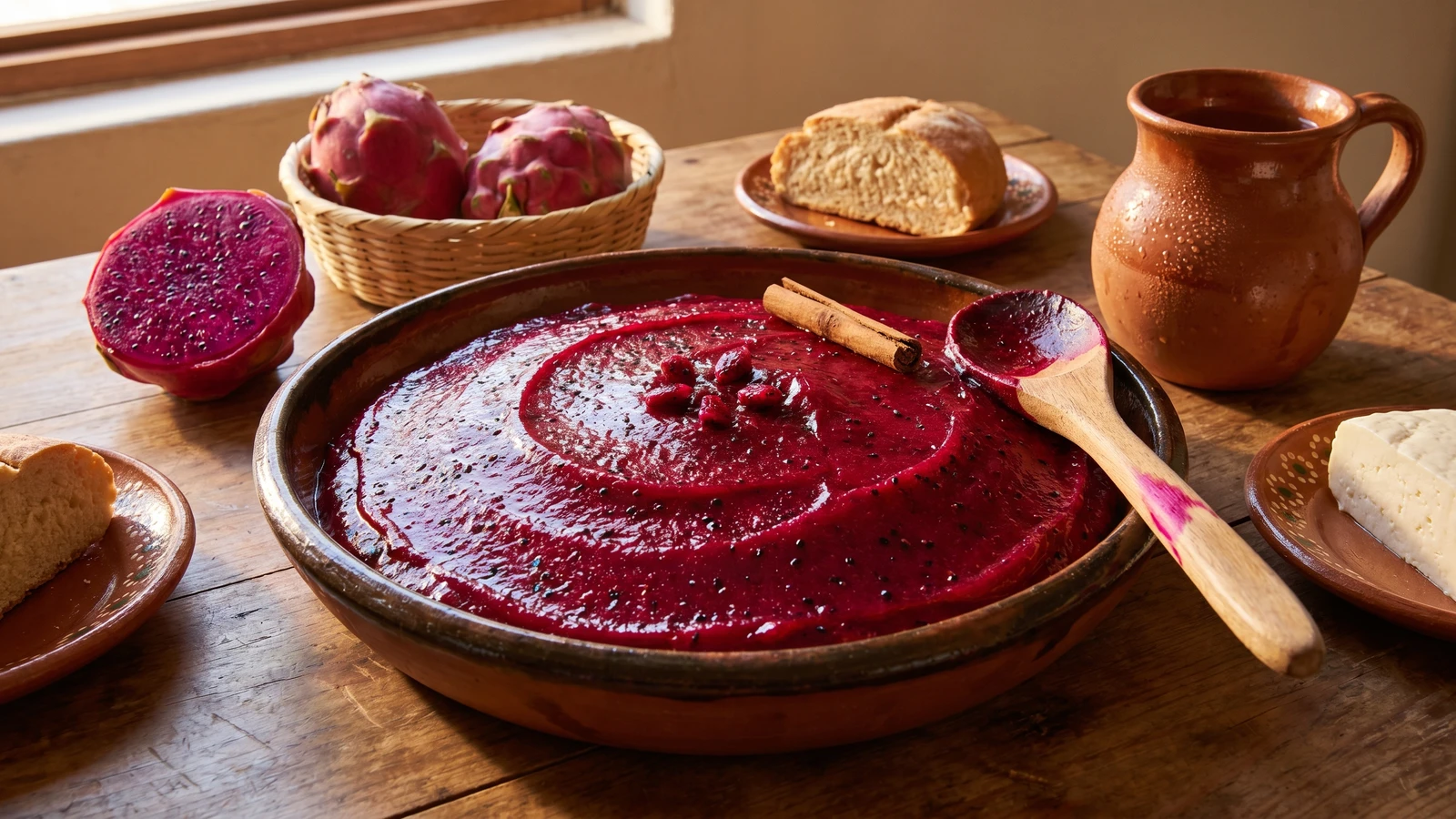
Sonora's wild pitaya from the May harvest, simmered with sugar and a squeeze of lime into a thick carmine paste. The fruit of the desert preserved for eating long after the rains end.
This is from Sonora. Specifically from the desert stretches between Hermosillo, Guaymas, and the Yaqui Valley, where the pitahaya cactus, the same that the seris and yaquis have harvested for centuries, fruits for a few weeks every May and June. The pitaya season is short and violent. The fruit ripens in a window the desert allows, and then it is over.
The pulp is bright magenta or deep coral, studded with small black seeds that you do not strain out. The flavor is somewhere between watermelon and prickly pear, with a faint floral edge that the heat of the cook concentrates. Sonorans turn the fresh fruit into aguas frescas, into helados, and, when there is more than a family can eat in a week, into this dulce: a slow reduction with sugar and lime that holds the May harvest into the dry months. Recetas probadas y garantizadas.
I traveled to a pitayera outside Bacum the year I was working on the northern volume. A senora named Dona Refugio showed me how to handle the fruit, how to singe the glochids off with a candle, how to know the pulp was ready by the way it pulled away from the side of her copper pot. She did not weigh anything. She tasted as she went. She told me her mother used to set the cooled dulce on a windowsill in a clay dish and that the cinnamon in the pot was the difference between a Sonoran dulce de pitaya and any other. I wrote it down. Saber cocinar es saber vivir.
This is not a dessert you make from a jar of pulp from the supermarket. If you cannot find pitaya in May or June at a Mexican mercado or a specialty fruit market, wait until next year. The cuisine respects its seasons and so should you.
The pitahaya cactus (Stenocereus thurberi, known locally as pitahaya dulce, and Stenocereus queretaroensis in central Mexico) has been harvested for its fruit by the Comcaac (Seri), Yaqui, and Mayo peoples of northwestern Mexico for at least two thousand years, and the May-June harvest historically marked the start of the indigenous Sonoran new year. Spanish missionary records from the 18th-century Jesuit missions in the Pimeria Alta note that the Seri organized their seasonal movements around the pitahaya ripening, and Father Ignaz Pfefferkorn described the fruit in 1795 as one of the principal staples of Sonoran subsistence. The dulce de pitaya tradition, sugar-cooked rather than sun-dried, emerged after the introduction of cane sugar to the region in the colonial period and remains tied specifically to Sonora and parts of Sinaloa, where the pitayeras still operate as small-scale family harvest camps each spring.
Quantity
12 to 14 (about 4 pounds whole)
thorns removed, halved and pulp scooped
Quantity
2 cups
adjusted to taste depending on the sweetness of the fruit
Quantity
1/4 cup (about 3 Mexican limes)
Quantity
1 strip, about 2 inches
pith removed
Quantity
1 small
Quantity
1/4 teaspoon
Quantity
2 tablespoons
only if needed to start the pot
| Ingredient | Quantity |
|---|---|
| ripe pitayas (fruit of the pitahaya cactus)thorns removed, halved and pulp scooped | 12 to 14 (about 4 pounds whole) |
| granulated sugar (azucar estandar)adjusted to taste depending on the sweetness of the fruit | 2 cups |
| fresh lime juice | 1/4 cup (about 3 Mexican limes) |
| lime zestpith removed | 1 strip, about 2 inches |
| cinnamon stick, canela de Ceylan | 1 small |
| fine sea salt | 1/4 teaspoon |
| water (optional)only if needed to start the pot | 2 tablespoons |
Pitayas come off the cactus armored. Even the fruit picked clean at the mercado in Hermosillo will have stubborn gloquidia, the tiny hair-like spines that bury themselves in your fingers. Hold each fruit with kitchen tongs and singe any visible spines over an open flame for two or three seconds. Rinse under cold water and pat dry. Do not skip this. The senoras in the pitayeras of Bacum and Empalme have done this their whole lives and they still get stuck if they rush.
Halve each pitaya lengthwise with a sharp knife. The interior should be bright magenta or deep coral depending on the variety, studded with edible black seeds. Scoop the pulp into a heavy bowl with a spoon. Leave the rind. You should end up with about 3 cups of seeded pulp. Do not strain the seeds. The seeds belong in the dulce. They give it the slight crunch that tells the eater this is real pitaya, not a jam made from something else.
Stir the sugar, lime juice, and salt into the pulp. Let it sit at room temperature for 20 minutes. The sugar pulls water out of the fruit and the pulp loosens. This is your starting liquid. If your pitayas are very firm and the pot looks dry after the macerating rest, add the two tablespoons of water. Most cooks will not need it.
Transfer the pulp to a heavy-bottomed nonreactive pot, copper if you have it, stainless steel otherwise. Add the cinnamon stick and the strip of lime zest. Cook over medium-low heat, stirring with a wooden spoon, until the sugar dissolves and the mixture comes to a gentle simmer. Do not crank the heat. Pitaya scorches faster than you think and a burned pot ends the project. La cocina no es decoracion, es trabajo.
Lower the heat to keep the pot at a lazy simmer. Cook for 60 to 75 minutes, stirring every few minutes at first and then almost constantly toward the end. The color will deepen from bright magenta to a darker, glossier carmine. The pulp will pull away from the sides of the pot when you drag the spoon across. The right consistency is thick enough that a spoonful dropped on a cold plate holds its shape and does not run when the plate is tilted. The senoras in Sonora call this the punto de cajeta, the cajeta point, even though this is not cajeta.
Remove the cinnamon stick and the lime zest. Taste and adjust. If the dulce is too sweet for you, a few more drops of lime will sharpen it. Pour the hot dulce into a clean glass jar or a wide ceramic dish and let it cool, uncovered, for at least 30 minutes. It will tighten as it cools. Cover only once it is at room temperature. Warm dulce sealed in a closed jar will sweat and the surface will weep.
Spoon the dulce over fresh queso fresco or panela. Spread it on a piece of pan de muerto or a thick slice of pan de pueblo. Eat it from a small clay bowl with a spoon and a glass of cold water. In Sonora they will serve it at the end of a comida campestre when the desert cools off in the evening. Asi se hace y punto.
1 serving (about 55g)
Culinary guides, cultural storytelling, and the editorial depth that makes cooking meaningful.
Discover Culinary ExplorerChef Lupita
Puebla's convent-style acitrón, made from cidra peel instead of endangered biznaga, built through repeated syrup soakings until the cubes turn firm, translucent, and ready for rosca or chiles en nogada.

Chef Lupita
Ciudad de México's Tulyehualco alegría is popped huautli folded into piloncillo honey, pressed with peanuts, pepitas, and raisins, then cut into the rectangular bars that built a pueblo's identity.

Chef Lupita
Oaxaca's pre-Columbian amaranth bar, popped on a hot comal and bound with piloncillo, honey, and the sacred Zapotec grain that the Spanish tried, and failed, to outlaw.

Chef Lupita
Querétaro's mercado candy of popped amaranto pressed with dark piloncillo syrup, pepitas, pecans, and cacahuate, a Bajío sweet that respects the seed before it decorates the table.