Culinary Explorer

A cooking platform built around craft, culture, and the stories behind what we eat.
Discover Culinary Explorer
Dulce de Leche de Tlacotalpan

Dulce de Leche de Tlacotalpan

Created by

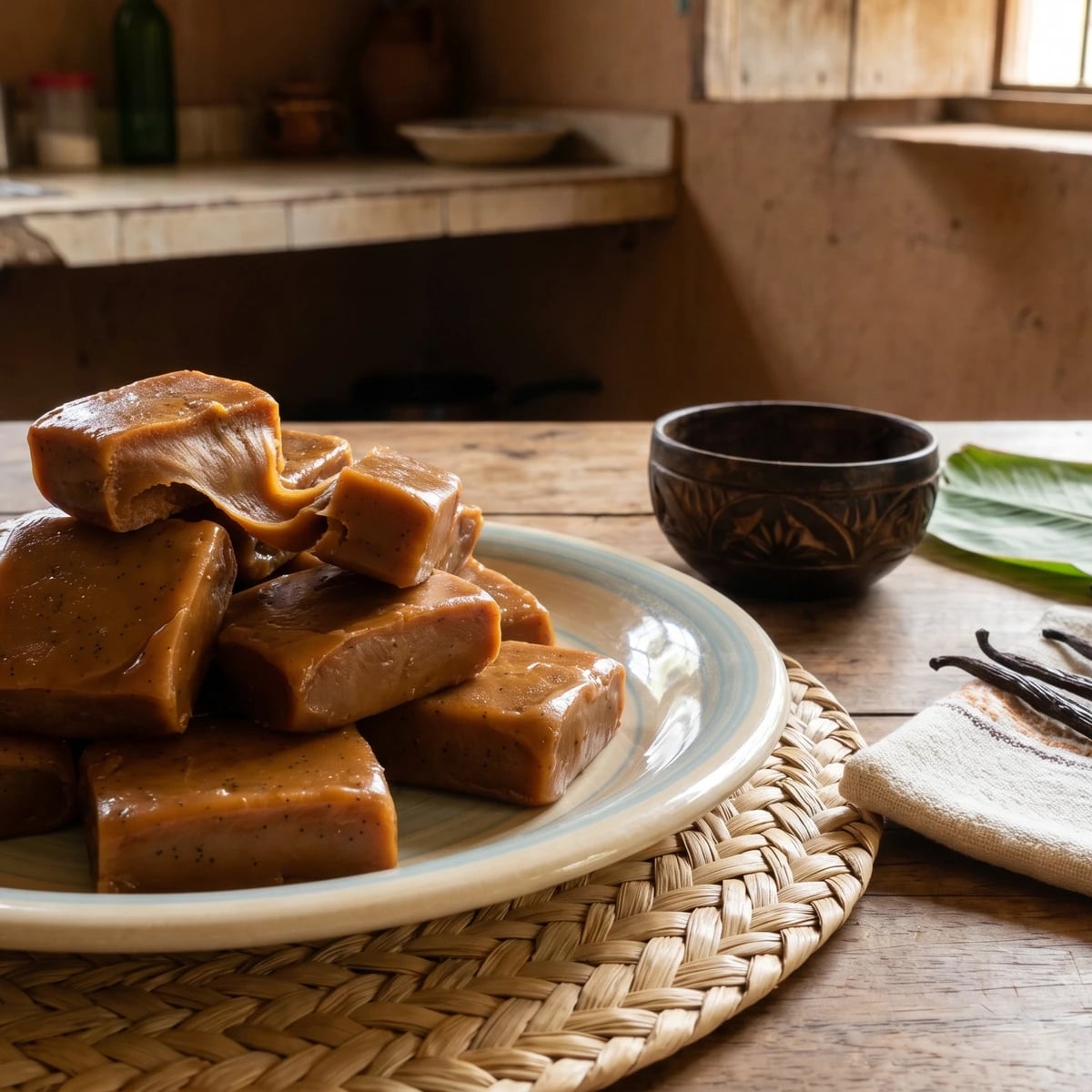
Veracruz's riverside milk caramel from Tlacotalpan, reduced slowly with piloncillo and whole vainilla de Papantla until the spoon drags through a thick, glossy fudge.

Desserts
Mexican
Make Ahead
Celebration
15 min
Active Time
2 hr 30 min cook2 hr 45 min total
Yield24 small pieces

Veracruz, the Sotavento, Tlacotalpan on the Papaloapan River. This dulce de leche belongs to that humid riverside town where milk, cane sugar, and vanilla all make sense together because the land around them has been producing those flavors for generations.

The defining ingredient is vainilla de Papantla, a whole pod, split open, not extract. Extract is for when you want a rumor of vanilla. Here the pod perfumes the milk while it reduces, and the piloncillo gives the caramel its dark mineral sweetness. The women who perfected this knew the point by the spoon, not by a thermometer: when the bottom of the pot shows, when the bubbles slow, when the milk pulls like fudge.

I learned this kind of sweet from Veracruz cooks who did not separate dessert from household economy. Milk that needed using, piloncillo from the market, one vanilla pod treated with respect. La cocina no es decoración, es trabajo. Stir until it is done. Cada estado, su propia cocina.

Tlacotalpan became an important river port in Veracruz during the colonial period, connecting cattle country, sugar production, and Gulf trade along the Papaloapan River. Vanilla cultivation in northern Veracruz, especially around Papantla, has Totonac roots long before Spanish rule, while milk candies developed after cattle and cane sugar expanded under colonial agriculture. The Veracruz version carries that history in one pot: dairy from colonial ranching, piloncillo from cane, and vanilla from a much older Indigenous tradition.

The technique, the tradition, and the story behind every dish.

Discover Culinary Explorer

Ingredients

whole cow's milk

Quantity

8 cups

piloncillo

Quantity

12 ounces

finely grated or chopped

granulated cane sugar

Quantity

1 cup

whole vainilla de Papantla pod

Quantity

1

split lengthwise

baking soda

Quantity

1/4 teaspoon

fine sea salt

Quantity

1/4 teaspoon

unsalted butter

Quantity

1 tablespoon

for greasing the pan

Equipment Needed

  • Wide copper cazo or heavy thick-bottomed pot
  • Long wooden spoon
  • 8-inch square pan or shallow glazed clay cazuela
  • Candy thermometer, optional but useful

Instructions

  1. 1

    Prepare the pan

    Grease an 8-inch square pan or a shallow clay cazuela with the butter. Set it near the stove. Once the milk caramel reaches the right point, it will not wait while you go looking for a dish.

  2. 2

    Start the milk

    Pour the milk into a wide heavy copper cazo, Dutch oven, or thick-bottomed pot. Add the piloncillo, cane sugar, split vainilla de Papantla pod, baking soda, and salt. Stir over medium heat until the piloncillo dissolves completely. The baking soda will foam a little. That is normal. It helps the milk brown evenly and keeps the texture smooth.

  3. 3

    Reduce slowly

    Lower the heat to medium-low and cook, stirring often with a wooden spoon, until the milk turns tan and starts to thicken, about 1 hour. Scrape the bottom and corners every few minutes. Milk sugar sticks where lazy cooks stop stirring. No me vengas con atajos.

  4. 4

    Watch the point

    Keep cooking and stirring as the mixture darkens to the color of cajeta and the bubbles become heavy and slow, 45 to 75 minutes more. Remove the vanilla pod when the caramel is thick enough to expose the bottom of the pot for two seconds when you drag the spoon through it. For a firmer candy, cook until a candy thermometer reads 238F to 240F.

    Do not walk away in the last 20 minutes. This is where the dulce decides whether it will be smooth or scorched.
  5. 5

    Beat and set

    Take the pot off the heat and stir firmly for 3 to 5 minutes. The shine will soften and the mixture will thicken like warm fudge. Pour it into the prepared pan and smooth the top with the wooden spoon. Let it cool at room temperature until firm, at least 2 hours.

  6. 6

    Cut and serve

    Cut into small squares or diamonds. Serve on a glazed earthenware plate with coffee, atole, or a small glass of fresh milk. This is Veracruz candy, not sauce for ice cream. Así se hace y punto.

Chef Tips

  • Use whole milk. Low-fat milk makes a thin, stubborn dulce that takes longer and tastes poorer. This candy needs milk fat.
  • Buy a pliable vainilla de Papantla pod if you can. A dry, brittle pod has already lost much of what you are paying for.
  • Piloncillo is not just sweetener. It brings molasses depth and color. White sugar alone makes a flatter candy. A substitution is a compromise, not an upgrade.
  • A wide pot is better than a tall one. More surface area means faster reduction and less risk of boiling over.

Advance Preparation

  • Dulce de leche de Tlacotalpan keeps for 1 week in an airtight container at room temperature in a cool kitchen.
  • For longer storage, refrigerate up to 3 weeks. Let the pieces come to room temperature before serving so the texture softens properly.

Frequently Asked Questions

Nutrition Information

1 serving (about 40g)

Calories
145 calories
Total Fat
3 g
Saturated Fat
2 g
Trans Fat
0 g
Unsaturated Fat
1 g
Cholesterol
10 mg
Sodium
75 mg
Total Carbohydrates
27 g
Dietary Fiber
0 g
Sugars
27 g
Protein
3 g

Note: Chef personas and recipes are created with AI assistance. Cook with care: follow safe food-handling practices, check doneness with a thermometer when needed, and adapt for allergies and your kitchen.

Where cooking meets culture.

Culinary guides, cultural storytelling, and the editorial depth that makes cooking meaningful.

Discover Culinary Explorer

More from Veracruz Desserts

Browse the full collection