
Chef Lupita
Acitrón de Cidra Conventual
Puebla's convent-style acitrón, made from cidra peel instead of endangered biznaga, built through repeated syrup soakings until the cubes turn firm, translucent, and ready for rosca or chiles en nogada.
A cooking platform built around craft, culture, and the stories behind what we eat.
Created by
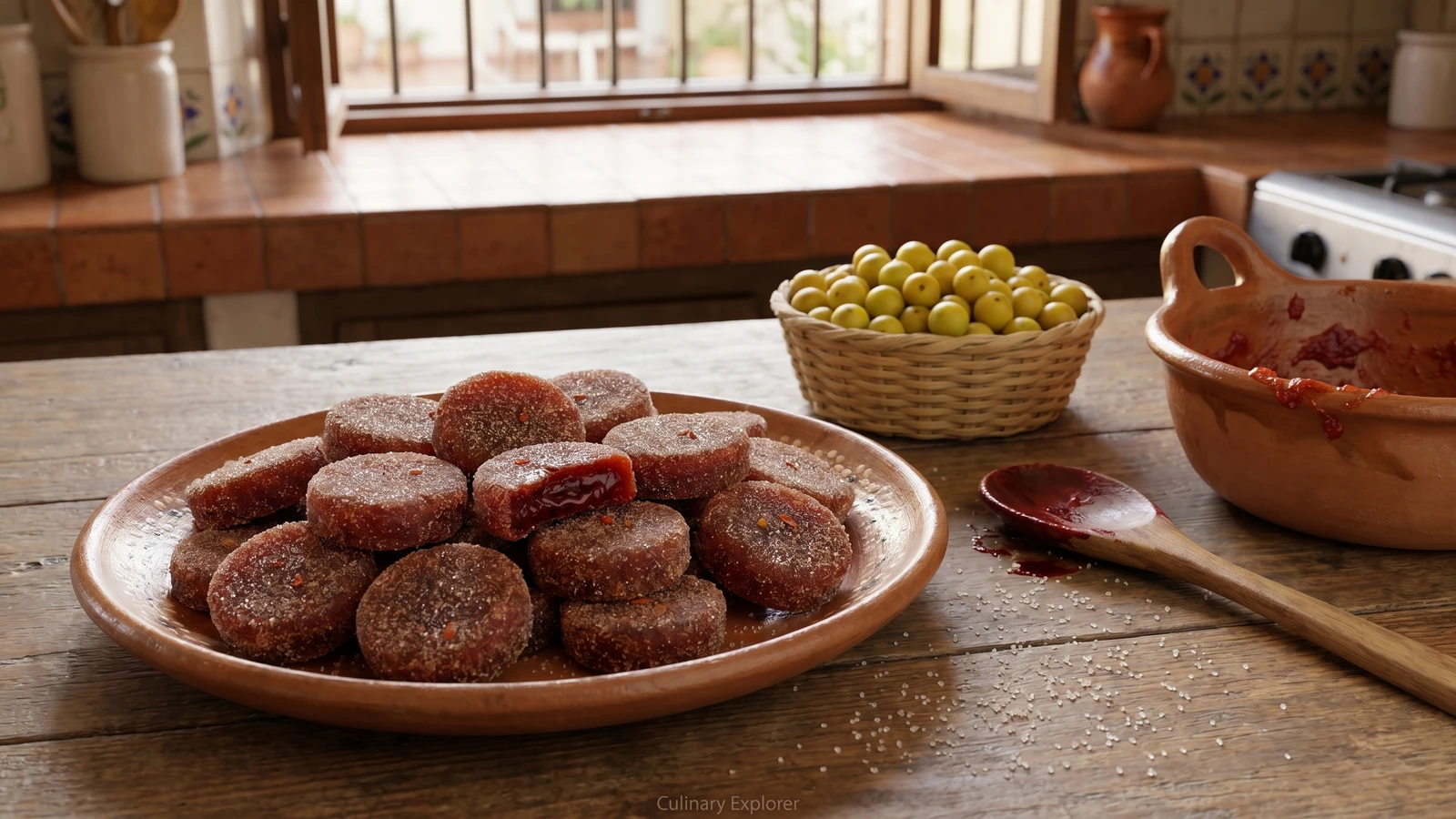
Jalisco's Lake Chapala candy made from tart wild arrayan berries, cooked down with sugar and chile piquin until the pulp turns glossy, thick, and firm enough to shape by hand.
Jalisco gives you this candy from the Ribera de Chapala, the villages along Lake Chapala where arrayan grows in patios, hillsides, and market baskets when the season is right. In Ajijic, Chapala, Jocotepec, and the towns that look toward the lake, this is not fancy confectionery. This is fruit, sugar, patience, and a señora who knows when the pulp has cooked enough because the spoon starts fighting back.
Arrayan is the ingredient that makes the candy belong there. It is tart, floral, and a little resinous, closer to a small wild guava than to the sweet supermarket fruit people expect. You cook it with just enough water to soften it, press out the pulp, then reduce it with sugar until it leaves the bottom of the pot. The chile piquin is not there to make it hot. It sharpens the berry and wakes up the sugar. Not all Mexican sweets are sweet in the same way. Cada estado, su propia cocina.
My mother had this in her Jalisco pages, written as 'dulce de arrayan de la laguna' with no measurements, only the instruction: 'mismo peso de pulpa y azucar, mover hasta que pese.' Same weight of pulp and sugar, stir until it feels heavy. That is how women wrote recipes when they expected you to pay attention. I give you measurements because teaching matters, but the final authority is still the pot. Saber cocinar es saber vivir.
Arrayan, often identified in western Mexico as a small wild myrtle berry related to guava, has long been gathered and sold around Lake Chapala and other parts of Jalisco as a seasonal fruit for aguas frescas, preserves, and sugar candies. The technique of cooking fruit pulp with sugar into a firm paste grew after colonial sugar production expanded in New Spain, adapting older native fruit preservation habits to cane sugar. In the Chapala region, dulce de arrayan remains tied to local markets and roadside vendors, where the candies are often shaped into small disks or balls and rolled in granulated sugar with a little chile.
Quantity
1 pound
rinsed and stems removed
Quantity
1 cup
Quantity
1 1/2 to 2 cups
equal weight to the strained pulp
Quantity
2 tablespoons
Quantity
1/4 teaspoon
Quantity
1/2 teaspoon, plus more to taste
Quantity
1/2 cup
for rolling
| Ingredient | Quantity |
|---|---|
| fresh ripe arrayan berriesrinsed and stems removed | 1 pound |
| water | 1 cup |
| granulated cane sugarequal weight to the strained pulp | 1 1/2 to 2 cups |
| fresh lime juice | 2 tablespoons |
| fine sea salt | 1/4 teaspoon |
| ground chile piquin | 1/2 teaspoon, plus more to taste |
| granulated cane sugarfor rolling | 1/2 cup |
Pick through the arrayan berries and discard any fruit that is moldy, fermented, or split open in a bad way. Rinse well and remove the stems. Good arrayan smells tart and floral. If it smells sour like spoiled fruit, do not cook it. Sugar does not fix bad fruit.
Put the arrayan berries and water in a heavy pot. Bring to a gentle simmer over medium heat and cook for 15 to 20 minutes, stirring now and then, until the skins wrinkle and the berries collapse when pressed with a spoon. You are not making soup. You are loosening the pulp from the seeds and skin.
Pass the softened fruit through a food mill or press it firmly through a fine-mesh sieve with a wooden spoon. Scrape the thick pulp from the underside of the sieve. Discard the seeds and skins. Weigh the pulp if you can. Use the same weight of sugar as pulp. If you do not have a scale, measure the pulp by volume and use the same volume of sugar. The scale is better. Preguntale a las senoras del mercado. They know this by the feel of the spoon.
Return the strained pulp to the clean pot. Add the equal amount of sugar, lime juice, salt, and ground chile piquin. Cook over medium-low heat, stirring constantly with a wooden spoon, for 30 to 40 minutes. The mixture will loosen first, then thicken and turn glossy. It is ready when the spoon leaves a clear path across the bottom of the pot and the paste gathers into a heavy mass instead of flowing back immediately.
Drop a small spoonful of the paste onto a cool plate. Let it sit for one minute. If you can roll it between your fingers without it spreading into a puddle, it is ready. If it sticks like jam, keep cooking and stirring. No me vengas con atajos. Undercooked dulce de arrayan will not hold its shape.
Scrape the hot paste onto a lightly oiled tray or a sheet of parchment. Spread it about 1/2 inch thick and let it cool until you can handle it, about 45 minutes. It should be warm, flexible, and firm enough to pinch without running. Do not refrigerate it now. Cold makes the outside firm before the center settles.
Put the rolling sugar in a shallow dish. Pinch off walnut-sized pieces of the paste, roll into balls, then flatten into small disks about 1 1/2 inches wide. Coat each piece in sugar on all sides. If you want the Chapala market style with more bite, mix a pinch more chile piquin into the rolling sugar.
Set the sugared candies on a tray in a single layer and let them dry at room temperature for 1 to 2 hours, until the outside feels dry and the inside stays chewy. Serve them in a clay dish with coffee, atole, or nothing at all. This is budget cooking with memory in it. Recetas probadas y garantizadas.
1 serving (about 20g)
Culinary guides, cultural storytelling, and the editorial depth that makes cooking meaningful.
Discover Culinary ExplorerChef Lupita
Puebla's convent-style acitrón, made from cidra peel instead of endangered biznaga, built through repeated syrup soakings until the cubes turn firm, translucent, and ready for rosca or chiles en nogada.

Chef Lupita
Ciudad de México's Tulyehualco alegría is popped huautli folded into piloncillo honey, pressed with peanuts, pepitas, and raisins, then cut into the rectangular bars that built a pueblo's identity.

Chef Lupita
Oaxaca's pre-Columbian amaranth bar, popped on a hot comal and bound with piloncillo, honey, and the sacred Zapotec grain that the Spanish tried, and failed, to outlaw.

Chef Lupita
Querétaro's mercado candy of popped amaranto pressed with dark piloncillo syrup, pepitas, pecans, and cacahuate, a Bajío sweet that respects the seed before it decorates the table.