Culinary Explorer

A cooking platform built around craft, culture, and the stories behind what we eat.
Discover Culinary Explorer
Driekoningentaart

Driekoningentaart

Created by

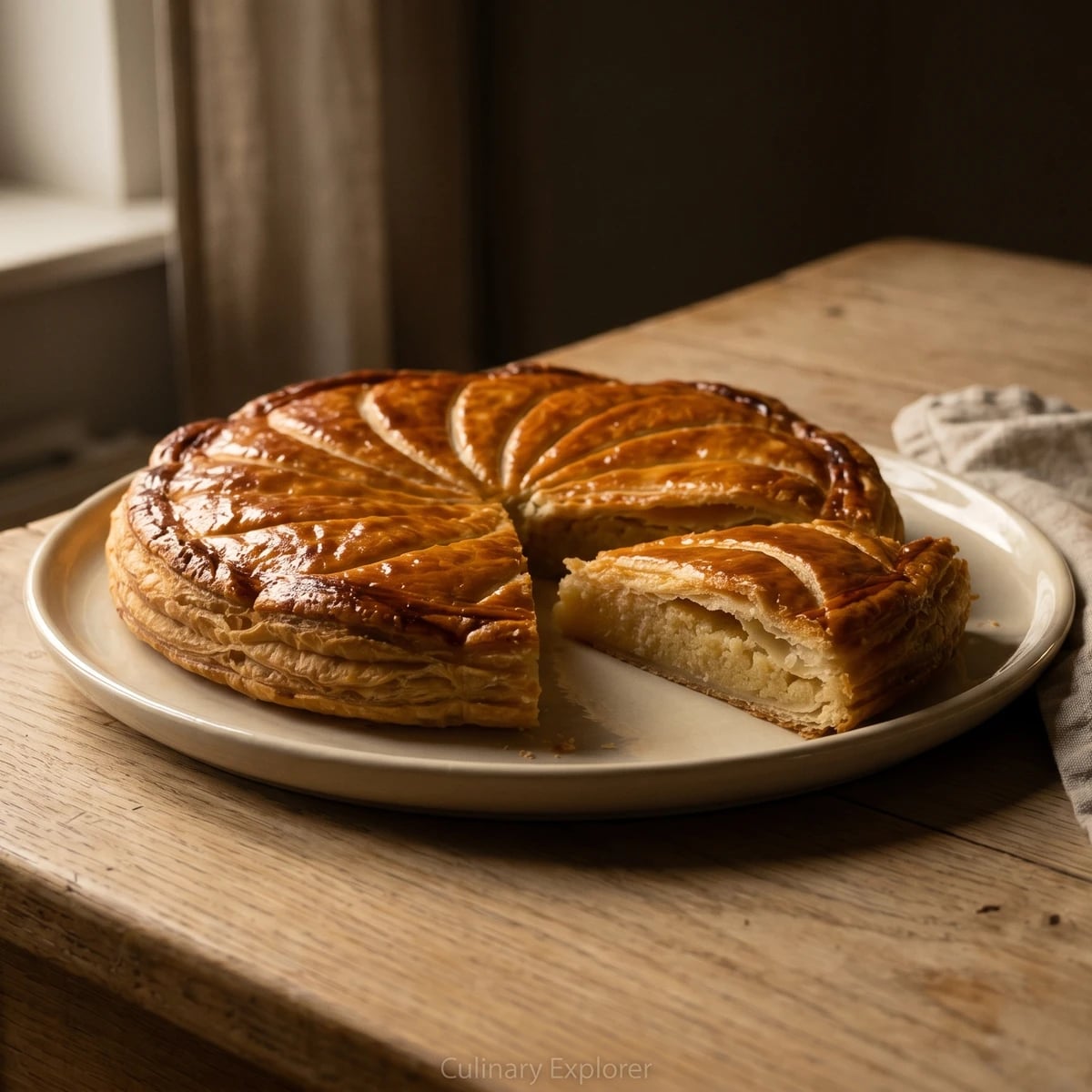
A flaky Epiphany tart with almond frangipane and one hidden bean, where the last candle of Christmas becomes a crown at the table.

Pastries & Cookies
Dutch
Holiday
Celebration
Special Occasion
30 min
Active Time
35 min cook1 hr 35 min total
Yield8 servings

Christmas used to end with a bean. Not with the exhausted clearing of decorations, not with a sensible return to porridge, but with Driekoningen, Three Kings, on 6 January, when a child could bite into almond cream and find himself monarch before the crumbs had settled. In my grandmother's second notebook, the page is marked only taart voor de koningen, cake for the kings. No sermon. Just pastry, almonds, and a crown cut from paper.

The name already tells you the day. Driekoningentaart belongs to Epiphany, the feast of the Magi, though the men in the Gospel are not counted, crowned, or named. Tradition did all that later, for obvious reasons: a party needs characters. The hidden bean is older than most of our tidy explanations, a little pagan mischief Christian Europe happily kept because it made the darkest part of winter bearable. Whoever finds it becomes koning voor een dag, king for a day, and must provide either commands, songs, or next year's cake, depending on how merciful your family is.

But let me tell you a secret. This is not a complicated tart pretending to be grand. It is two rounds of butter pastry, almond frangipane, one dried bean, and the discipline to seal the edges properly so the filling stays where history put it. Hou het altijd simpel. Chill the assembled tart before baking and cut only shallow marks in the top, because puff pastry rises best when treated firmly and then left alone. The reward is a golden, crisp-laminated shell around a soft almond centre, served at the old close of Christmas while one person at the table tries to look innocent.

Driekoningentaart is the Dutch and Low Countries expression of the wider European Epiphany king-cake custom, strongest in Catholic regions such as Brabant, Limburg, and Flanders, and closely related to the French galette des rois. The bean-king custom is documented in late medieval and early modern Europe, where a dried bean hidden in a cake elected a temporary ruler for Twelfth Night or Epiphany festivities. In the Netherlands the feast faded more in Protestant regions after the Reformation, but the cake and crown survived in southern households, bakeries, and school celebrations as the old close of the Christmas season.

The technique, the tradition, and the story behind every dish.

Discover Culinary Explorer

Ingredients

all-butter puff pastry

Quantity

2 sheets, about 320g total

chilled

unsalted butter

Quantity

100g

softened

fine sugar

Quantity

100g

eggs

Quantity

2

divided

ground almonds

Quantity

125g

plain flour

Quantity

1 tablespoon

almond extract

Quantity

1 teaspoon

fine salt

Quantity

1/4 teaspoon

dried white bean

Quantity

1

rinsed and dried

milk

Quantity

1 tablespoon

Equipment Needed

  • Baking tray
  • Parchment paper
  • 24 centimetre plate or cake ring for tracing
  • Pastry brush
  • Small sharp knife

Instructions

  1. 1

    Make the frangipane

    Beat the softened butter and sugar together until pale and creamy. Beat in 1 whole egg and 1 egg yolk, saving the remaining egg white for sealing. Stir in the ground almonds, flour, almond extract, and salt until you have a thick almond paste. It should spread, but not run; a loose filling will escape the pastry like a bad secret.

  2. 2

    Cut the pastry

    Cut two circles of puff pastry, each about 24 centimetres across. Lay one circle on a parchment-lined baking tray and keep the other cold while you work. Cold pastry is obedient pastry; warm butter smears instead of rising in clean layers.

  3. 3

    Fill and hide

    Spread the frangipane over the bottom pastry circle, leaving a 2 centimetre border all around. Press the dried bean into the filling near the outer edge, not in the centre, where the knife will find it too easily. Brush the pastry border with the reserved egg white.

  4. 4

    Seal the tart

    Lay the second pastry circle over the filling and press the edges together firmly. Use the back of a small knife to crimp the rim all around without cutting through it. This seal matters more than decoration. Almond filling belongs inside the tart, not performing on the baking tray.

  5. 5

    Glaze and chill

    Beat the remaining egg white with the milk and brush a thin coat over the top. With the point of a knife, score shallow curved lines from the centre outward, cutting only the surface. Chill the assembled tart for 30 minutes while the oven heats to 200C. The rest firms the butter again, and the pastry will thank you by lifting properly.

  6. 6

    Bake until golden

    Bake for 30 to 35 minutes, until the tart is deeply golden, puffed, and crisp at the edges. If it browns too quickly, lower the oven to 180C for the last ten minutes. Let it cool at least 20 minutes before slicing, because frangipane sets as it rests and a king should not be crowned by molten almond paste.

Chef Tips

  • Use all-butter puff pastry. The filling is simple, so the pastry must taste of butter, not shortening and regret.
  • Hide the bean near the edge and warn your guests before serving, especially children. Tradition is lovely; dental surprises are not.
  • A paper crown is not optional in spirit. Cut one from gold paper or plain brown wrapping paper if that is what the drawer gives you. The crown is how the table admits it is playing.
  • Serve the tart slightly warm or fully cooled. It keeps better than it looks, but the pastry is best on the day it is baked.

Advance Preparation

  • The frangipane can be made up to 2 days ahead and kept covered in the refrigerator; bring it just soft enough to spread before assembling.
  • The whole tart can be assembled and chilled up to 8 hours before baking.
  • Leftovers keep 2 days in an airtight tin; refresh briefly in a moderate oven to crisp the pastry.

Frequently Asked Questions

Nutrition Information

1 serving (about 85g)

Calories
425 calories
Total Fat
31 g
Saturated Fat
15 g
Trans Fat
0 g
Unsaturated Fat
16 g
Cholesterol
105 mg
Sodium
260 mg
Total Carbohydrates
30 g
Dietary Fiber
3 g
Sugars
14 g
Protein
7 g

Note: Chef personas and recipes are created with AI assistance. Cook with care: follow safe food-handling practices, check doneness with a thermometer when needed, and adapt for allergies and your kitchen.

Where cooking meets culture.

Culinary guides, cultural storytelling, and the editorial depth that makes cooking meaningful.

Discover Culinary Explorer

More from Oud & Nieuw, Kerst & Pasen

Browse the full collection