Culinary Explorer

A cooking platform built around craft, culture, and the stories behind what we eat.
Discover Culinary Explorer
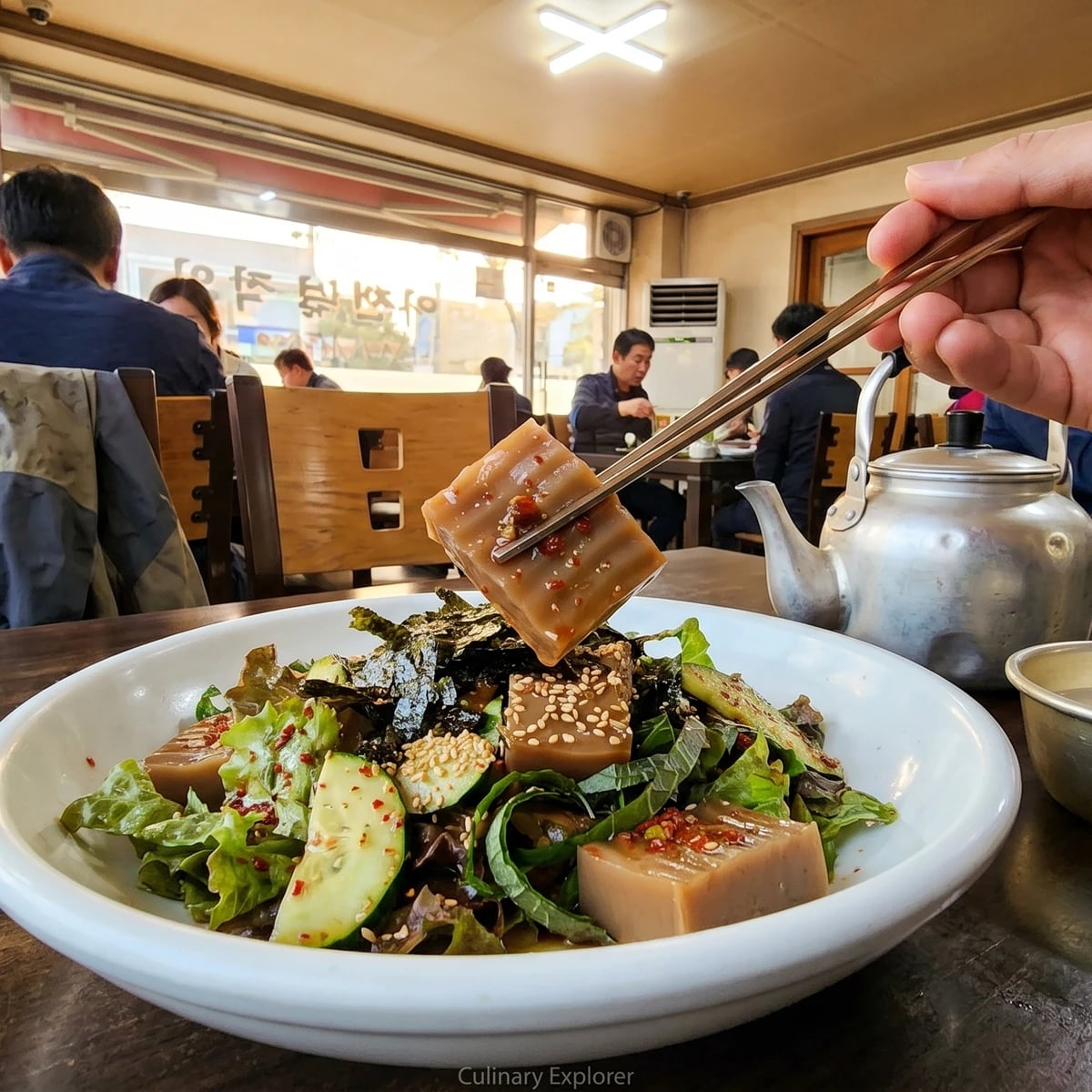
Dotori-muk-muchim (Acorn Jelly Salad)

Dotori-muk-muchim (Acorn Jelly Salad)

Created by

Tender acorn jelly folded with crisp greens in a soy, sesame, and gochugaru dressing, a mountain-born weeknight muchim that asks for a light hand more than a clever sauce.

Salads
Korean
Weeknight
Comfort Food
20 min
Active Time
1 min cook21 min total
Yield3 to 4 servings as banchan

Dotori-muk-muchim lives or dies after the knife. The jelly looks sturdy when it sits in the block, brown and quiet, but once you cut it, it has no pride at all. Stir it like cucumber salad and it collapses. Cut it large, season the greens first, then fold the muk through gently. That is the whole dish.

At the market, I buy dotori-muk when the weather asks for something cool beside rice, not heavy: spring ssukat if the leaves are tender, summer cucumber and perilla, winter lettuce and onion when that is what the basket gives. Acorn jelly is nutty and faintly bitter, and the dressing should wake that bitterness, not bury it. Soy sauce, gochugaru, sesame oil, garlic, vinegar, one measured teaspoon of sugar. No gochujang here. Paste makes the bowl dull.

Master Seong-nyeo made us dress the greens in one bowl and add the muk last. The soft thing arrives last if you want it to remain itself. Notebook 31 still has that line beside the amounts. Tonight this asks only for drying your greens well, soaking the onion, cutting the jelly thick, and serving it as soon as it is dressed. 손맛 is real; I measure it anyway, so someone else can bring the same clean bowl to the table.

Dotori-muk belongs to Korea's mountain food: acorns from oak forests were soaked and rinsed to remove tannins, ground for starch, and cooked into muk (jelly). Joseon-era agricultural and household manuals treated acorns as 구황식품 (guhwang sikpum, famine-relief food), the kind of food that mattered when grain harvests failed. The modern muchim, dressed with soy, sesame, gochugaru, and greens, moved into home banchan and makgeolli tables, especially around mountain markets where acorn starch was still made and sold.

The technique, the tradition, and the story behind every dish.

Discover Culinary Explorer

Ingredients

dotori-muk (prepared acorn jelly)

Quantity

1 block (450 to 500g)

rinsed or briefly warmed, then cut large

red leaf lettuce or young romaine

Quantity

2 packed cups (about 60g)

torn into 2-inch pieces

ssukat (crown daisy) leaves or tender baby spinach (optional)

Quantity

1 cup (about 30g)

Korean cucumber or English cucumber

Quantity

1 small Korean cucumber or 1/2 English cucumber (about 100g)

sliced into thin half-moons

onion

Quantity

1/4 small (about 40g)

very thinly sliced

perilla leaves

Quantity

6 leaves

cut into 1/2-inch ribbons

scallion

Quantity

1

thinly sliced on the diagonal

regular Korean soy sauce (jin-ganjang)

Quantity

3 tablespoons

rice vinegar

Quantity

1 tablespoon

gochugaru (Korean chili flakes)

Quantity

2 teaspoons

toasted sesame oil

Quantity

1 tablespoon

garlic

Quantity

1 small clove

minced to a paste

sugar or maesil-cheong (green plum syrup)

Quantity

1 teaspoon

water

Quantity

1 tablespoon

toasted sesame seeds

Quantity

1 tablespoon

divided

roasted gim (seaweed) (optional)

Quantity

1 sheet

torn

Equipment Needed

  • Wide shallow mixing bowl, at least 3 quarts
  • Sharp knife, wetted before cutting the muk
  • Wide spoon or flexible spatula
  • Salad spinner or clean kitchen towel
  • Small pot and slotted spoon, if warming packaged muk

Instructions

  1. 1

    Warm the muk

    Bring 4 cups water to a bare simmer in a small pot, then turn off the heat. Slide in the whole block of dotori-muk for 60 seconds, lift it out carefully, rinse it under cool water, and pat it dry. This is not to cook the jelly. It wakes up a chilled packaged block and removes the faint package smell. If your muk was made fresh today and already trembles softly, skip the bath.

    Handle the block with two hands or a wide spatula. Dotori-muk looks firmer than it is, and a cracked block will only break more once dressed.
  2. 2

    Cut it large

    Wet a sharp knife and cut the muk into 1-inch cubes or rectangles about 1/2 inch thick and 2 inches long. Lay the pieces on a plate instead of piling them high. Small pieces disappear into the greens and turn the salad muddy; large pieces keep the soft, clean bite that makes this dish worth making.

  3. 3

    Prepare the greens

    Put the sliced onion in cold water for 10 minutes, then drain and dry it well. Wash the lettuce, ssukat if using, cucumber, perilla, and scallion, then dry them until no water clings to the leaves. Water on the greens thins the seasoning and makes people blame the sauce. The fault began at the towel.

  4. 4

    Mix the yangnyeom

    In a small bowl, stir together the soy sauce, rice vinegar, gochugaru, sesame oil, garlic, sugar, water, and 2 teaspoons of the toasted sesame seeds. Taste it from the spoon. It should be salty, nutty, and lightly sharp, with the sweetness barely registering, because the greens and acorn jelly will soften it.

    No gochujang in this bowl. Its thickness hides the acorn jelly's faint bitterness and makes the salad heavy. Gochugaru gives color and warmth without covering the muk.
  5. 5

    Dress the vegetables

    Put the lettuce, ssukat, cucumber, drained onion, perilla, and scallion in a wide shallow bowl. Add about two-thirds of the dressing and toss with your fingers or chopsticks until the greens are lightly coated. The greens can take this first seasoning; the muk cannot take rough handling.

  6. 6

    Fold in muk

    Add the cut dotori-muk to the dressed greens and drizzle the remaining dressing around the sides of the bowl. Fold 6 to 8 times with a wide spoon or your hands, lifting from the bottom and turning gently. Stop while the pieces still have clean edges. A few pale sides are better than broken jelly.

  7. 7

    Serve at once

    Scatter the remaining 1 teaspoon sesame seeds over the top and add the torn gim if you are using it. Serve immediately, with rice for a weeknight table or with makgeolli if this is an anju (drinking food). After 30 minutes the greens give off water and the muk loses its clean shape, so dress only what the table will finish.

Chef Tips

  • Buy dotori-muk that trembles when the package is tilted and has a clear gray-brown or tan-brown color. If it is cracked, watery, or sour-smelling, leave it at the market. A modest ingredient handled correctly is good food; a tired one will not improve in the bowl.
  • Dry greens matter more here than people think. A tablespoon of water left on the leaves changes the dressing from clean seasoning into weak soup, and then the muk slides around instead of tasting seasoned.
  • Use the greens your month gives you. Ssukat (crown daisy) and minari (water dropwort) are lovely in spring, cucumber and perilla carry summer, and plain lettuce with a little onion is honest in winter.
  • This dish is naturally meatless. For a wheat-free table, use a gluten-free tamari in place of soy sauce and keep the same 3 tablespoon measure, then taste before adding any more salt.
  • Makgeolli belongs beside dotori-muk-muchim for a reason. The soft bitterness of the acorn jelly and the nutty sesame dressing sit well against the rice wine's gentle tang.

Advance Preparation

  • The dressing can be mixed up to 2 days ahead and refrigerated. Stir it well before using, because sesame oil separates and gochugaru settles at the bottom.
  • The greens can be washed and dried up to 4 hours ahead. Wrap them in a clean towel and refrigerate them so they stay crisp without carrying extra water into the bowl.
  • If making dotori-muk from powder, whisk 1 cup dotori-garu (acorn starch powder) with 5 cups water and 1/2 teaspoon fine salt, rest 10 minutes, then stir over medium-low heat for 15 to 20 minutes until glossy and thick. Stir in 1 teaspoon sesame oil, pour into a lightly oiled square dish, and cool at least 3 hours until set. For muchim, cut it only after it is fully firm.
  • Do not dress this salad ahead. You can cut the muk 1 hour ahead and keep it covered in the refrigerator, but the final folding belongs right before the meal.

Frequently Asked Questions

Nutrition Information

1 serving (about 240g)

Calories
145 calories
Total Fat
6 g
Saturated Fat
1 g
Trans Fat
0 g
Unsaturated Fat
5 g
Cholesterol
0 mg
Sodium
800 mg
Total Carbohydrates
21 g
Dietary Fiber
3 g
Sugars
3 g
Protein
3 g

Note: Chef personas and recipes are created with AI assistance. Cook with care: follow safe food-handling practices, check doneness with a thermometer when needed, and adapt for allergies and your kitchen.

Where cooking meets culture.

Culinary guides, cultural storytelling, and the editorial depth that makes cooking meaningful.

Discover Culinary Explorer

More from Saengchae, Geotjeori & Fresh Muchim

Browse the full collection