
Chef Klaus
Bethmännchen
Frankfurt's Advent marzipan ball is small, pale gold, and exacting: real almond paste, rosewater, three almond halves pressed on firmly, then a short bake for gloss.
A cooking platform built around craft, culture, and the stories behind what we eat.
Created by
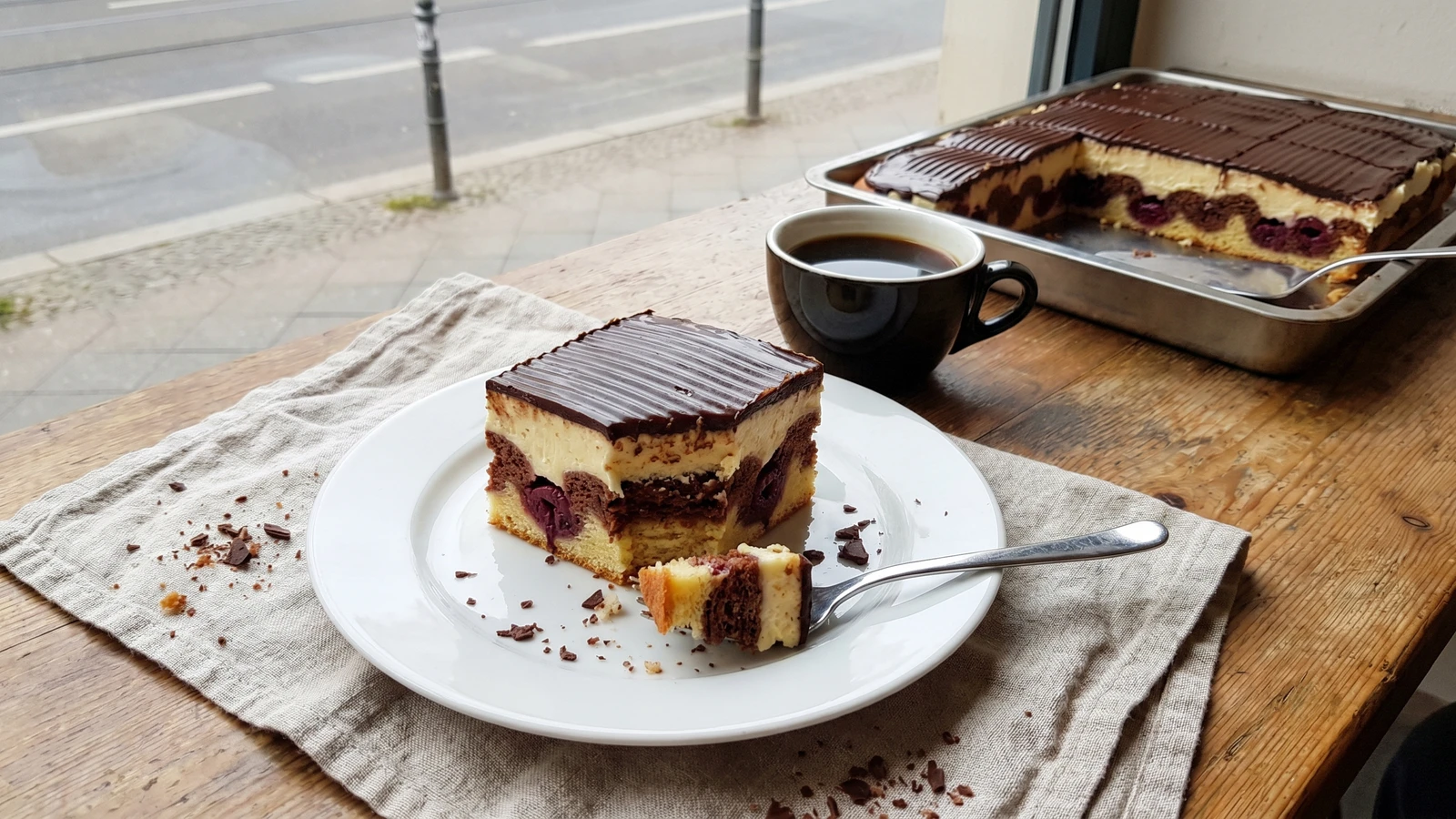
A German coffee-table cake built in layers: pale and cocoa batter, sour cherries sinking into the wave, cool buttercream, and dark chocolate combed like the Danube.
Donauwelle is a Blechkuchen, a sheet cake for Kaffee und Kuchen, birthday tables, and the Sunday plate when you want something made ahead and cut clean. It belongs strongest to the southern German and Austrian baking shelf, with the Danube in the name, but you see it across the country. Some call the red-white-black version Schneewittchenkuchen, Snow White cake. Others insist the top must be combed in waves or it has no business using the Danube name. Im Norden anders, im Süden anders, even cake gets argued over.
The cake works because the sour cherries sink through the cocoa batter into the pale batter and make the wave. Drain them well, then set them on the darker batter, not mixed through it. Wet cherries slide and float, and their syrup turns the crumb heavy; dry cherries drop cleanly and leave the cut face striped like water under chocolate.
I make the buttercream on real vanilla custard, not a packet. Nicht aus dem Glas does not mean we throw away the preserving jar of cherries, that jar is the larder doing its job. It means the cream is yours, the glaze is yours, and the cake is given time to set before you cut it. Das braucht seine Zeit. Chill it, warm the knife, and cut like you mean it.
Donauwelle became a standard German and Austrian home-baking and Konditorei cake in the twentieth century, when sheet cakes with buttercream layers suited family ovens, birthdays, and the afternoon coffee table. Its name comes from the Danube, Donau in German, because the sinking cherries push the pale and cocoa batters into a wave pattern; the same cake is also called Schneewittchenkuchen in some regions for its red cherries, white cream, and dark glaze. The regional dispute is mostly one of finish: some bakers use a firm chocolate couverture glaze combed with a cake comb, while others use a softer cocoa-fat glaze that cuts more easily from the refrigerator.
Quantity
2 jars, about 350g drained weight total
drained very well
Quantity
250g
softened, for the cake
Quantity
200g
Quantity
1 tablespoon vanilla sugar or 1 teaspoon extract
Quantity
1 pinch
Quantity
5
at room temperature
Quantity
375g
Quantity
12g
Quantity
5 tablespoons
divided
Quantity
25g
Quantity
500ml
for the custard
Quantity
100g
for the custard
Quantity
40g
Quantity
3
Quantity
1 bean or 2 teaspoons extract
Quantity
250g
softened, for the buttercream
Quantity
200g
chopped
Quantity
25g
Quantity
1 pinch
for the glaze
| Ingredient | Quantity |
|---|---|
| sour cherriesdrained very well | 2 jars, about 350g drained weight total |
| unsalted buttersoftened, for the cake | 250g |
| sugar | 200g |
| vanilla sugar or vanilla extract | 1 tablespoon vanilla sugar or 1 teaspoon extract |
| salt | 1 pinch |
| eggsat room temperature | 5 |
| plain flour | 375g |
| baking powder | 12g |
| milkdivided | 5 tablespoons |
| unsweetened cocoa powder | 25g |
| whole milkfor the custard | 500ml |
| sugarfor the custard | 100g |
| cornstarch | 40g |
| egg yolks | 3 |
| vanilla bean or vanilla extract | 1 bean or 2 teaspoons extract |
| unsalted buttersoftened, for the buttercream | 250g |
| dark chocolate or couverturechopped | 200g |
| coconut fat or neutral oil | 25g |
| saltfor the glaze | 1 pinch |
Tip the sour cherries into a sieve and leave them to drain for at least 20 minutes, then blot them lightly with kitchen paper. Keep the juice for another day, Weggeworfen wird nichts. Dry cherries sink into the batter and make the wave; syrupy cherries float, bleed, and leave the cake damp where it should be tender.
Whisk a little of the cold milk with the cornstarch, egg yolks, sugar, and vanilla until smooth, then bring the rest of the milk just to a simmer. Whisk the hot milk into the yolk mixture, return everything to the pan, and cook while stirring until thick and glossy. It must boil gently for a minute so the starch loses its raw taste and sets firmly enough to hold the buttercream.
Heat the oven to 180C and line a 30x40cm rimmed baking sheet. Beat the soft butter, sugar, vanilla sugar, and salt until pale, then beat in the eggs one at a time because the batter holds its air better when each egg is absorbed before the next arrives. Fold in the flour and baking powder with 3 tablespoons milk, stopping as soon as the flour disappears so the crumb stays fine.
Spread half the pale batter evenly in the tin. Stir the cocoa and 2 tablespoons milk into the remaining batter, then spread the cocoa batter over the pale layer. Scatter the drained cherries over the top and press them in lightly with flat fingers. Do not stir them through. They need to sink from above, pulling the dark batter down into the pale layer as the cake bakes.
Bake for 30 to 35 minutes, until the top springs back and a tester comes out with moist crumbs but no wet batter. Let the cake cool completely in the tin. Warm cake melts buttercream from underneath, and then you have pudding on a sponge, not Donauwelle.
Beat the softened butter until light and smooth, then spoon in the room-temperature custard a little at a time. Add the next spoon only when the last one has disappeared, because a slow emulsion gives you a cream that cuts cleanly and does not weep. Spread it over the cold cake in an even layer and chill for 45 minutes, until firm.
Melt the dark chocolate with the coconut fat and a pinch of salt over gentle heat, then let it cool until fluid but no longer hot. Pour it over the firm buttercream and spread it quickly. Comb waves through the glaze with a cake comb or fork while it is still soft, because once the chocolate sets, the Danube has closed for the day.
Chill the cake until the glaze is set, then cut it with a knife dipped in hot water and wiped dry between cuts. The warm blade goes through the chocolate without cracking it into the cream. Serve small squares with coffee. Schön ist, was schmeckt.
1 serving (about 150g)
Culinary guides, cultural storytelling, and the editorial depth that makes cooking meaningful.
Discover Culinary ExplorerChef Klaus
Frankfurt's Advent marzipan ball is small, pale gold, and exacting: real almond paste, rosewater, three almond halves pressed on firmly, then a short bake for gloss.

Chef Klaus
Bienenstich works when the almond top caramelises without burning and the yeast cake cools before the cream goes in. Rush either one and the bee has stung you.

Chef Klaus
North Germany's Freud-und-Leid-Kuchen, the cake for joy and sorrow both: a yeast sheet pressed full of cold butter, sugar, and almonds until the top turns crisp.

Chef Klaus
Dresden's coffee-table cake is three layers and one rule: bake the egg top gently until it trembles in the middle, because dry custard is just sweet scrambled egg.