
Chef Juliana
Ambrosia Baiana
You think curdled milk means you ruined dessert. Good. Tonight you'll do it on purpose, with lemon, yolks, cravo, and sugar, until the pot turns into golden gruminhos.
A cooking platform built around craft, culture, and the stories behind what we eat.
Created by
You think the little corn-husk bundle is a secret from someone else's stove. It isn't. Milk, sugar, patience, and a spoon track that stays open make this Mineira sweet learnable.
You see a little doce wrapped in palha and your brain whispers isso não é pra mim. I know that voice. It said the same thing to me when I was a grown woman staring at a pot, trying to understand how milk and sugar became anything other than sweet milk. Cozinhar não é dom, é um aprendizado. Anota aí: this one is all ponto.
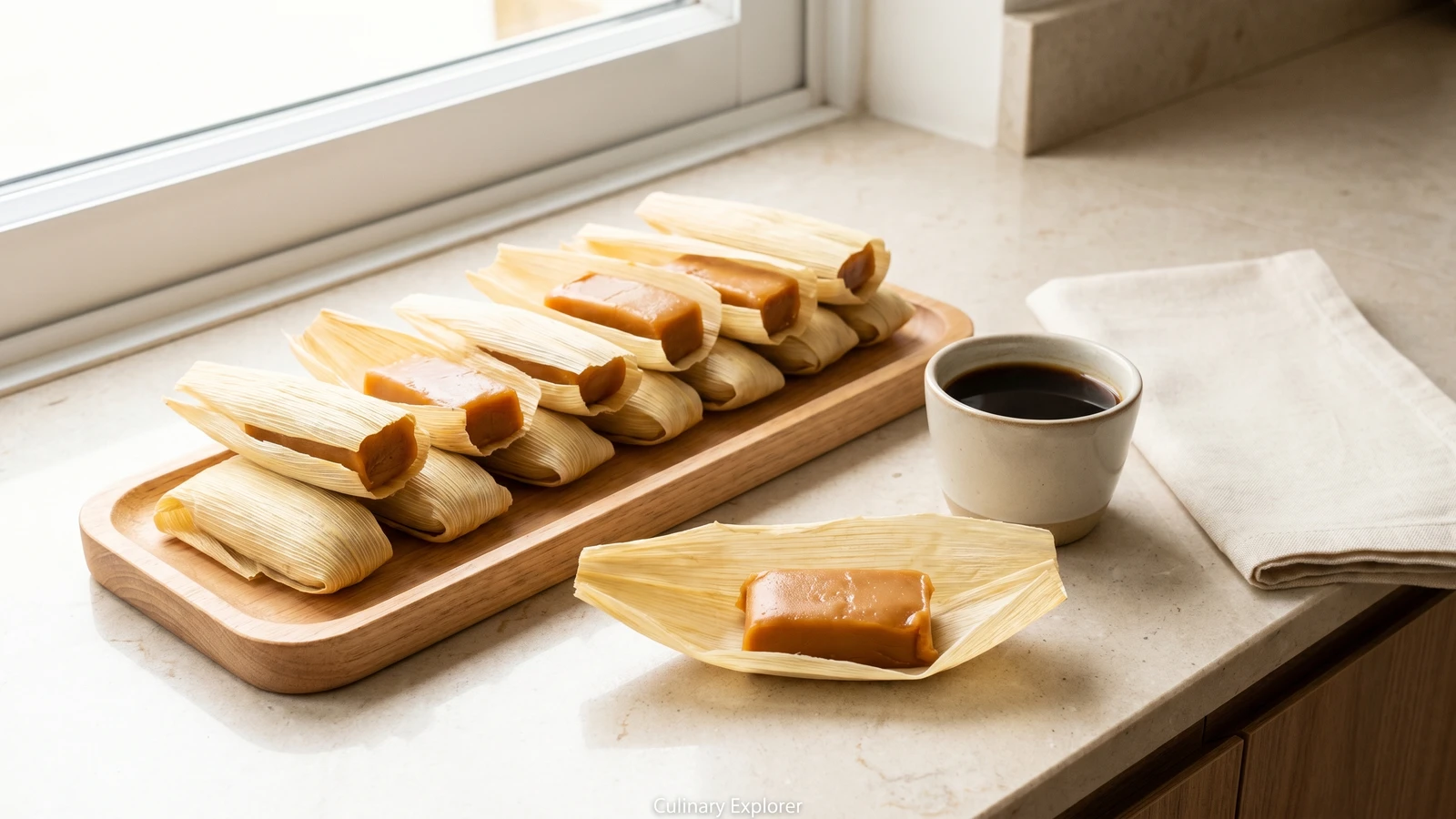
Doce de leite na palha sits in that Mineira family of sweets that knows how to make food last. Milk gets cooked down until it turns amber and firm, then each little piece is wrapped in dried corn husk. The wrapping isn't decoration. It keeps the sweets separate, carries a faint corn smell, and turns a spoonful of milk into something you can take on the road, put in a lunch bag, or hand to someone after coffee.
And yes, it belongs beside the everyday plate too. A gente talks so much about rice, beans, a piece of meat or egg, and something green because that pê-efe is the formula that quietly keeps a country itself. But after the plate comes the small sweet, not a factory bar pretending to be food, not powdered imitation, just milk and sugar cooked honestly until they behave.
We're doing the home version: a heavy pot, a gas stove, a wooden spoon, and patience. No tacho de cobre nobody owns. You will drag the spoon across the bottom and watch the pot tell you when it's ready. That's a receita que funciona.
Minas Gerais built a strong preserve-and-compote tradition during the eighteenth-century gold cycle, when farm kitchens turned milk, fruit, peel, and harvest surplus into sweets that could last and travel. The doceiras of São Bartolomeu and Sabará are known for fruit preserves, while Serra da Canastra and Araxá helped make milk sweets and cheese central to the state's table. A firm doce de leite wrapped in palha belongs to that same pantry logic: cook the surplus harder, wrap it cleanly, and send it down the road.
Quantity
12 to 16
preferably inner husks, free of spots or mold
Quantity
as needed
for soaking the corn husks
Quantity
8 cups
Quantity
3 cups
Quantity
1/4 teaspoon
Quantity
1/4 teaspoon
Quantity
1 tablespoon, plus more for greasing hands
| Ingredient | Quantity |
|---|---|
| clean dried corn huskspreferably inner husks, free of spots or mold | 12 to 16 |
| hot waterfor soaking the corn husks | as needed |
| whole milk | 8 cups |
| granulated sugar | 3 cups |
| baking soda | 1/4 teaspoon |
| fine salt | 1/4 teaspoon |
| unsalted butter | 1 tablespoon, plus more for greasing hands |
Choose the clean inner corn husks and discard anything dusty, stained, or moldy. Pour hot water over them and let them soften for 10 minutes, then rinse, pat very dry, and leave them flat on a towel while you cook. They need to bend without cracking, but they cannot be wet, because wet palha softens the sweet and invites trouble later.
Put the milk, sugar, baking soda, and salt in a heavy 5-liter wide pot. Stir while the milk is still cold, until the sugar no longer rasps against the bottom. Dissolving it now helps the sweet cook smooth instead of grainy, and the big pot matters because the baking soda makes the milk foam at the start.
Set the pot over medium heat and bring it up slowly, stirring often and scraping the bottom and corners. When the foam rises, lower the flame and keep it at a steady, lazy bubble. Milk catches on the bottom when you ignore it, and scorched milk tastes scorched all the way through. No perfume covers that.
Cook, stirring every few minutes at first, until the milk turns beige, then caramel, about 60 to 75 minutes. As it thickens, stir more often and scrape the whole bottom of the pot with a wooden spoon. The thicker it gets, the faster it can stick, because there is less water left to protect the sugar and milk solids.
When the mixture is deep amber and bubbling slowly, stir constantly. Drag the spoon across the bottom of the pot. If the path closes right away, keep cooking. If the path stays open for 2 seconds and the sweet pulls back from the sides in a heavy wave, start testing. Drop 1/2 teaspoon on a cold plate, wait 1 minute, and try to roll it between your fingers. It should make a soft little ball, not a smear. This is the whole game: too early and it won't hold, too late and it turns dry and crumbly.
Take the pot off the heat and stir in the butter. Beat the doce hard with the wooden spoon for 2 to 3 minutes, until the shine softens from glossy to satin and the mixture thickens another notch. This beating sets tiny sugar crystals through the sweet, which gives you a tender fudge instead of a sticky caramel that fights your teeth.
Grease a plate and your hands lightly with butter. Spoon heaping tablespoon portions onto the plate and let them cool just until you can touch them, about 5 to 8 minutes. Roll each portion into a small oval or stubby log. Work while they are warm and flexible, because once the ponto sets, the sweet stops negotiating.
Cut the dried husks into rectangles or long strips, about 4 by 6 inches. Place one sweet near the center, fold the palha around it, and twist or fold the ends closed. The husk keeps each piece separate and gives that quiet corn aroma. That's packaging doing kitchen work, not decoration showing off.
Let the wrapped sweets rest at room temperature for at least 2 hours before serving. They firm as they cool, and the palha settles around them. Serve after coffee or after a pê-efe, when everyone swears they don't want dessert and then reaches for one anyway.
1 serving (about 70g)
Culinary guides, cultural storytelling, and the editorial depth that makes cooking meaningful.
Discover Culinary ExplorerChef Juliana
You think curdled milk means you ruined dessert. Good. Tonight you'll do it on purpose, with lemon, yolks, cravo, and sugar, until the pot turns into golden gruminhos.

Chef Juliana
You are not ruining the milk. You're curdling it on purpose, slowly, until sugar, eggs, cinnamon, and patience turn cheap ingredients into dessert.

Chef Juliana
You think curdled milk means failure. Not here. Milk, yolks, sugar, and lemon cook into golden curds in amber whey, a Minas sweet where the ponto teaches the whole recipe.

Chef Juliana
You already trust rice for dinner. Trust it for dessert: cook it gently with milk, coconut, and canela until each grain turns soft, creamy, and impossible to blame on lack of talent.