
Chef Jeong-sun
Aehobak-guk (애호박국, Korean Zucchini Soup)
A clean summer soup of Korean zucchini and salted shrimp, built on quick anchovy-kelp broth and finished before the half-moons lose their shape on a weeknight table.
A cooking platform built around craft, culture, and the stories behind what we eat.
Created by
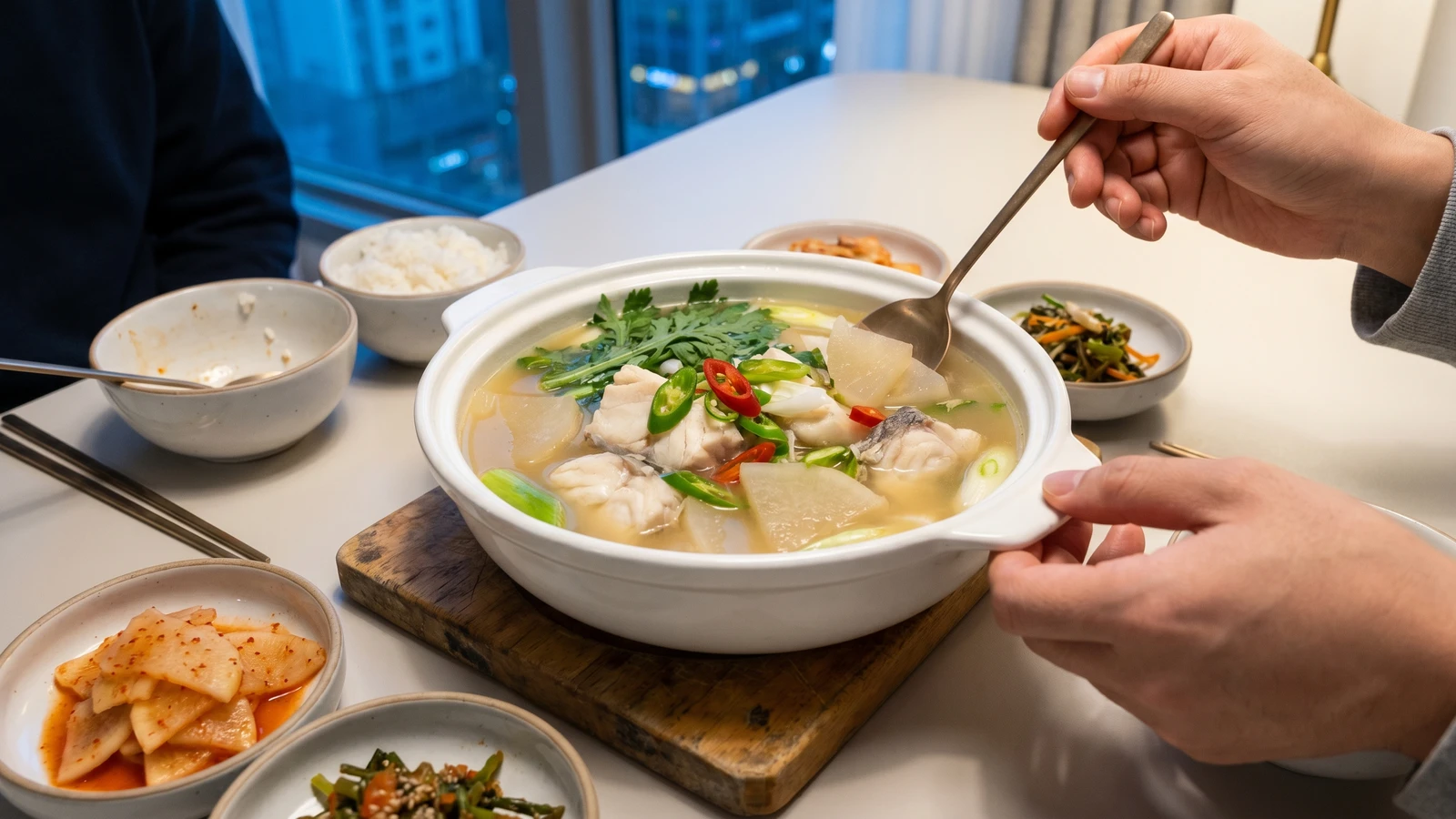
Fresh cod simmered briefly in a clear anchovy-kelp broth with Korean radish, chilies, and scallion, a winter stew that depends on restraint more than strength.
Cod is a cold-month fish. Cook the month you're standing in. When daegu (cod) is firm, heavy, and bright-eyed at the market, this stew asks for very little: good broth, radish cut thick enough to sweeten, and a cook who won't boil the fish to cotton.
This is not a gochujang stew. Some homes make it redder, and that's their table, but the version I write here is clear and peppery, closer to daegu-jiri (clear cod soup) than maeuntang (spicy fish stew). The radish goes in first because it needs time. The cod goes in last because it has none to spare.
My teacher would press a chopstick into the thickest piece of fish and say nothing. If it separated cleanly, the pot left the fire. If you wait until the broth looks dramatic, you've already lost the cod. Write down the minute your fish flakes, because thickness changes everything. Memory is a borrowed bowl.
Daegu (cod) has long been prized as a winter fish along Korea's southern and eastern coasts, especially around South Gyeongsang ports where cold-season cod fisheries shaped local soups and market cooking. Clear cod stews such as daegu-jiri sit beside redder maeuntang versions, showing the Korean habit of letting the same fish travel between restrained broth and sharper chili seasoning. The name daegu means "big mouth," a plain description of the fish before it ever became dinner.
Quantity
700g
bone-in steaks or thick fillet pieces, rinsed and patted dry
Quantity
1 teaspoon
for briefly salting the fish
Quantity
5 cups
Quantity
1 piece, about 4 inches square
Quantity
10 large
heads and guts removed
Quantity
300g
peeled and cut into 1/3-inch thick half-moons
Quantity
1 tablespoon
Quantity
1 teaspoon fish sauce or 1/2 teaspoon salt
plus more only if needed
Quantity
2 cloves
minced
Quantity
1 teaspoon
finely grated
Quantity
1 teaspoon
Quantity
1
sliced on the diagonal
Quantity
1
sliced on the diagonal
Quantity
2
cut into 2-inch lengths
Quantity
150g
trimmed
Quantity
100g
tough stems removed
Quantity
1/4 teaspoon
| Ingredient | Quantity |
|---|---|
| fresh codbone-in steaks or thick fillet pieces, rinsed and patted dry | 700g |
| coarse sea saltfor briefly salting the fish | 1 teaspoon |
| water | 5 cups |
| dried kelp (dasima) | 1 piece, about 4 inches square |
| dried anchovies (myeolchi)heads and guts removed | 10 large |
| Korean radish (mu)peeled and cut into 1/3-inch thick half-moons | 300g |
| soup soy sauce (guk-ganjang) | 1 tablespoon |
| fish sauce or fine sea saltplus more only if needed | 1 teaspoon fish sauce or 1/2 teaspoon salt |
| garlicminced | 2 cloves |
| fresh gingerfinely grated | 1 teaspoon |
| gochugaru (Korean chili flakes) (optional) | 1 teaspoon |
| green chilisliced on the diagonal | 1 |
| red chili (optional)sliced on the diagonal | 1 |
| scallionscut into 2-inch lengths | 2 |
| soybean sprouts (kongnamul) (optional)trimmed | 150g |
| crown daisy (ssukgat) or watercress (optional)tough stems removed | 100g |
| freshly ground black pepper | 1/4 teaspoon |
Sprinkle the cod with 1 teaspoon coarse sea salt and let it stand 10 minutes while you start the broth. Rinse briefly and pat dry. This tightens the surface and draws away a little blood and fishiness, but do not salt it longer, because cod is lean and dries quickly.
Put the water, kelp, and cleaned anchovies in a wide pot. Bring it just to a simmer over medium heat, then remove the kelp before the water boils hard. Simmer the anchovies 8 minutes more and lift them out. Kelp left too long turns the broth slick and bitter, and this stew has nowhere to hide that mistake.
Add the radish, soup soy sauce, and fish sauce to the broth. Simmer 10 to 12 minutes, until the radish edges turn slightly translucent and a chopstick enters with a little resistance. The radish must sweeten the broth before the cod arrives, because the fish will not stay in the pot long enough to wait for it.
Stir in the garlic, ginger, and gochugaru if using. Taste the broth now. It should be clean, lightly salty, and peppery, not heavy. Add only a pinch of salt if it tastes flat. A clear fish stew ruined by too much seasoning is still ruined, even if the fish was expensive.
Lower the cod into the simmering broth in one layer. Spoon broth over the top instead of stirring, so the pieces do not break. Simmer gently 4 to 6 minutes for thick fillet pieces, 6 to 8 minutes for bone-in steaks, just until the thickest piece flakes when pressed. Turn off the heat the moment it does. Cod goes from tender to dry while a careless cook is looking for a larger spoon.
Add the soybean sprouts, chilies, scallions, and crown daisy or watercress, pressing them lightly into the hot broth. Cover for 1 minute off the heat so the greens soften without losing their shape. Finish with black pepper and carry the pot to the table with rice and one or two quiet banchan.
1 serving (about 560g)
Culinary guides, cultural storytelling, and the editorial depth that makes cooking meaningful.
Discover Culinary ExplorerChef Jeong-sun
A clean summer soup of Korean zucchini and salted shrimp, built on quick anchovy-kelp broth and finished before the half-moons lose their shape on a weeknight table.
Chef Jeong-sun
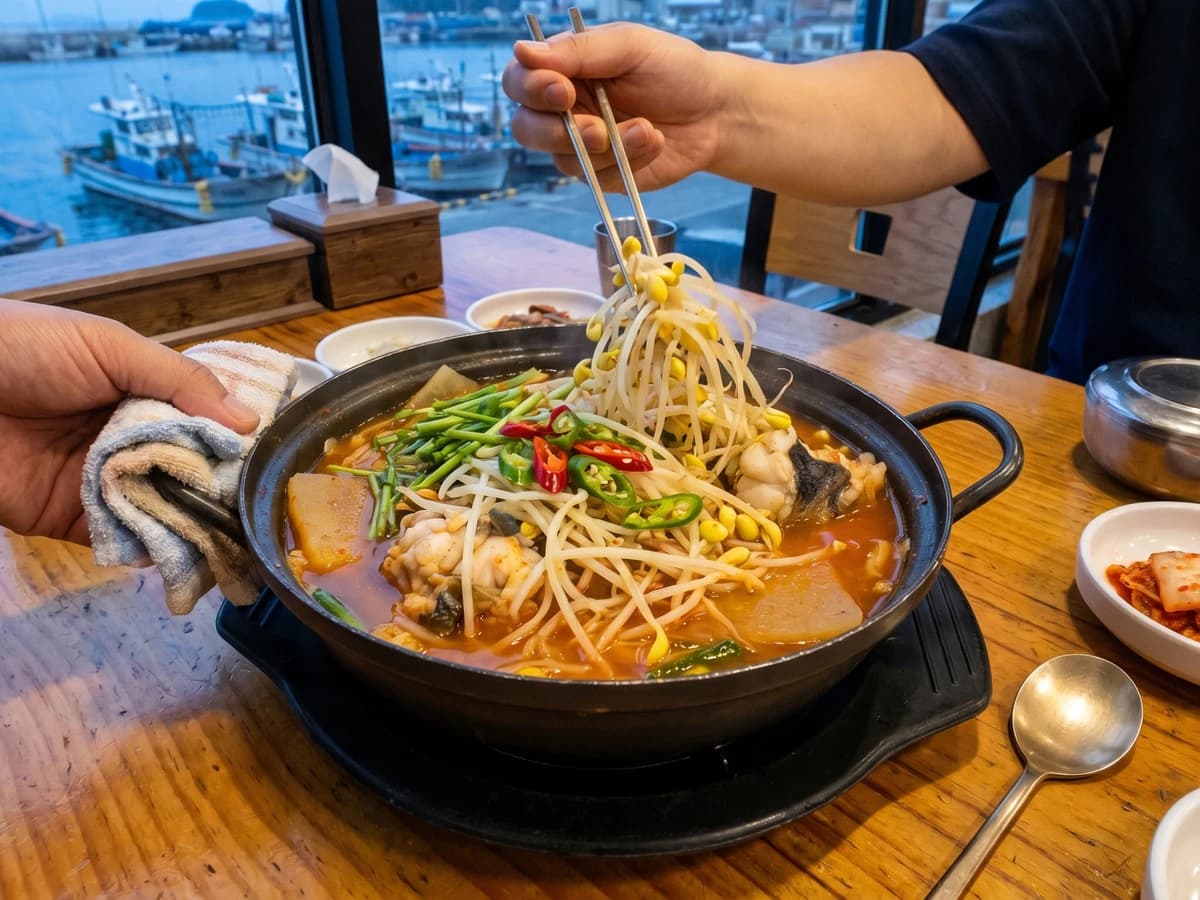
A Masan coast monkfish stew with firm white meat, gelatin at the bones, soybean sprouts for crunch, and a red broth seasoned to carry the fish, not bury it.

Chef Jeong-sun
A weeknight fish roe stew with radish and crown daisy in a clean spicy broth, where the whole success depends on adding the roe late enough that it sets tender, not chalky.

Chef Jeong-sun
Late-summer mallow leaves rubbed with salt until the bitter green water runs off, then simmered in a clean doenjang broth with dried shrimp, the quiet soup a Korean weeknight deserves.