
Chef Juliana
Ambrosia Baiana
You think curdled milk means you ruined dessert. Good. Tonight you'll do it on purpose, with lemon, yolks, cravo, and sugar, until the pot turns into golden gruminhos.
A cooking platform built around craft, culture, and the stories behind what we eat.
Created by
You thought curau was kitchen magic. It isn't. It's fresh corn, milk, a sieve, and the patience to stir until the spoon leaves a soft trail.
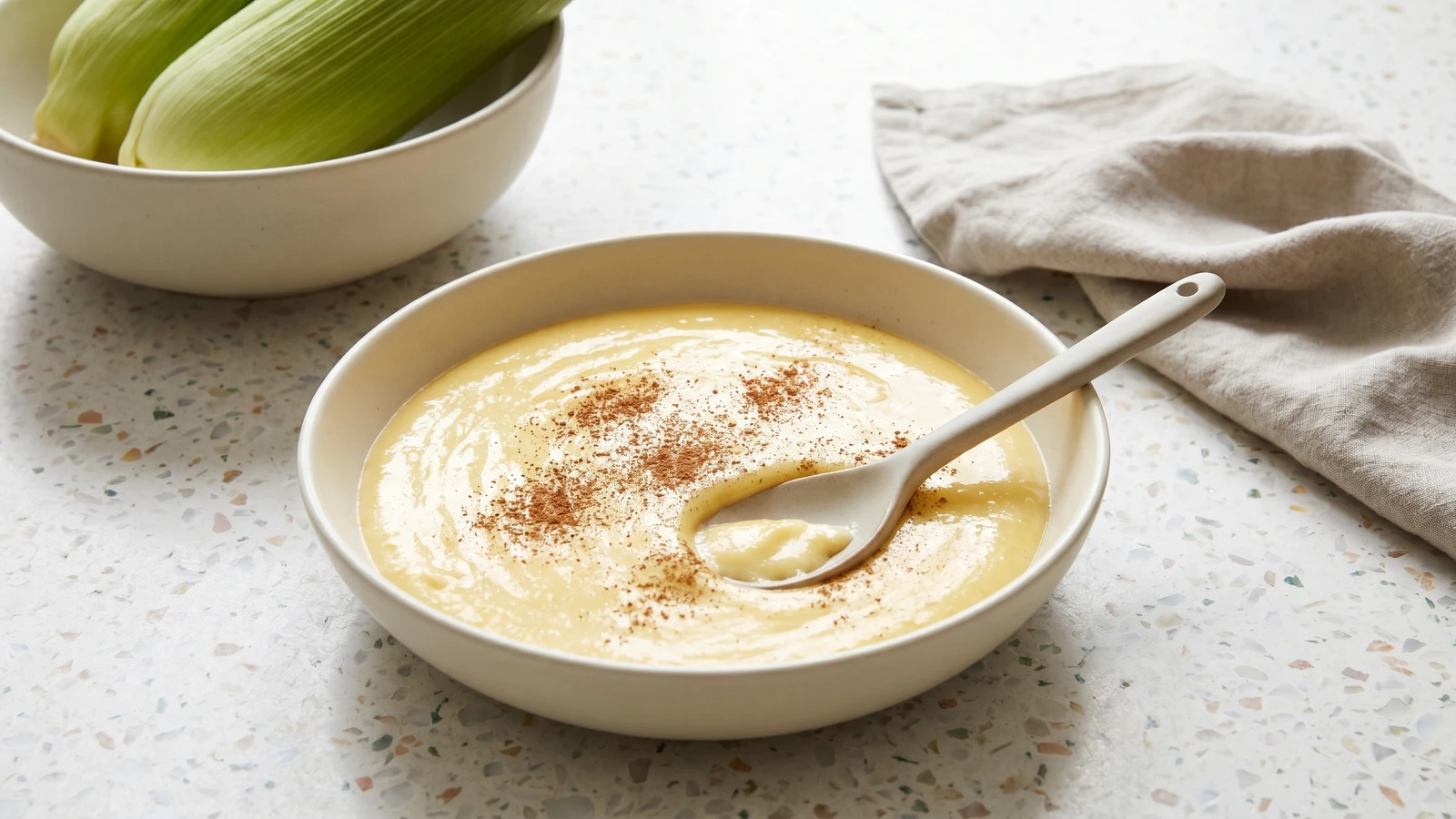
You look at that glossy yellow spoonful and hear the little voice: isso não é pra mim. Too smooth, too old-fashioned, too much like something an auntie made by feel while talking over her shoulder. Good. Let's take that excuse apart.
Curau is one of those sweets that proves comida de verdade doesn't need to be grand to matter. Corn, milk, sugar, cinnamon. That's it. The same country that feeds itself on the pê-efe, rice, beans, something from the pan, something green, also knows how to turn a cheap seasonal ear of corn into dessert for the table. Everyday food has room for sweetness. Of course it does.
The method is plain. You blend the raw kernels with milk because the corn carries its own starch and flavor. You strain because the husks are fibrous and nobody asked for chewy pudding. Then you cook low and slow, stirring, until it thickens into silk. Too hot and it grabs at the bottom. Too lazy with the spoon and it turns lumpy. Stay with it for a few minutes. A gente can do that.
Anota aí: cozinhar não é dom, é um aprendizado. Buy corn when it's actually good, sweet, full, and cheap, usually in season and not after traveling tired across half the world. Want the Tuesday shortcut? Frozen corn works. It won't taste as bright as fresh green corn, but it still teaches the real method. The powdered imitation can stay on the shelf looking embarrassed.
Curau is strongly tied to Brazil's corn season and Festa Junina tables, especially across the Southeast and Center-West, where green corn sweets fill June celebrations. The same preparation shifts names by region: in parts of the Northeast, a close cousin is often called canjica, while in the Southeast canjica usually means a different sweet made from hominy. The debate is useful because it shows what Brazilian home cooking really is: shared ingredients, regional names, and families defending their version at the table.
Quantity
6 large ears, about 4 cups kernels
kernels cut from the cobs
Quantity
3 cups
divided
Quantity
1/2 cup, plus more to taste
Quantity
1/4 teaspoon
Quantity
1 tablespoon
Quantity
1/2 teaspoon
for serving
| Ingredient | Quantity |
|---|---|
| fresh green cornkernels cut from the cobs | 6 large ears, about 4 cups kernels |
| whole milkdivided | 3 cups |
| sugar | 1/2 cup, plus more to taste |
| salt | 1/4 teaspoon |
| unsalted butter (optional) | 1 tablespoon |
| ground cinnamonfor serving | 1/2 teaspoon |
Stand each ear of corn upright in a wide bowl and cut the kernels off with a sharp knife, close to the cob but not so deep that you scrape the hard core. You want juicy yellow kernels, not woody bits. Fresh corn should smell sweet and grassy; if it smells tired, cook something else and don't blame the recipe.
Put half the corn in the blender with 1 1/2 cups of the milk and blend until the mixture looks pale yellow and very smooth, about 1 minute. Repeat with the remaining corn and another 1 cup milk. The milk helps the blades pull the corn into a fine puree, and the corn releases the starch that will thicken the pudding. No packet. The corn is doing its own work.
Pour the blended corn through a fine sieve into a heavy pot, pressing hard with a spoon to get every bit of liquid out. Scrape the underside of the sieve too, because that's where the thick good stuff clings. Stop when the pulp left behind looks dry and fibrous. Straining is what keeps curau silky instead of grainy, and silky is the whole point here.
Add the sugar, salt, and the remaining 1/2 cup milk to the pot. Set it over medium-low heat and stir with a wooden spoon or silicone spatula, scraping the bottom and corners from the beginning. It will look too thin at first. Let it. Corn starch thickens with heat, and if you rush the heat, the bottom thickens before the rest and you get lumps.
Keep stirring until the curau changes from thin milk to a glossy pudding that holds soft lines from the spoon, about 15 to 20 minutes. When you drag the spoon across the bottom, it should show the pot for a second before closing slowly. That's the ponto. If it bubbles angrily or sticks, lower the heat and keep scraping. Burnt milk and corn are dramatic in the worst way.
Turn off the heat and stir in the butter if you're using it. Taste carefully and adjust sugar only now, because sweetness reads differently once the corn has thickened. Pour into a shallow serving dish or small cups while it's still fluid, then smooth the top with the back of a spoon. It sets as it cools, so don't wait until it turns stubborn in the pot.
Dust the top with cinnamon and serve warm, at room temperature, or chilled. Warm curau is soft and spoon-coating; chilled curau sets firmer and cuts with a gentle wobble. Both are right. The only wrong version is the one made from powder and called the same thing with a straight face.
1 serving (about 190g)
Culinary guides, cultural storytelling, and the editorial depth that makes cooking meaningful.
Discover Culinary ExplorerChef Juliana
You think curdled milk means you ruined dessert. Good. Tonight you'll do it on purpose, with lemon, yolks, cravo, and sugar, until the pot turns into golden gruminhos.

Chef Juliana
You are not ruining the milk. You're curdling it on purpose, slowly, until sugar, eggs, cinnamon, and patience turn cheap ingredients into dessert.

Chef Juliana
You think curdled milk means failure. Not here. Milk, yolks, sugar, and lemon cook into golden curds in amber whey, a Minas sweet where the ponto teaches the whole recipe.

Chef Juliana
You already trust rice for dinner. Trust it for dessert: cook it gently with milk, coconut, and canela until each grain turns soft, creamy, and impossible to blame on lack of talent.