
Chef Graziella
Mozzarella in Carrozza
Naples' beloved fried mozzarella sandwich, where day-old bread becomes a golden carriage for molten cheese. Four minutes of perfection that cannot wait.
A cooking platform built around craft, culture, and the stories behind what we eat.
Free with an account.
Created by
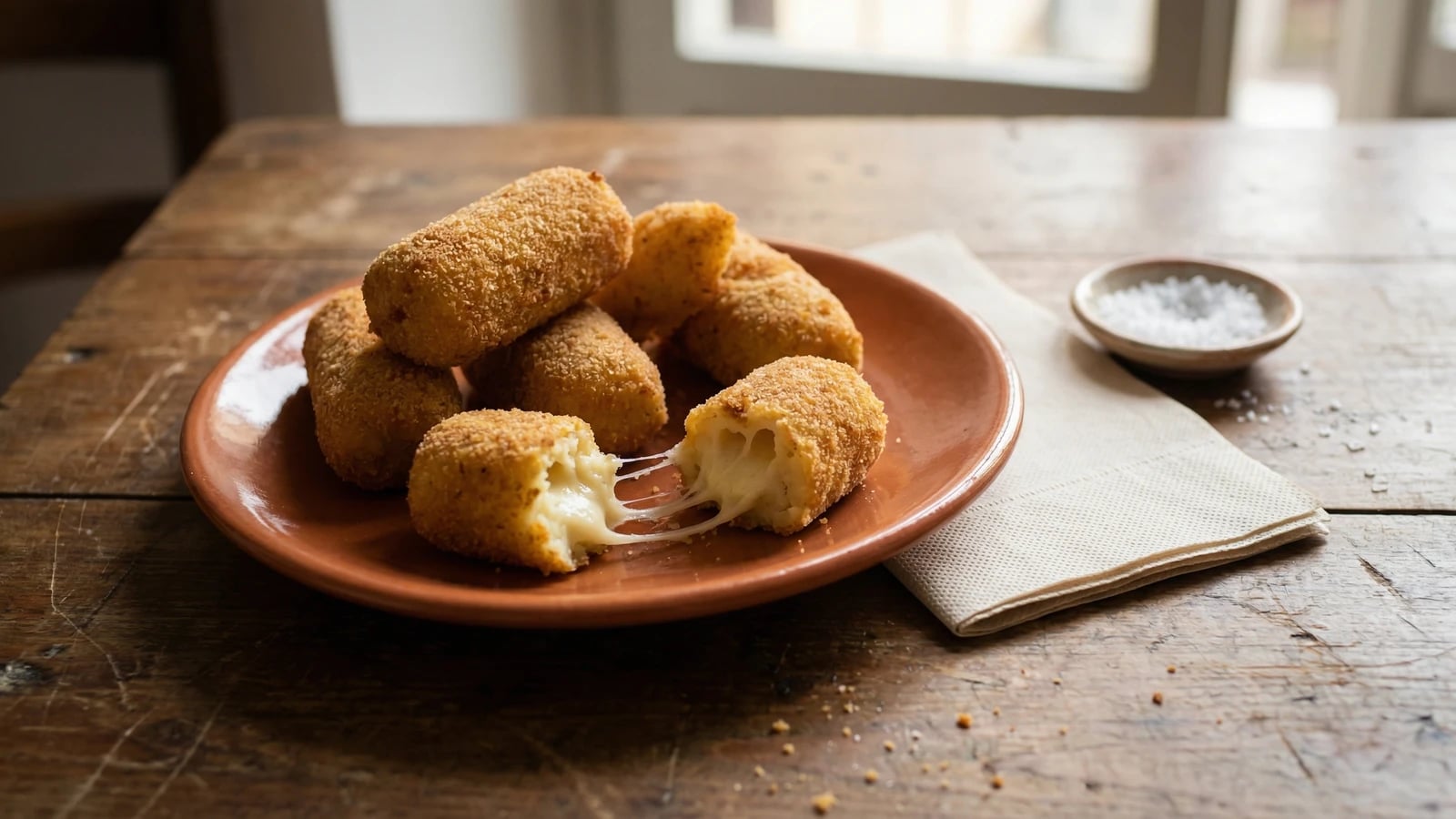
From the friggitorie of Naples, where frying is an art and potato croquettes are judged by the crack of the crust and the pull of melted cheese within.
By signing in, you agree to our Terms and Conditions and Privacy Policy
In Naples, crocchè are not appetizers. They are sustenance, tradition, and proof that the simplest ingredients, handled with respect, create the most satisfying food. Every friggitoria in the city makes them, and every Neapolitan has an opinion about who makes them best.
The exterior must shatter. This is non-negotiable. If your crocchè are soft, you have failed. The potato inside should be creamy, enriched with butter and Parmigiano-Reggiano, seasoned with the faint warmth of nutmeg. And at the center, provola cheese that has become molten, stretching in strings when you break the croquette open.
What you keep out matters. There is no garlic here, no herbs beyond parsley. The potato is the star, the cheese the surprise. The friggitoria masters of Naples understand that restraint creates purity of flavor. Too many additions and you lose the point entirely.
Crocchè arrived in Naples during the Bourbon rule of the 18th century, when French chefs introduced croquettes to the royal kitchens. Neapolitan cooks adapted the technique using local provola cheese, transforming an aristocratic preparation into street food sold from the friggitorie that still line the narrow streets of the Spanish Quarter.
Free with an account.
Quantity
2 pounds
Russet or Yukon Gold
Quantity
3 tablespoons
softened
Quantity
3
Quantity
3/4 cup
freshly grated
Quantity
2 tablespoons
chopped fine
Quantity
1/2 teaspoon
freshly grated
Quantity
to taste
Quantity
to taste
freshly ground
Quantity
6 ounces
cut into 24 small cubes
Quantity
1 cup
Quantity
3
beaten
Quantity
2 cups
Quantity
for deep frying
| Ingredient | Quantity |
|---|---|
| starchy potatoesRusset or Yukon Gold | 2 pounds |
| unsalted buttersoftened | 3 tablespoons |
| large egg yolks | 3 |
| Parmigiano-Reggianofreshly grated | 3/4 cup |
| fresh flat-leaf parsleychopped fine | 2 tablespoons |
| nutmegfreshly grated | 1/2 teaspoon |
| fine sea salt | to taste |
| black pepperfreshly ground | to taste |
| provola cheesecut into 24 small cubes | 6 ounces |
| all-purpose flour | 1 cup |
| large eggsbeaten | 3 |
| fine dry breadcrumbs | 2 cups |
| vegetable oil or lard | for deep frying |
Place whole, unpeeled potatoes in a large pot and cover with cold salted water. Bring to a gentle boil and cook until a knife slides through the center without resistance, 35 to 45 minutes depending on size. The potatoes must be thoroughly cooked. Undercooked potatoes create lumps that no amount of mashing will remedy.
Drain the potatoes and peel them while still hot. Use a kitchen towel to protect your hands. Pass the hot potatoes through a ricer or food mill immediately. They must be riced while hot; cold potatoes become gluey. Spread the riced potatoes on a baking sheet to release steam and cool slightly, about 10 minutes.
Transfer the warm riced potatoes to a large bowl. Add the softened butter and mix until incorporated. Add the egg yolks one at a time, mixing well after each. Fold in the Parmigiano-Reggiano, parsley, and nutmeg. Season with salt and pepper. The mixture should be smooth, pliable, and hold together when squeezed. If too wet, spread on the baking sheet again to dry slightly.
With lightly floured hands, take a portion of potato mixture about the size of a small egg. Flatten it in your palm, place a cube of provola in the center, then close the potato around the cheese and roll into a cylinder about three inches long. The cheese must be completely sealed inside. Any gap will allow the cheese to escape during frying. Repeat with remaining mixture and cheese.
Set up three shallow dishes: flour in the first, beaten eggs in the second, breadcrumbs in the third. Roll each croquette in flour, shaking off excess. Dip in egg, letting excess drip away. Roll in breadcrumbs, pressing gently to adhere. Place on a baking sheet lined with parchment. Refrigerate for at least 20 minutes to firm the coating.
Pour oil to a depth of three inches in a heavy pot. Heat to 350°F (175°C). Fry the croquettes in batches of four or five, turning occasionally, until deep golden brown on all sides, 3 to 4 minutes total. Do not crowd the pot. Crowding drops the oil temperature and creates greasy, pale croquettes. Transfer to a wire rack set over a baking sheet.
Season the hot croquettes with a pinch of fine salt. Serve immediately while the exterior is crackling crisp and the provola inside has become molten. These do not wait. They do not reheat. Call your guests to the table before you begin frying the final batch.
1 serving (about 275g)
By signing in, you agree to our Terms and Conditions and Privacy Policy
Culinary guides, cultural storytelling, and the editorial depth that makes cooking meaningful.
Free with an account.
Chef Graziella
Naples' beloved fried mozzarella sandwich, where day-old bread becomes a golden carriage for molten cheese. Four minutes of perfection that cannot wait.

Chef Graziella
The beloved Caprese combination arranged on skewers for easy eating at gatherings. Three ingredients, no cooking, and a reminder that Italian food is about selection, not complication.

Chef Juliette
Tiny éperlans, lightly floured and fried until their tails stand crisp, arrive in a generous heap on a napkin with fried parsley and grooved lemon, a weeknight lesson in heat and restraint.

Chef Juliette
Brandade de Morue turns salt cod, warm olive oil, and milk into a pale, silky emulsion: keep everything warm and add the oil slowly, then crown the generous dome with butter-fried bread.