
Chef Lupita
Acitrón de Cidra Conventual
Puebla's convent-style acitrón, made from cidra peel instead of endangered biznaga, built through repeated syrup soakings until the cubes turn firm, translucent, and ready for rosca or chiles en nogada.
A cooking platform built around craft, culture, and the stories behind what we eat.
Created by
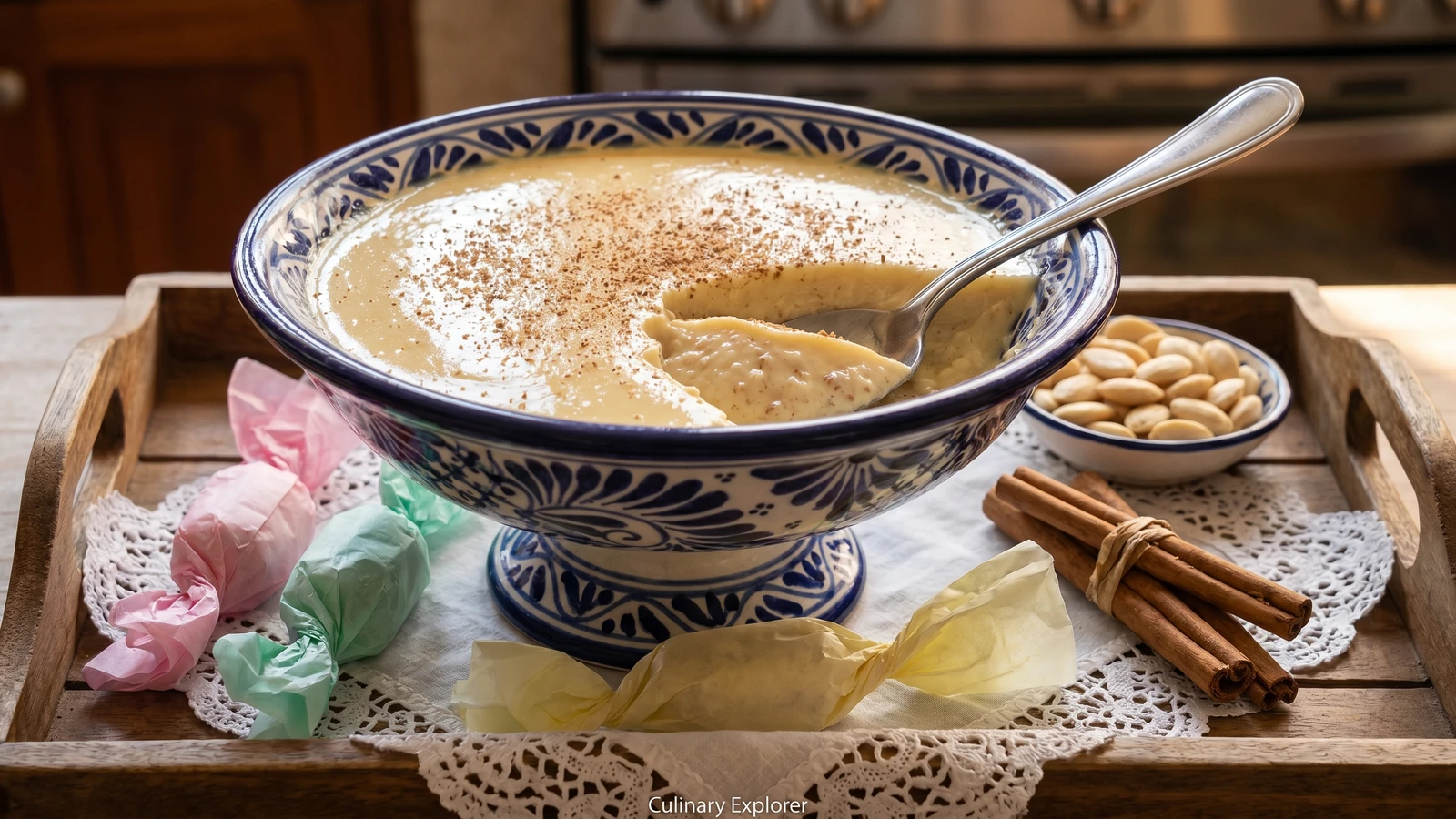
Puebla's convent pudding of milk reduced for hours, thickened with yemas de huevo and almendra pelada, scented with canela, and finished with nutmeg on a talavera platter.
Puebla de los Ángeles, in the central highland valleys of the state of Puebla, is where Crema Reina belongs. This is dulcería poblana, not flan, not rice pudding, not a shortcut made from cans. Leche entera reduced slowly, yemas de huevo for silk, almendra pelada for body, canela for the aroma, and nuez moscada over the top. No chile belongs here. Not every Mexican dish is chile and lime. This is a 32-state cuisine.
The women who perfected this were cloistered sisters, lay cooks, and the señoras who carried convent technique into Puebla homes. They knew the patience of milk. You stand at the stove and scrape the bottom with a wooden spoon because milk scorches when the cook gets proud and distracted. The almonds are not decoration. They thicken the cream and give it that quiet body that tells you this came from a convent kitchen, not a box.
My mother was from Jalisco, but her notebook had one page titled crema reina de Puebla with a line in the margin: la leche no se apura. The milk is not rushed. She was right. Do not substitute condensed milk for leche reducida. Do not put corn syrup in the almíbar. The technique is the inheritance. Saber cocinar es saber vivir.
Crema reina belongs to Puebla's criollo-conventual dessert tradition, developed in Puebla de los Ángeles during the 17th and 18th centuries, when convents such as Santa Clara and Santa Rosa became centers of milk, sugar, almond, and egg sweets. Unlike mole poblano, whose origin legend is often attached to Santa Rosa, this pudding is not reliably tied to one named nun; it survives as a technique in manuscript and household recipe lines: leche reducida, yemas de huevo, almendra pelada, canela, and a final dusting of nuez moscada. The almonds and nutmeg came through Spanish and transatlantic trade routes, while Puebla's dairy and sugar economy made the slow custard practical for feast tables and convent dulcerías.
Quantity
2 quarts
preferably not UHT
Quantity
1 large
Quantity
1/4 teaspoon
Quantity
1 cup
soaked in warm water for 20 minutes
Quantity
3/4 cup
Quantity
2 ounces
finely grated
Quantity
1/3 cup
Quantity
8
room temperature
Quantity
1 teaspoon
preferably from Papantla
Quantity
1/4 teaspoon
for serving
| Ingredient | Quantity |
|---|---|
| leche enterapreferably not UHT | 2 quarts |
| Mexican canela stick | 1 large |
| fine sea salt | 1/4 teaspoon |
| almendra peladasoaked in warm water for 20 minutes | 1 cup |
| azúcar de caña | 3/4 cup |
| piloncillo clarofinely grated | 2 ounces |
| water | 1/3 cup |
| yemas de huevoroom temperature | 8 |
| pure Mexican vanilla extractpreferably from Papantla | 1 teaspoon |
| freshly grated nuez moscadafor serving | 1/4 teaspoon |
Put the almendra pelada in a bowl and cover with warm water for 20 minutes. Drain well. If you could only find almonds with skins, cover them with boiling water for 1 minute, drain, and slip off every skin by hand. Yes, every one. The cream should be pale and smooth, not flecked with brown skins.
Pour the leche entera into a wide heavy pot or copper cazo. Add the Mexican canela stick and salt. Bring just to a gentle bubble over medium heat, then lower the heat and cook slowly, scraping the bottom and sides with a wooden spoon every few minutes, until the milk reduces from 8 cups to about 5 cups. This takes 1 hour 45 minutes to 2 hours 15 minutes. The milk should taste cooked, rounded, and faintly sweet before you add the sugar. This is where lazy recipes reach for condensed milk. No me vengas con atajos.
Remove the canela stick and reserve it for the table if you want the cook's proof beside the dish. Ladle 1 cup of the hot reduced milk into a blender with the drained almendra pelada. Blend for 2 full minutes, stopping to scrape the jar, until the almond paste is as smooth as your blender can make it. A metate does this beautifully. A blender is allowed. The point is smoothness, not suffering.
Combine the azúcar de caña, grated piloncillo claro, and water in a small saucepan. Cook over medium heat, stirring until dissolved, then simmer 8 to 10 minutes until the syrup falls from the spoon in a thin thread. Do not use corn syrup. It gives shine without flavor, and this dish is not asking for tricks.
Whisk the yemas de huevo in a bowl until smooth. Slowly ladle in 1 1/2 cups of the hot reduced milk, whisking constantly. You are teaching the yemas to accept the heat. Pour hot milk all at once and they scramble. Do it slowly and they bind the cream.
Return the almond mixture, the remaining reduced milk, the almíbar, and the tempered yemas to the pot. Cook over low heat, stirring constantly with the wooden spoon, until the cream thickens enough to leave a clear track across the back of the spoon, 12 to 18 minutes. If you use a thermometer, aim for 170F to 175F. Do not let it boil. Stir in the vanilla at the end, then strain through a fine-mesh strainer into a clean bowl for the convent texture.
Pour the crema into a shallow talavera serving dish or individual talavera cups. Press parchment or wax paper directly on the surface if you do not want a skin. Cool to room temperature, then refrigerate at least 3 hours. Just before serving, grate nuez moscada over the top. Serve cool, not icy, with a clean spoon mark through the cream. Recetas probadas y garantizadas.
1 serving (about 245g)
Culinary guides, cultural storytelling, and the editorial depth that makes cooking meaningful.
Discover Culinary ExplorerChef Lupita
Puebla's convent-style acitrón, made from cidra peel instead of endangered biznaga, built through repeated syrup soakings until the cubes turn firm, translucent, and ready for rosca or chiles en nogada.

Chef Lupita
Ciudad de México's Tulyehualco alegría is popped huautli folded into piloncillo honey, pressed with peanuts, pepitas, and raisins, then cut into the rectangular bars that built a pueblo's identity.

Chef Lupita
Oaxaca's pre-Columbian amaranth bar, popped on a hot comal and bound with piloncillo, honey, and the sacred Zapotec grain that the Spanish tried, and failed, to outlaw.

Chef Lupita
Querétaro's mercado candy of popped amaranto pressed with dark piloncillo syrup, pepitas, pecans, and cacahuate, a Bajío sweet that respects the seed before it decorates the table.