
Chef Margarida
Alcatra
The slow-braised beef of Terceira island, where wine and warm spices transform humble cuts into something sacred. This is festival food, gathering food, the dish that brings the Azorean diaspora home.
A cooking platform built around craft, culture, and the stories behind what we eat.
Created by
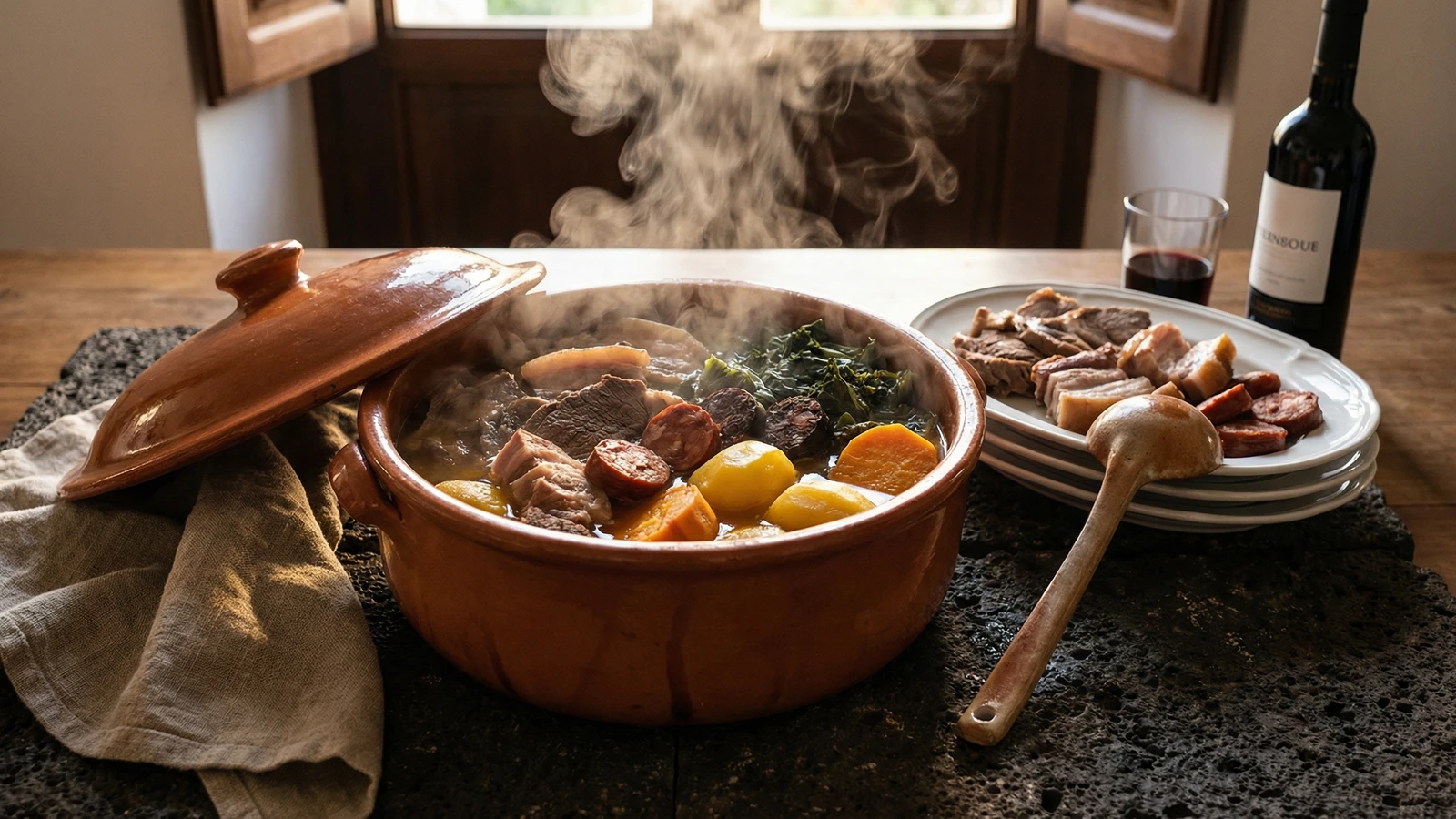
The legendary stew of São Miguel island, buried at dawn in volcanic earth and unearthed hours later, tender and transformed. The only dish in Portugal where the cook is the planet itself.
There's a place in the Azores where the earth breathes. Steam rises from the ground. Sulfur hangs in the air. And every morning, cooks carry heavy pots down to the caldeiras of Furnas and bury them in holes where the volcanic heat reaches 100 degrees celsius. They walk away. They come back hours later. And the earth has cooked their dinner.
I first saw this when I traveled to São Miguel to document the recipes of the Azorean grandmothers. Dona Celeste, 82 years old, led me down to the fumaroles at six in the morning, her pot wrapped in burlap and tied with rope. She buried it in a hole no bigger than a washing machine, covered it with volcanic soil, and marked the spot with a stick. "Volto às duas," she said. I'll be back at two. Eight hours. That's how long the earth needs.
What comes out of that hole is unlike any stew I've tasted anywhere in Portugal. The meats fall apart. The vegetables have absorbed every flavor. There's a faint mineral quality, something almost smoky, that you can't replicate any other way. It's the taste of the island itself.
You can't bury a pot in volcanic steam at home. I know. But you can honor this dish by understanding what makes it work: slow, moist, gentle heat that transforms tough cuts and humble vegetables into something extraordinary. A heavy pot. A very low oven. Patience. That's your volcano. It won't taste exactly the same. Nothing could. But it will taste like the Azores, like memory, like somewhere you've never been but somehow remember.
Cozido das Furnas has been cooked in the volcanic caldeiras of São Miguel island since at least the 16th century, when Portuguese settlers discovered the fumaroles could reach cooking temperatures. The tradition nearly died in the mid-20th century but was revived as both local heritage and tourist attraction. Today, the Furnas lakeside caldeiras hold dozens of buried pots each morning, each marked with the restaurant or family name, creating a communal cooking ground unlike anywhere else on earth.
Quantity
500g
bone-in
Quantity
500g
Quantity
400g
skin on
Quantity
300g
Quantity
4
bone-in, skin-on
Quantity
2 (about 200g each)
Quantity
2 (about 150g each)
Quantity
1 (about 150g)
Quantity
800g
peeled and halved
Quantity
400g
peeled and quartered
Quantity
400g
peeled and quartered
Quantity
4 medium
peeled, cut into large chunks
Quantity
2 medium
peeled and quartered
Quantity
1 small
quartered through the core
Quantity
300g
ribs removed, leaves whole
Quantity
1 large
quartered
Quantity
6
smashed
Quantity
4
Quantity
1 tablespoon
Quantity
1 teaspoon
Quantity
2 cups
Quantity
to cover
| Ingredient | Quantity |
|---|---|
| beef shankbone-in | 500g |
| beef short ribs | 500g |
| pork bellyskin on | 400g |
| pork spare ribs | 300g |
| chicken thighsbone-in, skin-on | 4 |
| chouriço de carne | 2 (about 200g each) |
| morcela (blood sausage) | 2 (about 150g each) |
| farinheira (flour sausage) | 1 (about 150g) |
| waxy potatoespeeled and halved | 800g |
| sweet potatoespeeled and quartered | 400g |
| inhame or taro rootpeeled and quartered | 400g |
| carrotspeeled, cut into large chunks | 4 medium |
| turnipspeeled and quartered | 2 medium |
| green cabbagequartered through the core | 1 small |
| couve galega or kaleribs removed, leaves whole | 300g |
| onionquartered | 1 large |
| garlic clovessmashed | 6 |
| bay leaves | 4 |
| coarse sea salt | 1 tablespoon |
| black peppercorns | 1 teaspoon |
| dry white wine | 2 cups |
| water | to cover |
Choose your largest, heaviest pot with a tight-fitting lid. A 10-liter stockpot or large Dutch oven is ideal. The layering matters. Start with the beef shank and short ribs at the bottom. These need the longest cooking and the most heat. Add the pork belly and spare ribs on top of the beef. Season this layer with half the salt, half the peppercorns, the bay leaves, smashed garlic, and quartered onion. Nestle the chicken thighs on top of the pork. The meats should be packed reasonably tight.
Pierce the chouriço, morcela, and farinheira with a fork in a few places so they don't burst during cooking. Tuck them around and between the meats. Now add the heartiest vegetables: the regular potatoes, sweet potatoes, inhame, carrots, and turnips. Push them into any gaps. These vegetables will drink the broth and the rendered fat, becoming impossibly silky.
Place the cabbage quarters on top, cut-side down. Drape the kale leaves over everything like a blanket. These go last because they cook fastest. Sprinkle the remaining salt and peppercorns over the top.
Pour the white wine over everything, then add enough water to come about two-thirds up the contents. Don't submerge the cabbage and kale. You want steam to do the work, not a full boil. Cover with a layer of parchment paper pressed directly onto the surface, then seal the pot with its lid. If the lid doesn't seal perfectly, wrap the entire lid-to-pot junction with aluminum foil to trap every bit of steam.
Place the pot in a cold oven. Set the temperature to 120°C (250°F). Walk away. This is important. You're simulating volcanic heat: constant, gentle, patient. Let it cook undisturbed for 6 hours minimum. In Furnas, the pots stay buried for 7 to 8 hours. Time is your volcano now. Do not open the pot. Do not check. Do not worry. Trust the process.
After 6 hours, turn off the oven but leave the pot inside for another 30 minutes. This resting period lets everything settle. Then, carefully remove the pot and take it directly to the table if you can. The unveiling is part of the ritual. Remove the lid at the table so everyone can witness the steam and smell the extraordinary perfume that's been building for hours.
Traditionally, the meats and vegetables are served on separate platters so each person can choose what they want. Use a slotted spoon to transfer the vegetables to one large platter. Arrange the different meats on another. Slice the sausages on a cutting board at the table. Ladle the cooking broth into a gravy boat. Every element is served together but distinctly, honoring each ingredient's contribution to the whole.
1 serving (about 600g)
Culinary guides, cultural storytelling, and the editorial depth that makes cooking meaningful.
Discover Culinary ExplorerChef Margarida
The slow-braised beef of Terceira island, where wine and warm spices transform humble cuts into something sacred. This is festival food, gathering food, the dish that brings the Azorean diaspora home.

Chef Juliette
John Dory has the delicacy of sole and the firmness of turbot. A light flouring, a quick butter sauté, and nut-brown beurre noisette show exactly why looks never mattered.

Chef Juliette
Fresh haddock proves its delicacy in the meunière pan: a fine flour crust, moist pearly flakes, and beurre noisette sharpened with lemon and parsley, ready from one skillet in half an hour.

Chef Juliette
Éperlans à l’Anglaise turns small fish into a lesson in disciplined coating: boned smelts under a close, crisp crumb, pan-fried in clarified butter and finished with bright, half-melted maître d’hôtel butter.