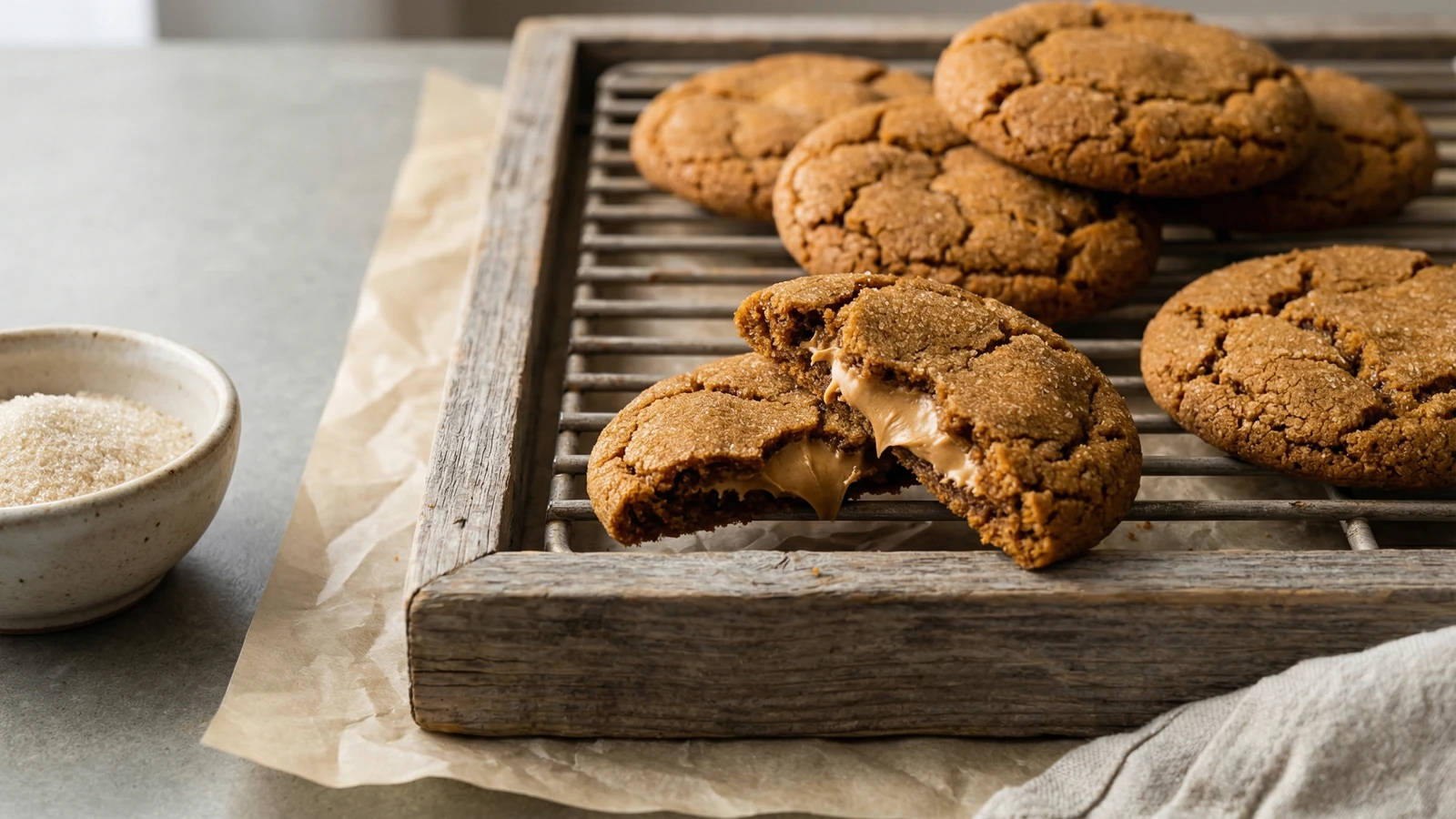
Shatteringly crisp ginger cookies hiding molten pockets of speculoos spread, where Old World spice meets modern indulgence in every crackled, sugar-dusted bite.
Pastries & Cookies
American
Make Ahead
Holiday
30 min
Active Time
14 min cook•3 hr total
Yield24 cookies
The gingersnap arrived in America with German and Dutch immigrants who understood that aggressive spicing and a proper snap distinguished a cookie worth eating from one merely worth having. These cookies broke audibly. They meant business. Somewhere along the way, we forgot that.
This recipe remembers. The exterior shatters when you bite through, giving way to a warm, creamy center of cookie butter that tastes like caramelized gingerbread. It's spice on spice, a conversation between the sharp heat of fresh ginger and the mellow sweetness of speculoos. The textural contrast alone justifies the extra step of freezing those cookie butter centers.
Biscoff spread, that Belgian import Americans discovered and promptly went mad for, contains the same warm spices as a proper gingersnap. Hiding it inside one creates a flavor echo chamber. The molasses in your dough calls to the caramelized cookies ground into that spread. They recognize each other.
I've taught this technique to home bakers convinced stuffed cookies require professional training. They don't. Freeze your filling solid, work with cold dough, and trust the process. The cookies do the rest.
The technique, the tradition, and the story behind every dish.
Line a small baking sheet with parchment paper. Using a teaspoon measure, scoop 24 rounded teaspoons of cookie butter onto the parchment, spacing them apart. Freeze until completely solid, at least 2 hours or overnight. These need to be frozen hard as marbles, or they'll ooze out during baking.
Stir the cookie butter well before portioning. The oils can separate, and you want consistent centers.
2
Combine the dry ingredients
Whisk together the flour, ginger, cinnamon, cloves, black pepper, baking soda, and salt in a medium bowl. The pepper isn't detectable as heat in the finished cookie, but it amplifies the ginger and adds complexity. Don't skip it.
3
Cream butter and sugar
In a large bowl with an electric mixer, beat the softened butter and brown sugar on medium-high speed until light and fluffy, about 3 minutes. Scrape down the sides halfway through. The mixture should look pale and creamy, almost mousse-like. This is where your texture is built.
4
Add wet ingredients
Add the molasses, egg, and vanilla to the butter mixture. Beat on medium speed until fully incorporated, about 1 minute. The batter will look slightly curdled and glossy from the molasses. This is correct. Don't panic.
5
Build the dough
Add the dry ingredients to the wet ingredients in two additions, mixing on low speed just until no flour streaks remain. The dough will be soft and sticky. Resist the urge to add more flour. Wrap tightly in plastic and refrigerate for at least 1 hour or until firm enough to handle.
Overnight chilling develops flavor and makes the dough much easier to work with. Plan ahead if you can.
6
Assemble the cookies
Remove the dough from the refrigerator and the cookie butter balls from the freezer. Work quickly. Portion the dough into 24 pieces, roughly 2 tablespoons each. Flatten a piece of dough in your palm, place a frozen cookie butter ball in the center, and wrap the dough completely around it, sealing any cracks. Roll between your palms to form a smooth ball. The filling should be entirely hidden.
7
Roll in sugar
Pour the granulated sugar into a shallow bowl. Roll each assembled ball in the sugar until completely coated, then place on parchment-lined baking sheets, spacing 3 inches apart. These spread considerably. Twelve cookies per standard sheet is the maximum. Refrigerate the assembled cookies for 15 minutes while the oven heats.
8
Bake until crackled
Preheat your oven to 350°F (175°C). Bake one sheet at a time on the center rack for 12 to 14 minutes. The cookies will puff dramatically, then collapse and crack across the surface. The edges should look set and matte while the centers still appear slightly underdone. They'll firm as they cool. Pull them early rather than late.
9
Cool completely
Let the cookies rest on the baking sheet for 5 full minutes. They're too fragile to move before this. Transfer to a wire rack to cool completely. The snap develops as they cool. Eaten warm, you get soft cookies with molten centers. Eaten cooled, you get the proper shatter and the creamy filling. Both are valid. The choice is yours.
Chef Tips
•Use creamy Biscoff spread, not the crunchy variety. The crunchy version contains cookie pieces that interfere with freezing and create weak spots where filling can leak.
•Fresh spices matter enormously here. If your ground ginger has been in the pantry for two years, it tastes like cardboard. Buy new. The investment is minimal and the difference is immediate.
•For extra-crackled tops, remove the cookies from the oven when they still look slightly raw in the center. They'll continue cooking on the hot sheet and develop more dramatic fissures.
•These cookies travel beautifully for gifting. Layer between parchment in a tin. They keep their snap for 5 days at room temperature if stored airtight.
Advance Preparation
•Cookie butter balls can be frozen up to 2 weeks ahead. Keep frozen until ready to assemble.
•Dough can be refrigerated for up to 3 days, improving in flavor and workability.
•Assembled, unbaked cookies can be frozen on a sheet, then transferred to a freezer bag for up to 2 months. Bake directly from frozen, adding 2 minutes to the bake time.
•Baked cookies keep at room temperature in an airtight container for up to 5 days. Do not refrigerate, as moisture softens the snap.
Frequently Asked Questions
Nutrition Information
1 serving (about 47g)
Calories
295 calories
Total Fat
9 g
Saturated Fat
6 g
Trans Fat
0 g
Unsaturated Fat
3 g
Cholesterol
12 mg
Sodium
130 mg
Total Carbohydrates
30 g
Dietary Fiber
1 g
Sugars
19 g
Protein
2 g
Where cooking meets culture.
Culinary guides, cultural storytelling, and the editorial depth that makes cooking meaningful.