Culinary Explorer

A cooking platform built around craft, culture, and the stories behind what we eat.
Discover Culinary Explorer
Coda alla Vaccinara

Coda alla Vaccinara

Created by

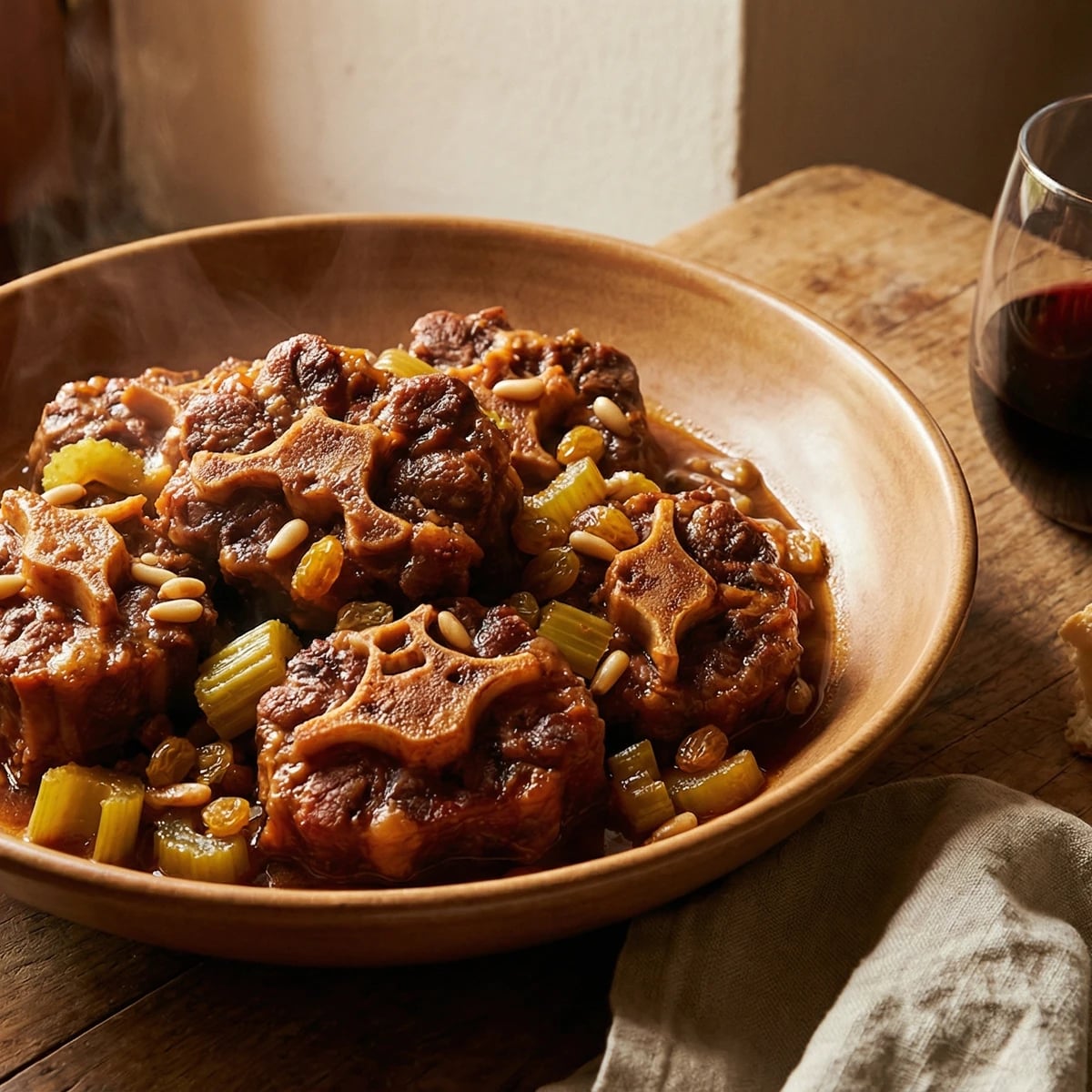
The great oxtail stew of Rome, born in the slaughterhouses of Testaccio, where workers transformed the fifth quarter into one of Italy's most profound braises. Celery, pine nuts, and raisins cut the richness.

Soups & Stews
Italian, Roman
Make Ahead
Special Occasion
Comfort Food
45 min
Active Time
4 hr cook4 hr 45 min total
Yield6 servings

This is poor food. I mean this as the highest compliment Italian cooking can receive. The vaccinari, the slaughterhouse workers of Rome's Testaccio district, received the quinto quarto as partial payment for their labor: the fifth quarter of the animal, everything the wealthy did not want. Head, tripe, feet, tail. From this they made dishes that nobility would later beg to eat.

Coda alla vaccinara requires nothing expensive and everything patient. The oxtail gives its collagen to the braising liquid over hours, creating a sauce that clings and coats. The surprise is the celery, and there must be a great deal of it. This is not garnish. The celery is the point, braised until it melts against the meat. Pine nuts and raisins add the sweet-savory notes that Romans have favored since ancient times.

The cocoa powder will seem strange until you taste what it does. It deepens the color and adds a bitter complexity that balances the richness without any trace of chocolate flavor. The Romans understood this centuries ago. Trust them.

Coda alla vaccinara originated in Rome's Testaccio district, where the city's central slaughterhouse operated from 1891 until 1975. The vaccinari, butchers and slaughterhouse workers, received the 'fifth quarter' of each animal as part of their wages, the offal and extremities that wealthy Romans rejected. From this constraint came genius: oxtail braised for hours with an abundance of celery, the vegetable that grew cheap and plentiful in Roman gardens.

The technique, the tradition, and the story behind every dish.

Discover Culinary Explorer

Ingredients

oxtail

Quantity

4 pounds

cut into 2-inch segments

extra virgin olive oil

Quantity

1/4 cup

yellow onion

Quantity

1 medium

diced fine

carrot

Quantity

1 medium

peeled and diced fine

celery stalks

Quantity

2

diced fine, for soffritto

guanciale or pancetta

Quantity

4 ounces

diced

dry white wine

Quantity

1 cup

San Marzano tomatoes

Quantity

1 can (28 ounces)

crushed by hand

beef broth

Quantity

2 cups

whole cloves

Quantity

2

cinnamon stick

Quantity

1

kosher salt

Quantity

to taste

black pepper

Quantity

to taste

freshly ground

celery

Quantity

1 large bunch (about 1 1/2 pounds)

for finishing

pine nuts

Quantity

1/3 cup

golden raisins

Quantity

1/3 cup

unsweetened cocoa powder

Quantity

2 tablespoons

Equipment Needed

  • Heavy 7-quart Dutch oven with lid
  • Large pot for blanching celery
  • Tongs for turning oxtail

Instructions

  1. 1

    Prepare the oxtail

    Pat the oxtail pieces thoroughly dry with paper towels. Season generously with salt and pepper on all sides. The meat must be dry or it will steam instead of brown, and you will have robbed yourself of the foundation of this dish. Set aside while you prepare the vegetables.

  2. 2

    Brown the meat

    In a heavy Dutch oven, heat the olive oil over medium-high heat until it shimmers but does not smoke. Brown the oxtail in batches, turning to color all sides deeply. This takes 4 to 5 minutes per batch. Do not crowd the pot. Transfer the browned pieces to a plate. The fond on the bottom of the pot is gold. Do not scrape it away.

    If the fat begins to smoke or the fond turns black, reduce the heat. Burnt fond makes bitter sauce. Dark brown is correct; black is ruined.
  3. 3

    Build the soffritto

    Pour off all but two tablespoons of fat from the pot. Reduce heat to medium. Add the guanciale and cook until the fat renders and the meat begins to crisp at the edges, about 5 minutes. Add the onion, carrot, and the two diced celery stalks. Cook slowly, stirring occasionally, until the vegetables are completely soft and the onion is golden, about 15 minutes. One can often trace the unsatisfying taste of would-be Italian dishes to the reluctance of cooks to execute this step thoroughly.

  4. 4

    Deglaze and add liquids

    Pour in the white wine and scrape up every bit of fond from the bottom of the pot. Let the wine simmer until it has reduced by half and the raw alcohol smell has vanished. Add the crushed tomatoes, beef broth, cloves, and cinnamon stick. Stir to combine.

  5. 5

    Braise the oxtail

    Return the oxtail and any accumulated juices to the pot. The liquid should come about two-thirds up the sides of the meat. Bring to a gentle simmer, then cover with the lid slightly ajar and reduce heat to the lowest setting. The sauce should bubble lazily, with only an occasional blip breaking the surface. Braise for 3 hours, turning the pieces every 45 minutes.

    If your stovetop runs hot, use a heat diffuser or transfer the pot to a 300°F oven. The braise must be gentle. Aggressive boiling toughens the meat.
  6. 6

    Prepare the finishing celery

    While the oxtail braises, prepare the celery for the finish. This is the signature of coda alla vaccinara: an abundance of celery that surprises those who do not know the dish. Remove and discard the tough outer stalks. Cut the remaining stalks into 2-inch lengths. Blanch in boiling salted water for 3 minutes, then drain and set aside.

  7. 7

    Toast the pine nuts

    In a dry skillet over medium-low heat, toast the pine nuts, stirring constantly, until golden in spots, 2 to 3 minutes. Pine nuts burn in an instant. Watch them. The moment they are done, transfer them to a plate to stop the cooking.

  8. 8

    Finish the braise

    After 3 hours, the meat should be tender but not yet falling from the bone. Add the blanched celery, pine nuts, raisins, and cocoa powder. Stir gently to distribute. Continue braising, uncovered now to reduce the sauce, for another 45 minutes to 1 hour. The celery should become very tender, and the sauce should thicken to coat a spoon.

    The cocoa powder is traditional. It adds depth and color without chocolate flavor. Trust this. The Romans have been doing it for generations.
  9. 9

    Rest and serve

    Remove the cloves and cinnamon stick. Taste and adjust salt and pepper. Let the stew rest for 15 minutes off heat. The sauce will settle and the flavors will bind. Serve in warm shallow bowls, ensuring each portion receives oxtail, celery, and plenty of sauce. Crusty bread is not optional. Someone must eat the marrow from the bones.

Chef Tips

  • Ask your butcher to cut the oxtail into segments at the joints. The pieces should be roughly equal in size so they cook evenly. Avoid very thin tail-end pieces, which will overcook before the larger segments are tender.
  • Guanciale is the correct cured pork for Roman cooking. It comes from the jowl and has a different flavor than pancetta, which comes from the belly. Seek out guanciale if you want authenticity. Pancetta is an acceptable substitute.
  • The stew improves dramatically overnight. The fat solidifies on top and can be lifted away. The flavors deepen and marry. Make this the day before you intend to serve it.

Advance Preparation

  • The complete stew can be made two days ahead and refrigerated. Remove the solidified fat from the surface before reheating. Warm gently over low heat, adding a splash of water if the sauce has thickened too much.
  • The oxtail can be browned and the soffritto prepared a day ahead. Refrigerate separately and continue with the braising the next day.

Frequently Asked Questions

Nutrition Information

1 serving (about 350g)

Calories
720 calories
Total Fat
45 g
Saturated Fat
13 g
Trans Fat
0 g
Unsaturated Fat
30 g
Cholesterol
150 mg
Sodium
800 mg
Total Carbohydrates
22 g
Dietary Fiber
5 g
Sugars
12 g
Protein
52 g

Note: Chef personas and recipes are created with AI assistance. Cook with care: follow safe food-handling practices, check doneness with a thermometer when needed, and adapt for allergies and your kitchen.

Where cooking meets culture.

Culinary guides, cultural storytelling, and the editorial depth that makes cooking meaningful.

Discover Culinary Explorer

More from Chef Graziella's Soups and Stews

Browse the full collection