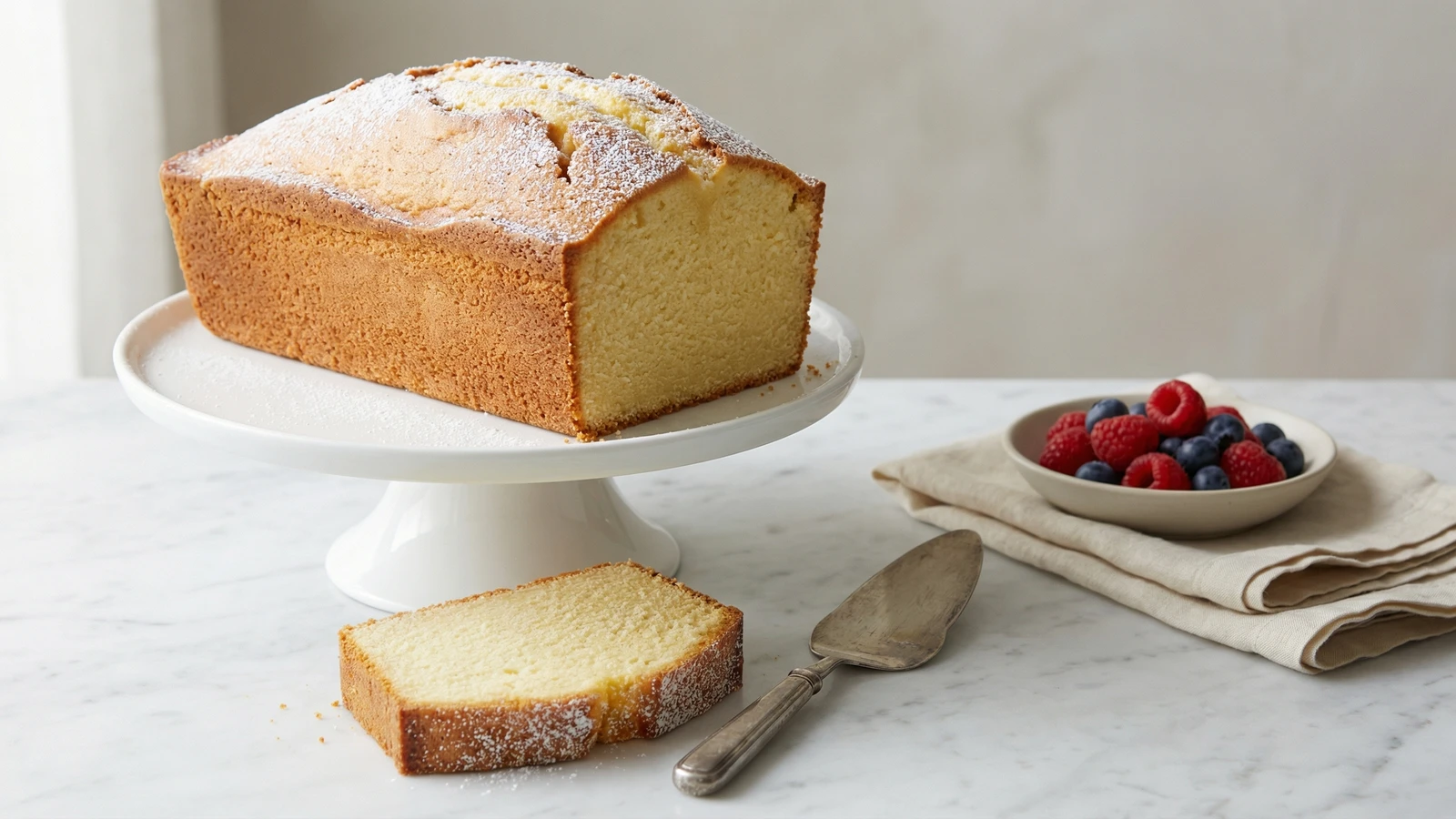
A golden-crusted monument to butter and simplicity, with a fine, tight crumb that slices cleanly and a richness that needs no adornment. The cake your grandmother made, assuming she knew what she was doing.
Desserts
American
Make Ahead
Potluck
20 min
Active Time
1 hr 15 min cook•1 hr 35 min total
Yield12 servings
The pound cake predates America itself. English bakers created it as a memory device: one pound butter, one pound sugar, one pound eggs, one pound flour. No measuring cups required. Just a scale and common sense. Colonial cooks brought the recipe across the Atlantic, where it became the foundation of Southern hospitality.
This version respects tradition while acknowledging modern kitchens. Sour cream replaces some of the original butter's heft, adding moisture and a subtle tang that keeps the crumb tender without sacrificing that characteristic density. The result is a cake that slices cleanly, toasts beautifully, and improves for days in an airtight container.
I've watched home cooks approach pound cake with unnecessary fear. They shouldn't. The technique is forgiving once you understand the principles. Room temperature ingredients emulsify properly. Extended creaming builds structure. Low oven temperature allows the center to set before the crust burns. Master these three ideas and you'll produce a cake worthy of any occasion.
Serve it plain with afternoon coffee. Toast thick slices and top with macerated berries. Layer it into trifle. Pound cake asks only to be made and shared. The rest is up to you.
The technique, the tradition, and the story behind every dish.
Position a rack in the lower third of your oven and preheat to 325°F. This low, slow approach is essential for pound cake. Higher heat creates a dome and a tough crust before the interior sets. Generously butter a 10-inch tube pan or 12-cup Bundt pan, getting into every crevice with soft butter on your fingers. Dust with flour, tap out the excess, and set aside.
A tube pan with a removable bottom makes unmolding foolproof. If using a decorative Bundt, consider a baking spray with flour for insurance in the intricate grooves.
2
Cream butter and sugar thoroughly
Place the softened butter in the bowl of a stand mixer fitted with the paddle attachment. Beat on medium speed for two minutes until smooth and creamy. Add the sugar gradually, about half a cup at a time, beating well after each addition. Once all the sugar is incorporated, increase speed to medium-high and beat for a full five minutes. The mixture should be nearly white, impossibly fluffy, and increased significantly in volume. Scrape down the sides twice during this process.
This extended creaming is not optional. You are beating air into the butter, and that air is the primary leavening for pound cake. Skimp on time here and you'll produce a dense brick.
3
Add eggs one at a time
With the mixer on medium speed, add the eggs one at a time, beating for thirty seconds after each addition. The batter may look slightly curdled after the first few eggs. Don't panic. Continue adding eggs and the emulsion will come together. After the final egg, beat for another minute until the mixture is smooth and satiny. Add the vanilla extract and beat briefly to incorporate.
4
Combine dry ingredients
Whisk together the flour, salt, and baking soda in a medium bowl. This small amount of baking soda reacts with the sour cream's acidity, providing a gentle lift that keeps the crumb tender without making the cake cakey. True pound cake walks a tightrope between density and delicacy.
5
Alternate flour and sour cream
Reduce mixer speed to low. Add the flour mixture in three additions, alternating with the sour cream in two additions, beginning and ending with flour. Mix only until each addition just disappears. The batter will be thick, glossy, and incredibly smooth. Stop the mixer the moment you no longer see streaks of flour. Overmixing develops gluten and toughens the crumb.
The sour cream adds moisture and tenderness while its fat content enriches the crumb. Full-fat Greek yogurt works as a substitute, though purists may object.
6
Fill pan and smooth top
Scrape the batter into your prepared pan using a large rubber spatula. Spread evenly and smooth the top. Run a knife through the batter in a zigzag pattern to release any large air pockets that might create tunnels. Tap the pan firmly on the counter three times. This settles the batter and eliminates hidden air bubbles that mar the finished cake.
7
Bake low and slow
Bake for 1 hour and 15 minutes to 1 hour and 25 minutes. The cake is done when the top is deeply golden, the surface springs back when gently pressed, and a wooden skewer inserted in the center emerges with just a few moist crumbs clinging to it. Do not open the oven door during the first hour. Temperature fluctuations can cause the cake to fall.
Every oven lies. Start checking at 1 hour and 10 minutes. A slight crack along the top is traditional and indicates proper rise.
8
Cool completely before unmolding
Let the cake cool in the pan on a wire rack for fifteen minutes. The structure needs time to set. Run a thin knife around the edges and the center tube, then invert onto the rack. If using a Bundt pan, tap the bottom firmly and lift away. Let the cake cool completely, at least two hours, before slicing. Pound cake improves overnight as the flavors meld and the crumb tightens.
Chef Tips
•Room temperature ingredients are non-negotiable. Cold eggs will curdle the batter and cold butter won't cream properly. Set everything out two hours before you begin, or warm eggs in a bowl of lukewarm water for ten minutes.
•Invest in a quality vanilla extract. Imitation vanilla turns bitter when baked at length. Pure extract from Madagascar or Tahitian beans makes a noticeable difference in a cake this simple.
•The crack on top is a badge of honor, not a flaw. It forms as steam escapes from the dense batter, indicating proper rise. Some bakers brush it with butter while still warm for a glossy finish.
•Pound cake freezes magnificently. Wrap the cooled cake tightly in plastic, then foil, and freeze for up to three months. Thaw overnight at room temperature before serving.
•For a citrus variation, add the finely grated zest of two lemons or one orange to the butter during creaming. The oils release into the fat, perfuming every bite.
Advance Preparation
•Pound cake tastes better the day after baking. The crumb tightens and flavors deepen as it rests wrapped at room temperature.
•Keeps beautifully at room temperature, wrapped in plastic, for up to five days. Refrigeration dries the crumb and mutes the butter flavor.
•Slices can be toasted under a broiler or in a cast iron pan with butter to revive day-old cake. The caramelized edges are worth the extra step.
Frequently Asked Questions
Nutrition Information
1 serving (about 106g)
Calories
690 calories
Total Fat
41 g
Saturated Fat
25 g
Trans Fat
0 g
Unsaturated Fat
15 g
Cholesterol
230 mg
Sodium
660 mg
Total Carbohydrates
74 g
Dietary Fiber
1 g
Sugars
51 g
Protein
7 g
Where cooking meets culture.
Culinary guides, cultural storytelling, and the editorial depth that makes cooking meaningful.