Culinary Explorer

A cooking platform built around craft, culture, and the stories behind what we eat.
Discover Culinary Explorer
Chocolate-Dipped Florentines

Chocolate-Dipped Florentines

Created by Chef Thomas

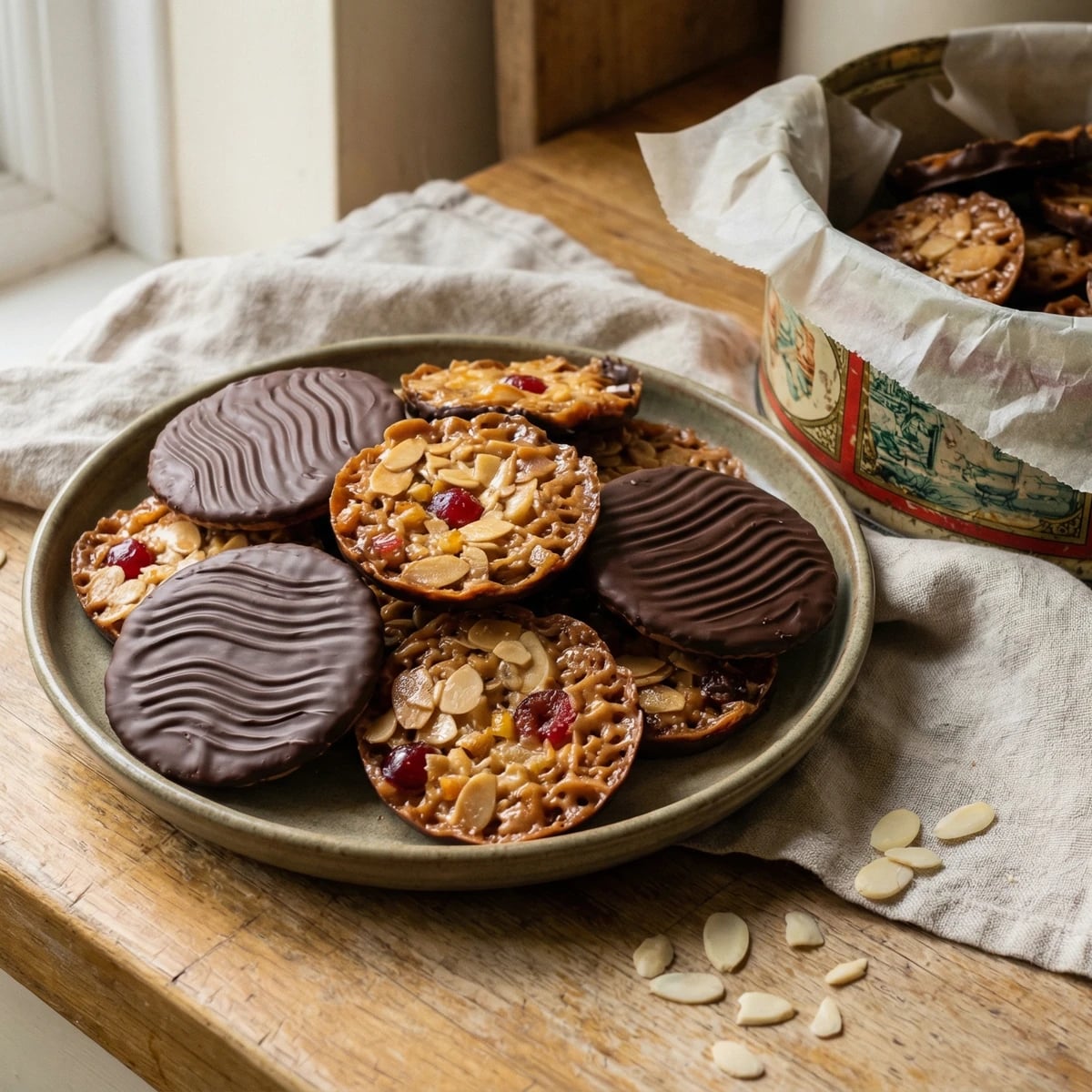
Lace-thin biscuits crisp with caramel, almonds and candied fruit, backed with dark chocolate combed into wavy lines. The Christmas tin biscuit that looks like trouble and isn't.

Pastries & Cookies
British
Christmas
Holiday
20 min
Active Time
15 min cook•35 min total
YieldAbout 18 biscuits

December does something to the kitchen. The light goes early, the windows steam up by four o'clock, and there's a quiet pull to make things you wouldn't bother with the rest of the year. Florentines belong to that moment. They're a Christmas biscuit and only a Christmas biscuit, and there's no good reason for that except habit, which is reason enough.

They look like they ought to be difficult. The bakery window kind, all neat circles and combed chocolate, give the impression of something fiddly and professional. They're not. You melt butter and syrup in a pan, stir in some almonds and chopped fruit, and let the oven turn the whole thing into a lace biscuit. The chocolate goes on at the end. It's the sort of recipe that takes longer to read than to make.

The candied peel matters. Buy the good stuff, the proper chunks in syrup from a deli or a decent supermarket, not the gritty plastic tubs of mixed peel that taste of nothing. Same goes for the cherries. You want fruit you'd happily eat on its own. A florentine is mostly the things you put in it, so what you put in it had better be worth tasting.

I make a batch every year, somewhere between the carols and the cards, and pack them into an old tin lined with greaseproof. Half get given away. The other half disappear before Christmas Eve. I wrote it down in the notebook once: almonds, cherries, peel, December. Some things only need that much explanation.

The technique, the tradition, and the story behind every dish.

Discover Culinary Explorer

Ingredients

unsalted butter

Quantity

50g

golden caster sugar

Quantity

50g

golden syrup

Quantity

50g

plain flour

Quantity

50g

sifted

flaked almonds

Quantity

75g

good mixed candied peel

Quantity

50g

finely chopped

glacé cherries

Quantity

50g

finely chopped

double cream

Quantity

1 tablespoon

dark chocolate

Quantity

200g (around 70% cocoa solids)

broken into pieces

Equipment Needed

  • •Two large baking trays
  • •Baking parchment
  • •Small heavy-bottomed saucepan
  • •Heatproof bowl for melting chocolate
  • •Palette knife
  • •Wire cooling rack

Instructions

  1. 1

    Heat the oven

    Set the oven to 180C/160C fan. Line two large baking trays with baking parchment. Don't skimp on the parchment. Caramel and metal are not friends, and you'll want the biscuits to lift away cleanly when they've cooled.

    Chop the peel and cherries smaller than feels right. Big lumps make the biscuits hard to spread and harder to eat. You want flecks of colour through the lace, not boulders.
  2. 2

    Melt the caramel base

    Put the butter, sugar and golden syrup in a small heavy pan over a low heat. Stir gently as it melts. When the butter has dissolved into the syrup and the whole thing looks glossy and smooth, take it off the heat. You're not making toffee. No bubbling, no colour change. Just melted, just combined.

  3. 3

    Fold in the rest

    Tip in the flour, almonds, candied peel, cherries and cream. Stir until everything is coated in the buttery syrup and the mixture clings together in a sticky, fruited heap. It will look like not nearly enough. It is enough. Florentines spread enormously in the oven, which is the whole point.

  4. 4

    Spoon onto trays

    Drop heaped teaspoons of the mixture onto the lined trays, leaving plenty of space between each one. At least eight centimetres. They will spread into thin, lacy discs and any closer and you'll end up with one giant florentine, which is its own kind of disaster. Six or seven per tray is plenty.

    If you want them properly round, take them out halfway through baking and nudge the edges in with the back of a teaspoon. I rarely bother. Slightly wonky biscuits look like someone made them, which is the truth.
  5. 5

    Bake until golden and lacy

    Bake for ten to twelve minutes. You're looking for a deep, even gold across the whole biscuit, with the edges a shade darker than the middle. The kitchen will start to smell of toffee and toasted almonds, which is one of the better smells December has to offer. If they're still pale in the centre, give them another minute. Pale florentines are sad florentines.

  6. 6

    Cool on the tray

    Leave the biscuits on the trays for a few minutes to firm up. They come out of the oven soft and bendy and need that pause to set into something you can lift. Once they hold their shape, transfer them carefully to a wire rack with a palette knife and let them cool completely. They should be flat, brittle, and the colour of dark honey.

  7. 7

    Melt the chocolate

    Melt the chocolate in a heatproof bowl set over a pan of barely simmering water, stirring now and then until smooth and glossy. Take it off the heat before the last few pieces have melted and let the residual warmth finish the job. Overheated chocolate goes thick and grainy, and you can't talk it back.

    If you know how to temper chocolate, do. The biscuits will set with a proper snap and a glossy finish. If you don't, don't worry. Untempered chocolate works beautifully here, it just needs the fridge to set firm.
  8. 8

    Coat the flat side

    Turn the cooled florentines upside down so the flat sides face up. Spoon a generous teaspoon of melted chocolate onto each one and spread it to the edges with the back of the spoon. Once the chocolate has started to set but is still soft, drag a fork across the surface in wavy lines. This is the bit that makes them look like florentines and not just biscuits with chocolate on. Leave to set completely, chocolate side up, before storing.

Chef Tips

  • •Spend on the chocolate and the candied peel. Florentines are not a place for compromises. Three or four ingredients are doing all the work, and any one of them being mediocre will pull the whole biscuit down. Good dark chocolate, proper candied orange or lemon peel, and almonds that smell of almonds when you open the bag.
  • •Store them in a tin between layers of baking parchment, somewhere cool but not the fridge. They'll keep for a good week if hidden well. The chocolate can bloom slightly in cold storage, which is harmless but looks tired. A cool cupboard is kinder.
  • •If you want to make them feel a little less traditional, swap a third of the almonds for finely chopped pistachios. The colour against the dark chocolate is rather lovely, and the slight sweetness of pistachios sits well with the candied peel. Not a rule. Just a thought.

Advance Preparation

  • •Florentines keep beautifully in an airtight tin for up to a week, layered between sheets of baking parchment to stop the chocolate sticking.
  • •The biscuits themselves can be baked a day ahead and the chocolate added the following morning. Store the bare biscuits in an airtight container so they stay crisp.
  • •They freeze well, undipped, for up to a month. Defrost at room temperature for an hour before coating with chocolate.

Frequently Asked Questions

Nutrition Information

1 serving (about 30g)

Calories
160 calories
Total Fat
10 g
Saturated Fat
4 g
Trans Fat
0 g
Unsaturated Fat
5 g
Cholesterol
7 mg
Sodium
8 mg
Total Carbohydrates
18 g
Dietary Fiber
2 g
Sugars
12 g
Protein
2 g

Note: Chef personas and recipes are created with AI assistance. Cook with care: follow safe food-handling practices and adapt for allergies and your kitchen.

Chef Thomas is a fictional culinary guide to British Seasonal Home Cooking, written with the assistance of AI.

Where cooking meets culture.

Culinary guides, cultural storytelling, and the editorial depth that makes cooking meaningful.

Discover Culinary Explorer

More from British Biscuits & Scones

Browse the full collection