
Chef Lupita
Agua de Alfalfa
Ciudad de México's highland market agua fresca, fresh alfalfa blended with pineapple and lime until bright green, strained clean, and poured cold from the vitrolero.
A cooking platform built around craft, culture, and the stories behind what we eat.
Created by
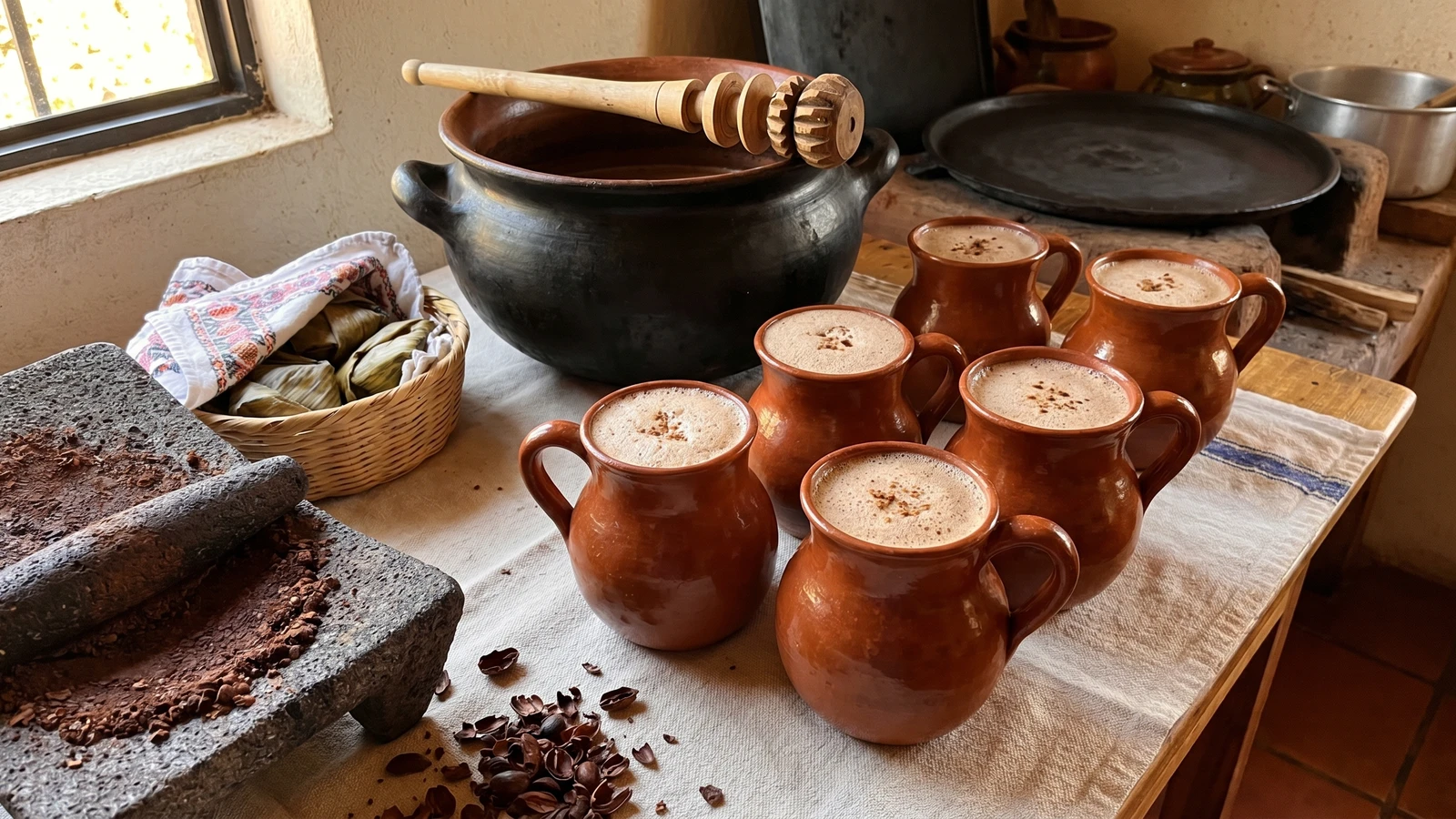
Michoacán's P'urhépecha chocolate de metate, built from cacao roasted on a comal, canela, almond, and piloncillo, beaten with a molinillo until the foam rises thick in a clay jarro.
Michoacán, in the Meseta P'urhépecha and the Lago de Pátzcuaro basin, is where this chocolate belongs on the map. I learned this version around Tzintzuntzan, where red clay jarros sit beside the stove and the molinillo is not a decoration. It is the tool that gives the drink its foam.
Cacao does not grow in those cold highlands. That is not a contradiction. The beans traveled through trade, then the women on the Meseta made them their own by roasting on a comal, peeling by hand, and grinding on the metate until the fat came out and the paste shone. Si no conoces el mercado, no conoces la cocina.
This is not kamáta urápiti, the white corn atole, and it is not chaqueta, the dark Michoacán atole. Here the cacao is the body. Canela, almendra, piloncillo. No chile. No marshmallow. No powder from a packet. You beat it with a molinillo until the foam stands in the jarro. That foam is work, not decoration.
On Christmas mornings, a clay olla of chocolate on the stove can feed the house before anyone sits down properly. My mother used to say a good cup of chocolate tells you whether the cook has patience. She was right. Cada estado, su propia cocina.
The P'urhépecha state, centered at Tzintzuntzan on Lake Pátzcuaro, remained independent of Mexica rule until the Spanish entered Michoacán in the 1520s. Cacao did not grow in the cold Meseta P'urhépecha, so beans arrived through trade from warmer lowlands, while the metate and comal kept the Indigenous method of roasting and grinding intact. Sugar, canela, and almonds entered New Spanish chocolate after the 16th century, and by the 17th century household chocolate was commonly beaten with a molinillo to build the foam that Indigenous drinkers had valued long before milk entered the cup.
Quantity
7 ounces
unroasted and picked over
Quantity
1/2 cup
Quantity
1 large stick, about 4 inches
broken into pieces
Quantity
5 ounces
finely grated
Quantity
1/4 teaspoon
Quantity
1 cup
Quantity
5 cups
Quantity
for serving
| Ingredient | Quantity |
|---|---|
| fermented dried cacao beansunroasted and picked over | 7 ounces |
| almendras, blanched almonds | 1/2 cup |
| Mexican canela (Ceylon cinnamon)broken into pieces | 1 large stick, about 4 inches |
| piloncillofinely grated | 5 ounces |
| fine sea salt | 1/4 teaspoon |
| water | 1 cup |
| whole milk | 5 cups |
| corundas or pan de muerto (optional) | for serving |
Set a dry comal de barro, cast iron comal, or heavy skillet over medium-low heat. If you are cooking over leña, let the fire settle into steady embers before the cacao touches the clay. On a modern stove, keep the flame modest. The principle is the same: patient heat from below, not aggression. No me vengas con atajos.
Spread the cacao beans in one layer on the comal. Toast for 8 to 12 minutes, stirring constantly with a wooden spoon or moving them with your fingers if you know your comal well. The skins will darken, some beans will crack softly, and the smell will move from raw and dusty to deep chocolate and roasted nut. Do not blacken them. Burned cacao turns bitter and no amount of piloncillo will save it.
Transfer the toasted cacao to a clean kitchen towel and let it cool just until you can handle it. Rub firmly to loosen the papery skins, then pick through and remove the shells. Do not obsess over every speck, but do not leave handfuls of husk either. The metate wants cacao, not trash from your impatience.
Toast the almonds on the same comal for 3 to 5 minutes, stirring until they smell sweet and show pale golden spots. Toast the broken canela for 30 to 45 seconds, just until its aroma opens. Mexican canela is soft and fragrant, not the hard cassia bark sold as cinnamon in many supermarkets. Pregúntale a las señoras del mercado.
If your metate is cold, rinse it with hot water and dry it completely. Grind the cacao first, a small handful at a time, pushing with the mano until the rough crumbs turn into a dark paste. Add the toasted almonds and canela and grind again. Add the grated piloncillo and salt last. Keep working until the cacao fat comes out and the paste shines. This is the labor that gives the chocolate its body.
Divide the chocolate paste into 6 rough disks or tablets, about 2 ounces each. Press them with your palms or a small tortilla press lined with parchment. Let them rest for 15 minutes so they firm up. You can use them immediately or wrap them for later. Recetas probadas y garantizadas, but only if the paste is ground fine enough to dissolve cleanly.
In a clay olla or heavy saucepan, combine the water and the chocolate tablets over medium-low heat. Stir and press the tablets against the side of the pot until they loosen into a dark, grainy liquid. Add the whole milk and lower the heat. Warm the mixture until tiny bubbles gather at the edge and the surface trembles. Do not boil it. Boiled milk tastes cooked, and cooked milk flattens the cacao.
Set the molinillo between your palms and roll it hard in the center of the olla, lifting the carved head just enough to pull air through the chocolate. Beat for 3 to 5 minutes, until a thick beige foam gathers on top and carries tiny flecks of canela. The foam is not decoration. It is the sign that the drink was worked properly. Así se hace y punto.
Ladle the chocolate into warm clay jarros, giving each person both liquid and foam. Use Tzintzuntzan red clay, Capula glazed earthenware, or Patamban black clay if you have it. Serve with corundas for a Michoacán table, or pan de muerto when the season brings it. If the foam settles, beat the olla again. Saber cocinar es saber vivir.
1 serving (about 290g)
Culinary guides, cultural storytelling, and the editorial depth that makes cooking meaningful.
Discover Culinary ExplorerChef Lupita
Ciudad de México's highland market agua fresca, fresh alfalfa blended with pineapple and lime until bright green, strained clean, and poured cold from the vitrolero.

Chef Lupita
Aguascalientes' Lenten agua fresca, jewel-red from cooked beet and full of apple, banana, orange, lettuce, and ground peanuts, served cold when Holy Week meets the Feria de San Marcos.

Chef Lupita
Sonora and Sinaloa's creamy malted barley water, built on toasted cebada perla, Mexican canela, vanilla from Papantla, and evaporated milk. Pink-beige, rich, and served cold over heavy ice in a heavy glass tumbler. Liquid cookie comfort the northwest way.

Chef Lupita
Yucatán's everyday tonic of boiled chaya leaves blended with lima agria, sugar, and ice. The bright green jarra that sits on every Peninsula table from Mérida to Valladolid.