
Chef Lupita
Aporreadillo Michoacano con Huevo
Michoacán's Tierra Caliente almuerzo, where salted beef is softened, pounded, fried in lard, folded with egg and chile perón salsa, then served beside morisqueta like a proper working table.
A cooking platform built around craft, culture, and the stories behind what we eat.
Created by
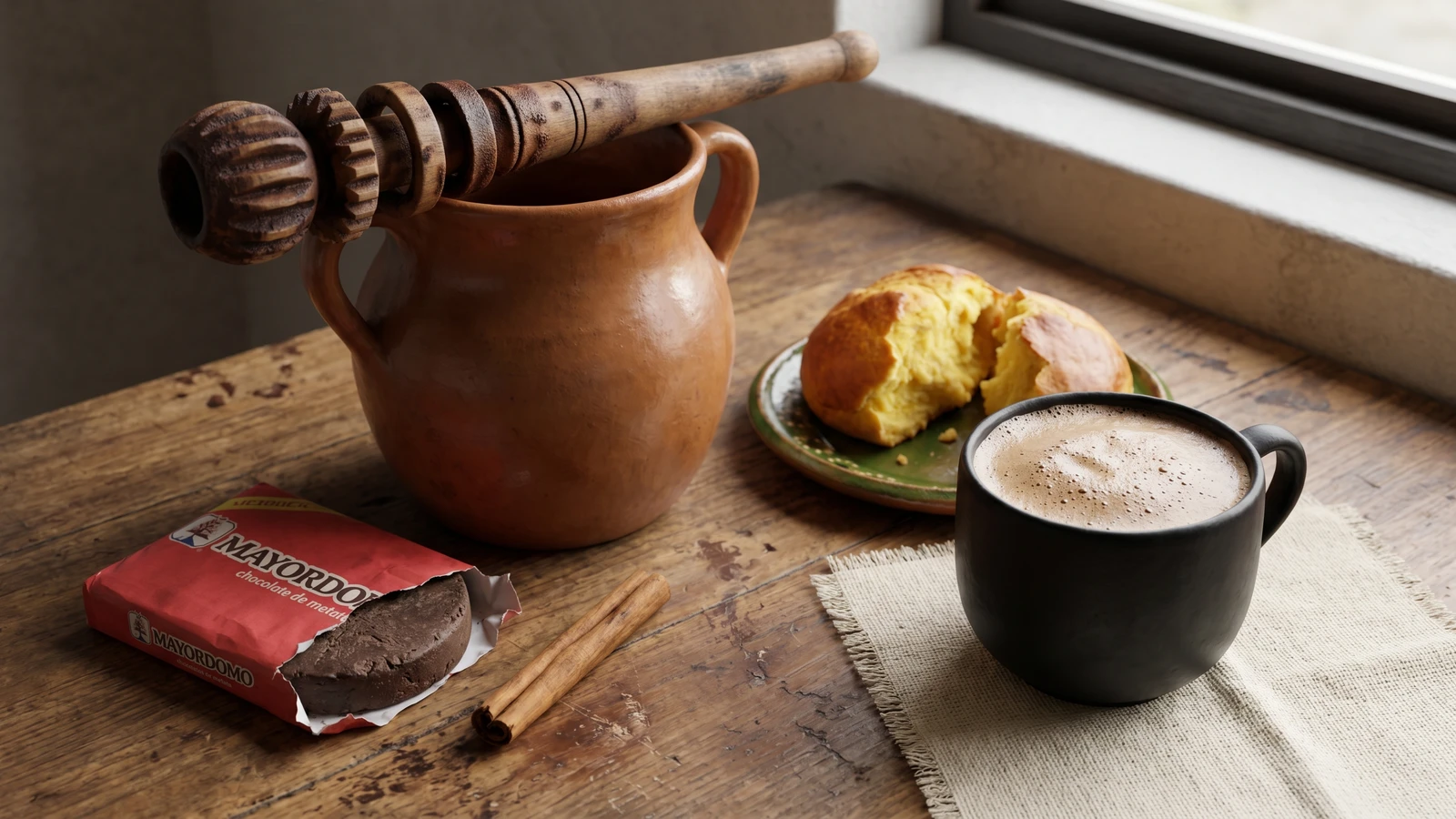
Oaxaca's morning ritual of stone-ground cacao dissolved in plain water, frothed by hand with a molinillo until the espuma rises thick and holds its shape in a jícara of barro negro.
This is Oaxaca's chocolate, and it is made with water. Not milk. Water. That distinction matters more than anything else I can tell you about this drink, because it tells you what kind of cooking tradition you are dealing with: one that trusts the ingredient to carry itself.
In the Valles Centrales, in the city of Oaxaca, in the Mercado 20 de Noviembre, the chocolate grinders have been working since before dawn. You walk past the storefronts on Calle Mina and the smell hits you a block away: roasted cacao, canela, sugar caramelizing against the stone. The vendors at Mayordomo, La Soledad, Guelaguetza will grind your blend to order. You choose your cacao. You choose how much sugar. You choose canela or almonds or both. They grind it on the spot, press it into tablets, and wrap it in paper. That tablet is the recipe. Everything that follows is technique.
The molinillo does the work that no whisk, no blender, no milk frother can replicate. You roll the carved wooden handle between your palms, fast, pressing it against the bottom of the olla, and the chocolate froths from the friction. The espuma, the foam, is what separates chocolate de agua made properly from chocolate de agua made by someone in a hurry. A good espuma is thick, tan, holds its shape in the cup. A bad one dissolves in seconds. My mother did not make Oaxacan chocolate. She was jalisciense and she used milk. But she had a molinillo, dark from years of use, that her own mother had given her. She would say: "El molinillo no se lava, se cura" (the molinillo is not washed, it is seasoned). She was right. The wood absorbs the cacao over years and the flavor deepens with every use.
You serve this in clay, in a jícara or a taza de barro negro, with pan de yema from one of the bakeries near Santo Domingo. You dunk the bread. You drink the foam first. Saber cocinar es saber vivir.
Cacao was cultivated in Mesoamerica for at least 3,000 years before contact, and the Zapotec and Mixtec peoples of Oaxaca's Valles Centrales consumed it as a bitter, water-based, spiced drink long before the Spanish introduced cane sugar and canela (Ceylon cinnamon). The molinillo, ironically, is a colonial-era invention: the Spanish adapted a turned-wood tool to replicate the frothy texture that pre-Columbian cooks achieved by pouring the liquid between vessels from a height. Oaxaca's insistence on water over milk is not poverty cooking but cultural continuity: the water-based preparation lets the cacao and canela speak without the fat of milk dulling the flavor, and it aligns directly with the pre-Columbian original. The concentration of chocolate grinders along Calle Mina near the Mercado 20 de Noviembre dates to the early 20th century and remains one of Mexico's most intact artisanal food corridors.
Quantity
4 tablets (approximately 90 grams each)
Mayordomo, La Soledad, or similar Oaxacan brand
Quantity
4 cups
Quantity
1 stick, about 3 inches
Quantity
for serving
| Ingredient | Quantity |
|---|---|
| chocolate de metate oaxaqueñoMayordomo, La Soledad, or similar Oaxacan brand | 4 tablets (approximately 90 grams each) |
| water | 4 cups |
| Mexican canela (Ceylon cinnamon) | 1 stick, about 3 inches |
| pan de yema oaxaqueño (optional) | for serving |
Pour the water into a tall, narrow olla de barro or a deep saucepan. Add the canela stick. Bring the water to a simmer over medium heat. You want it hot enough that the chocolate dissolves on contact, but not at a rolling boil. Boiling water makes the chocolate taste scorched and kills the foam before you can build it. Watch for small bubbles along the edges. That is your temperature.
Break the chocolate tablets into rough pieces with your hands. Drop them into the hot water. Stir gently with a wooden spoon until every piece has dissolved completely. The water will turn a deep, opaque brown. If you see grainy bits floating, the water was not hot enough or you did not stir long enough. Every grain should vanish. The canela stick stays in the pot. It is still working.
Remove the canela stick. Place the molinillo upright in the pot, the carved end submerged, the handle between your open palms. Roll the handle back and forth quickly by rubbing your palms together, pressing the carved rings against the bottom. You will feel resistance at first, then the liquid will start to catch air. Keep going. The surface will begin to foam, first in patches, then across the whole surface. A proper espuma takes two to three minutes of steady rolling. Do not stop when you see the first bubbles. Those are thin and will collapse. You want the foam dense enough that it holds its shape when you stop.
Ladle the chocolate into tazas de barro negro or jícaras, spooning the espuma on top of each cup so it sits thick and visible above the rim. The foam is not decoration. It is the proof that the drink was made correctly. Serve immediately alongside slices of pan de yema. You dunk the bread into the chocolate. That is the ritual. Asi se hace y punto.
1 serving (about 330g)
Culinary guides, cultural storytelling, and the editorial depth that makes cooking meaningful.
Discover Culinary ExplorerChef Lupita
Michoacán's Tierra Caliente almuerzo, where salted beef is softened, pounded, fried in lard, folded with egg and chile perón salsa, then served beside morisqueta like a proper working table.

Chef Lupita
Guerrero's Costa Grande aporreado is salted cecina pounded soft, scrambled with egg, and finished in a red guajillo and chile de árbol salsa loud with garlic and cilantro.

Chef Lupita
Los Altos de Chiapas turns two-night fermented white corn into a tart-sweet atole, cooked with canela and piloncillo, then poured hot into jícaras for desayuno.

Chef Lupita
Oaxaca's Mixteca region ferments nixtamalized masa for days until it turns tart and alive, then simmers it with piloncillo and canela into a thick, warm atole served at first light in clay.