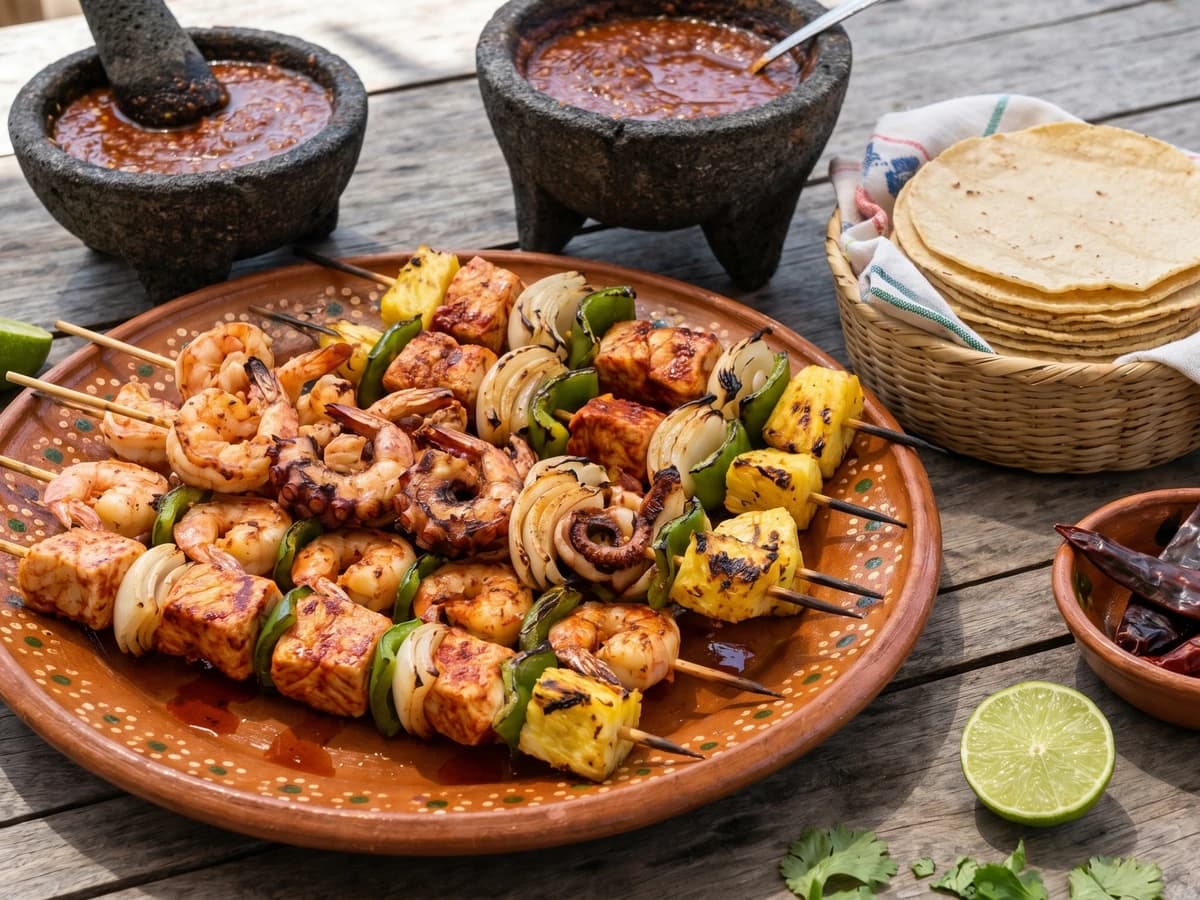
A Chihuahua and Sonora bar staple: thin chistorra seared on the plancha with pulled chunks of melting asadero, served with hot flour tortillas and a molcajete of chiltepin salsa.
Appetizers & Snacks
Mexican
Game Day
BBQ
Quick Meal
15 min
Active Time
15 min cook•30 min total
Yield4 to 6 servings as a botana
This is from the north. Chihuahua, Sonora, the borderlands where the cattle ranches taught Mexico how to make flour tortillas and where the sausage tradition came down through Basque and Navarrese settlers who brought chistorra with them from the old country. Cada estado, su propia cocina, and the north has its own.
Chistorra is not chorizo. People in the south of Mexico confuse the two and they should not. Chorizo is fatter, looser, seasoned with vinegar and a heavier hand of chile. Chistorra is thin, firm, smoked or air-cured, the color comes from pimenton more than from chile ancho. It cooks in minutes. You sear it on a hot plancha and the orange fat that comes out is half the recipe.
The cheese is queso asadero, made in Chihuahua, a stretching cheese that pulls into strands when it melts. Not cheddar. Not pepper jack. Not whatever the supermarket calls Mexican blend. If you cannot find asadero, queso Oaxaca is its cousin and it will do. The flour tortillas have to be made with manteca and they have to be soft enough that you can fold them around hot sausage without cracking. The corn tortillas of the south have no place at this table. La cocina del norte es la cocina del trigo.
My mother was from Jalisco and she did not cook this. I learned it in Chihuahua, at a cantina in Cuauhtemoc, from a senora who slid the plancha across the bar and told me to eat with my hands. She watched me fold the first taco wrong and corrected it. The chiltepin salsa was in a small molcajete and it was the hottest thing I had eaten that year. La manteca es el sabor and the chiltepin is the punctuation. Saber cocinar es saber vivir.
Chistorra arrived in northern Mexico through Basque and Navarrese immigrants in the 19th and early 20th centuries, settling primarily in Chihuahua, Sonora, and Coahuila where ranching and meat-curing traditions took root. The Spanish original, made with pimenton de la Vera, was adapted in Mexico to use locally available paprika and the smoke profiles of mesquite and oak common to the northern sierras. Queso asadero, the stretching cheese paired with chistorra in this preparation, is itself a relatively young cheese, developed in Chihuahua in the late 19th century by Mennonite communities who settled in the Cuauhtemoc valley after migrating from Canada in the 1920s, and whose dairy production reshaped the cheese economy of the entire north. The chiltepin chile, by contrast, predates all of this: it is the wild ancestor of all domesticated capsicums, harvested from native shrubs in the Sonoran sierra and considered a heritage ingredient protected by indigenous and rural communities across northwestern Mexico.
The technique, the tradition, and the story behind every dish.
•Heavy cast iron plancha or 12-inch cast iron skillet
•Volcanic stone molcajete for the salsa
•Comal for charring tomatoes and warming tortillas
•Sharp knife for slicing the chistorra on the plancha
•Wooden board or trivet to carry the hot plancha to the table
Instructions
1
Make the chiltepin salsa
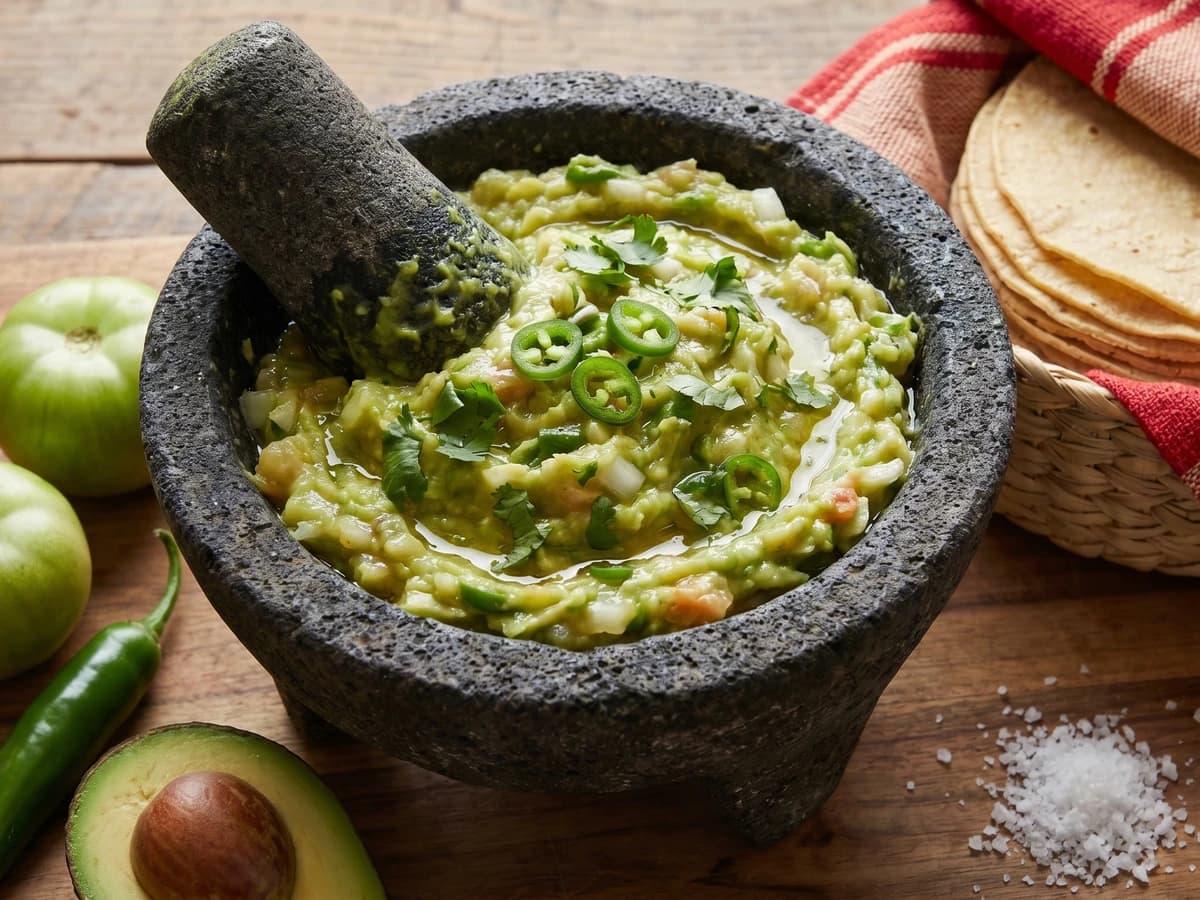
Heat a dry comal over medium. Char the tomatoes until the skins blister and blacken in patches, about 8 minutes, turning as you go. Add the garlic clove for the last two minutes, peel still on, until it softens. While the tomatoes char, toast the chiltepines in a separate small skillet for about 20 seconds, just until fragrant. Chiltepin is small but it is loud. Do not let it smoke. Peel the garlic and put everything in a molcajete with the salt and water. Grind to a coarse salsa. This is the salsa of the Sonoran sierra and it does not need anything else.
Chiltepin is the wild chile of the north, harvested by hand in the Sonoran sierra in fall. It is hotter than it looks. Two tablespoons is a lot. Start with one if you have not used it before.
2
Heat the plancha
Set a heavy cast iron plancha or wide skillet over medium heat. Let it come up slowly. A good plancha needs five minutes to heat evenly. If you rush this, the chistorra will tear when you try to turn it and the cheese will scorch before it melts. Add the lard and let it slick the surface.
3
Sear the chistorra
Lay the chistorra links on the plancha in a single layer. They will start to release their orange-red fat almost immediately. That fat is paprika, garlic, and pork. Do not pour it off. Let the sausage cook for about 3 minutes per side until the casing crisps and the color deepens to a dark rust. Chistorra is thin and cooks fast. Move it around so every section gets contact with the iron.
4
Add the onion
Push the chistorra to one side of the plancha. Add the white onion to the rendered fat on the other side. Let it soften and pick up color, about 4 minutes. The onion is not a garnish, it is part of the bite. The fat from the chistorra is what cooks it and that is the whole point.
5
Melt the asadero
Slice the chistorra into 2-inch pieces right on the plancha. Pull the onions in among the sausage. Drop the chunks of asadero directly into the hot rendered fat in the open spots on the plancha. Asadero melts low and slow. It is a stretching cheese from Chihuahua and it pulls into long strands when it is ready. Lower the heat slightly. In about 2 minutes the cheese will pool and start to pick up golden edges where it touches the iron. Do not stir. Let it form a soft sheet you can pull at the table.
If you cannot find queso asadero, queso Oaxaca will work. They are cousins. Do not use mozzarella from the supermarket and absolutely do not use cheddar. Yellow cheese on chistorra is Tex-Mex, not norteno.
6
Serve from the plancha
Carry the plancha straight to the table on a wooden board or trivet. The chistorra and the molten asadero stay on the iron. Set the warm flour tortillas in a basket beside it, the chiltepin salsa in the molcajete, and the lime wedges in a small clay dish. Each person tears a tortilla, scoops sausage and a pull of cheese, adds onion, drops a spoon of salsa, squeezes lime. Eat it standing up if you have to. The cheese stiffens fast once the iron cools. Asi se hace y punto.
Chef Tips
•Chistorra should be firm and dry, not slick and wet. Look for it at a Mexican carniceria or an Iberian deli. The mass-market grocery store version with too much filler will leak water on the plancha and steam instead of sear. That is not chistorra, that is a sad imitation.
•Asadero melts at a lower temperature than most cheeses. If you cook it on too high a heat the proteins seize and the cheese turns rubbery and oily. Medium heat, with patience, gives you the long pull. No me vengas con atajos.
•The flour tortillas are not optional and they are not interchangeable with corn. Get them fresh from a tortilleria de harina, or make them with manteca and bread flour. Northern Mexico runs on wheat and this is not the dish to argue with that fact.
•If chiltepin is impossible to find, dried chile de arbol is a compromise, not an upgrade. Use half as much, toast it the same way, and know that the floral, almost smoky character of true chiltepin is what you are missing.
Advance Preparation
•The chiltepin salsa can be made up to two days ahead and refrigerated. The flavor sharpens overnight as the chile bites into the tomato.
•Chistorra keeps refrigerated for up to a week and freezes well for a month. Thaw fully before searing or it will steam on the plancha.
•Do not pre-melt the cheese. Asadero must be melted at the moment of serving. Cold and re-warmed asadero turns greasy and loses the pull.
Frequently Asked Questions
Nutrition Information
1 serving (about 340g)
Calories
930 calories
Total Fat
57 g
Saturated Fat
25 g
Trans Fat
0 g
Unsaturated Fat
30 g
Cholesterol
135 mg
Sodium
2285 mg
Total Carbohydrates
55 g
Dietary Fiber
3 g
Sugars
3 g
Protein
40 g
Where cooking meets culture.
Culinary guides, cultural storytelling, and the editorial depth that makes cooking meaningful.