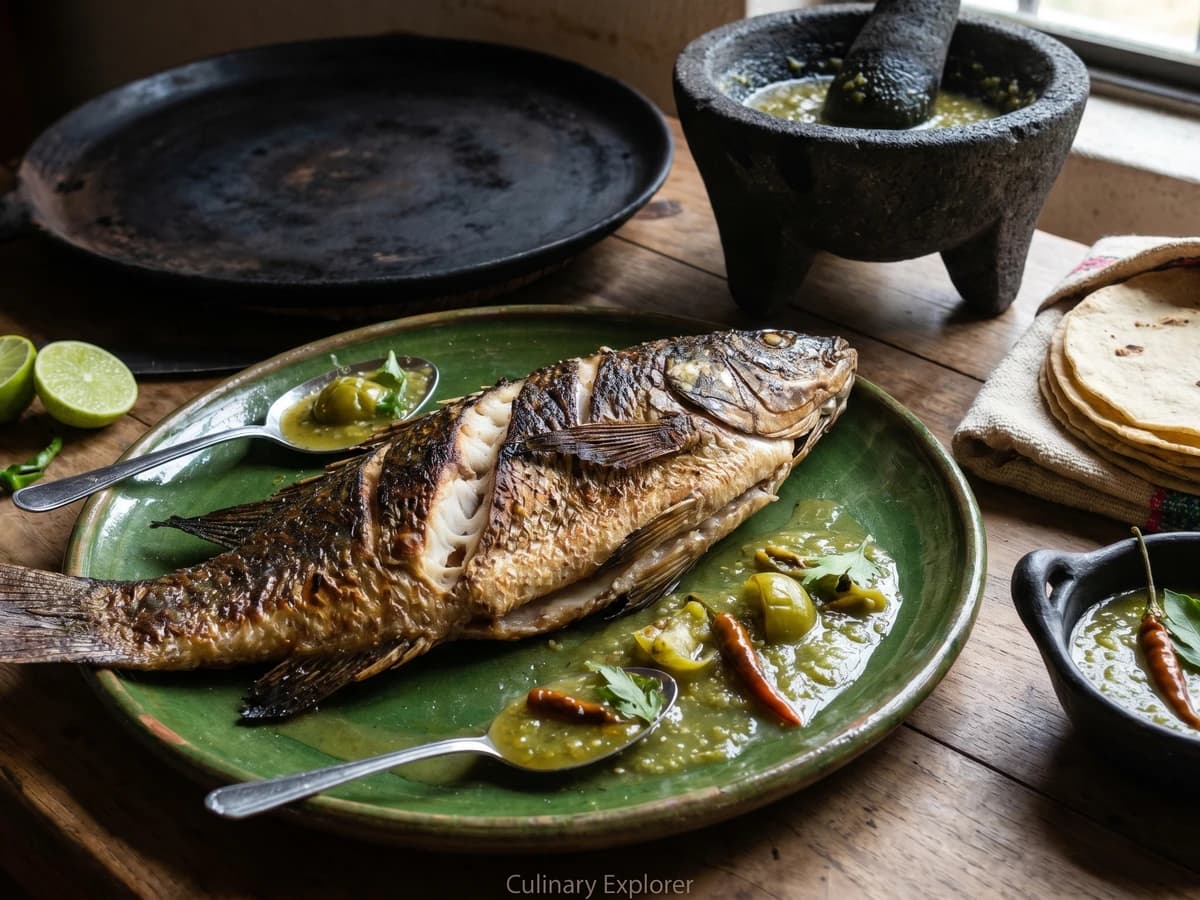
Chef Lupita
Acúmara Tatemada al Comal
Michoacán's Lake Pátzcuaro acúmara, a whole kurucha from the lago tatemada on a comal de leña and served with chile perón atápakua, corn tortillas, and P'urhépecha discipline.
A cooking platform built around craft, culture, and the stories behind what we eat.

Created by
Sinaloa's three-hundred-year-old preserved pork from the town of Mocorito, slow-simmered then refried in a guajillo and pasilla adobo cut with vinegar. The original road food of the north.
Chilorio is from Sinaloa. Specifically from Mocorito, a small town in the central valley about an hour north of Culiacan, where this dish was born of necessity three centuries ago. Before refrigeration, before highways, before any of the things that made food preservation easy, the cooks of Mocorito figured out how to keep pork edible for weeks: cook it down, fry it in its own lard, dress it in a vinegared chile adobo, and seal it under a layer of fat in a clay pot. That preserved pork traveled with ranch hands across the Sierra Madre and fed families through the dry months. Today the refrigerator does the work the lard used to do, but the technique stays.
This is a northern dish, which means flour tortillas, not corn. The wheat fields of Sinaloa and Sonora made flour tortillas a regional tradition long before they became a Tex-Mex shorthand. Chilorio belongs in a flour tortilla. Put it in a corn tortilla and you have made something else.
The adobo is built on guajillo for color and pasilla for depth, with a little ancho for sweetness, vinegar for preservation, and the warm spices, cumin, clove, oregano, that mark northern Mexican cooking. No tomato. No achiote. No chocolate. Chilorio is austere by design. It was meant to last, not to impress. My notes from Mocorito are pencil-smudged from a senora named Dona Ofelia who told me, with no small amount of pride, that her grandmother's chilorio fed the Revolution. I believe her. Cada estado, su propia cocina.
Chilorio dates to at least the 18th century in the Sinaloan town of Mocorito, where it developed as a method of preserving pork in the era before refrigeration; the combination of slow cooking, frying in lard, and acidulating with vinegar allowed the meat to keep for several weeks when sealed under fat in a clay pot. Mocorito was officially designated a Pueblo Magico in 2015, a recognition tied in part to its culinary heritage and the continued production of artisanal chilorio by local families. The dish is a defining example of northern Mexican cocina rancheraseca, dry, portable foods built for long distances and harsh climates, and it stands alongside machaca and carne seca as one of the great preserved-meat traditions of the Mexican north.
Quantity
3 pounds
cut into 2-inch chunks
Quantity
1 tablespoon
Quantity
1/2 medium
Quantity
4
peeled, divided
Quantity
1
Quantity
to cover
Quantity
8
stemmed and seeded
Quantity
4
stemmed and seeded
Quantity
2
stemmed and seeded
Quantity
1 teaspoon
Quantity
1 teaspoon
Quantity
4
Quantity
2
Quantity
3 tablespoons
Quantity
1/2 cup
Quantity
for serving
warmed
Quantity
for serving
Quantity
for serving
Quantity
for serving
| Ingredient | Quantity |
|---|---|
| boneless pork shouldercut into 2-inch chunks | 3 pounds |
| kosher salt | 1 tablespoon |
| white onion | 1/2 medium |
| garlic clovespeeled, divided | 4 |
| bay leaf | 1 |
| water | to cover |
| dried chile guajillostemmed and seeded | 8 |
| dried chile pasillastemmed and seeded | 4 |
| dried chile anchostemmed and seeded | 2 |
| whole cumin seeds | 1 teaspoon |
| dried Mexican oregano | 1 teaspoon |
| whole black peppercorns | 4 |
| whole cloves | 2 |
| apple cider vinegar | 3 tablespoons |
| pork lard (manteca de cerdo) | 1/2 cup |
| flour tortillas (optional)warmed | for serving |
| refried beans (optional) | for serving |
| diced white onion (optional) | for serving |
| lime wedges (optional) | for serving |
Place the pork shoulder in a heavy pot. Add the onion half, two of the garlic cloves, the bay leaf, and the salt. Cover with water by an inch. Bring to a gentle simmer over medium heat. Skim the gray foam that rises in the first fifteen minutes. Lower the heat and cook at lazy bubbles for about two hours, until the meat shreds easily with a fork. Cold water start, slow simmer. A rolling boil tightens the meat and clouds the fat you are about to render.
Lift the pork out with a slotted spoon and let it rest until cool enough to handle. Strain and reserve one cup of the cooking broth. Shred the pork by hand into rough threads, the way the senoras in Mocorito do it. Not a fine mince. Not large chunks. Threads. The texture matters because every strand will catch the adobo in the next step.
Heat a dry comal or heavy skillet over medium. Toast the guajillo, pasilla, and ancho chiles separately, about 30 seconds per side. The skin will puff and the kitchen will smell like a Sinaloan despensa in autumn. The pasilla burns the fastest. Watch it. Burned chile turns the adobo bitter and there is no recovering from it later.
Place the toasted chiles in a heatproof bowl and cover with hot tap water. Hot, not boiling. Let them soften for 20 minutes. Drain and transfer to a blender. Add the remaining two garlic cloves, the cumin seeds, oregano, peppercorns, cloves, vinegar, and 3/4 cup of the reserved pork broth. Blend on high for two full minutes until completely smooth. Strain through a fine-mesh sieve, pressing on the solids with a spoon. The adobo should coat the back of the spoon. The vinegar is what made chilorio a preserved food in the first place. Do not skip it.
In a wide heavy skillet or cazuela, melt the lard over medium heat until it shimmers. Add the shredded pork in one layer. Fry without stirring for three or four minutes so the bottom edges turn golden, then stir and let another side catch. La manteca es el sabor. This is where chilorio earns its color and its texture. The pork should be lightly crisped at the edges before the adobo touches it.
Pour the strained adobo over the pork. It will sputter. Stir to coat every thread. Lower the heat to medium-low and cook uncovered for 20 to 25 minutes, stirring every few minutes, until the adobo has soaked into the meat and the lard begins to separate around the edges of the pan. The chilorio is ready when it is dark, glossy, and almost dry, with a thin slick of red-stained fat at the bottom of the pan. That fat is the preservative. That is what kept this dish alive for travelers and ranch hands for three centuries before refrigeration.
Pull the pan off the heat and let the chilorio rest for ten minutes. The flavor settles. Serve in flour tortillas, the way they do it across Sinaloa, with refried beans, raw white onion, and lime. A spoonful of chilorio on a plate of beans and eggs is the classic Sinaloan breakfast. Asi se hace y punto.
1 serving (about 145g)
Culinary guides, cultural storytelling, and the editorial depth that makes cooking meaningful.
Discover Culinary ExplorerChef Lupita
Michoacán's Lake Pátzcuaro acúmara, a whole kurucha from the lago tatemada on a comal de leña and served with chile perón atápakua, corn tortillas, and P'urhépecha discipline.

Chef Lupita
Puebla's weekday adobo of pork shoulder braised in a thick guajillo and ancho sauce sharpened with vinegar, cumin, and clove. The deep red of a market spice stall, the dish a poblana cooks without thinking.

Chef Lupita
Loreto's pit-roasted clams, planted hinge-up in beach sand and tatemadas under a fast fire of dried romerillo brush, the resinous Baja desert shrub that gives this dish its smoke.

Chef Lupita
Oaxaca's eighth mole, the silky, almond-and-cinnamon almendrado, served over poached chicken. Mild, sweet, restrained, and a quiet rebuttal to anyone who thinks Mexican food has to be hot to be Mexican.