
Chef Lupita
Aporreadillo Michoacano con Huevo
Michoacán's Tierra Caliente almuerzo, where salted beef is softened, pounded, fried in lard, folded with egg and chile perón salsa, then served beside morisqueta like a proper working table.
A cooking platform built around craft, culture, and the stories behind what we eat.
Created by
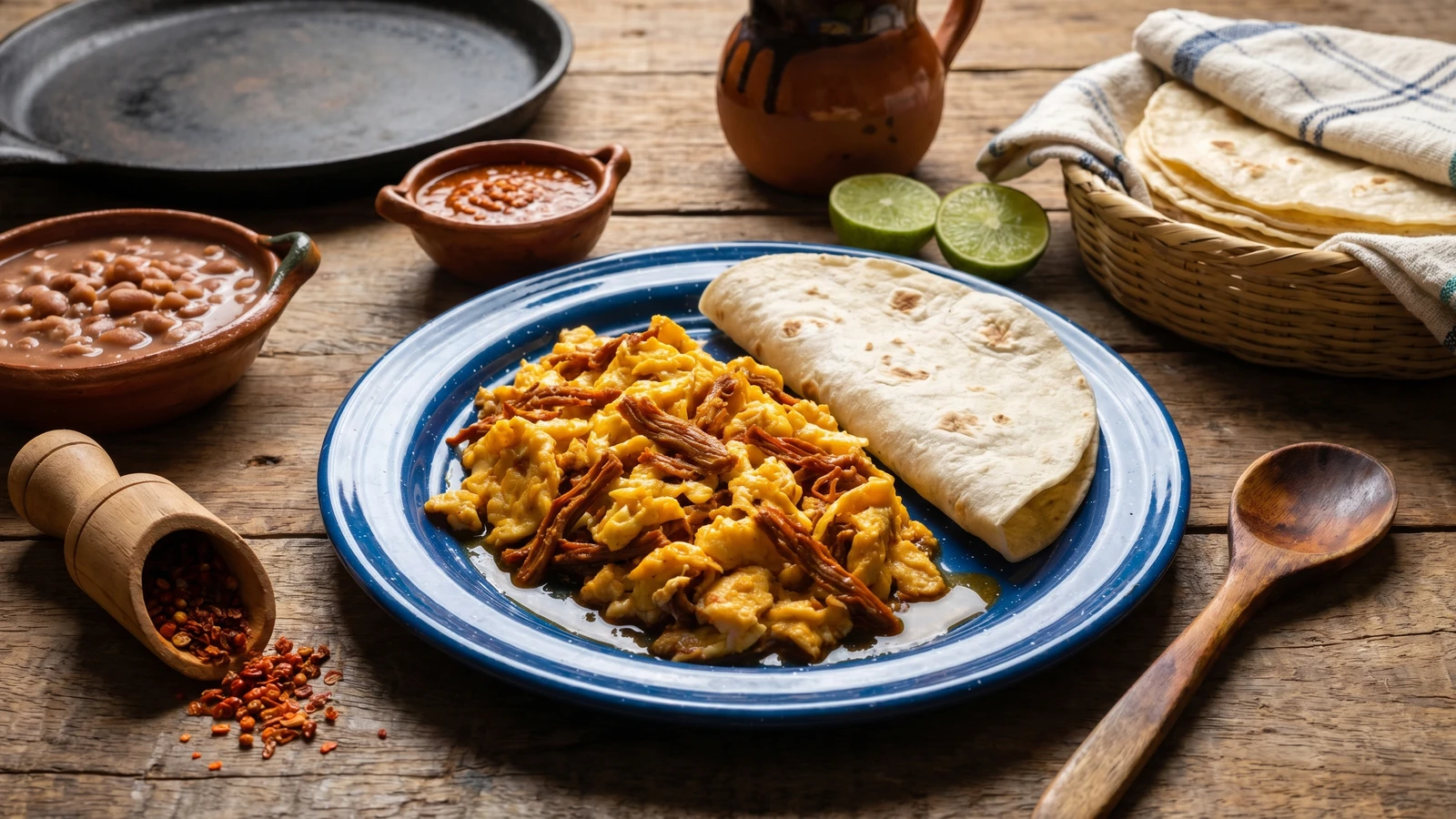
Mocorito's most famous export, plated for breakfast: pork slow-cooked with chile ancho and guajillo, pan-crisped until the edges catch, and folded into soft scrambled eggs. Eaten in a sobaquera with salsa de chiltepín and a clay cup of café de talega.
This is from Mocorito, in northern Sinaloa. Not Culiacan, not Mazatlan. Mocorito, the small town in the foothills that the federal government named a Pueblo Mágico because of two things: its colonial chapel and its chilorio. The chilorio came first.
Chilorio is not seasoned pork. It is a preservation art. Pork shoulder simmered until the water cooks off, then shredded and fried in its own fat with a paste of chile ancho, guajillo, garlic, cumin, oregano, and a serious pour of vinegar. The vinegar is the point. It is what lets a jar of chilorio sit on a Sinaloan ranch shelf for weeks under a cap of its own manteca, ready for the morning the cook does not have time to start from scratch. The senoras of Mocorito have been making it this way since long before refrigeration reached the sierra. This is a noroeste dish, born of distance from markets and respect for the pig.
For breakfast, you take a scoop of the chilorio you already have, you crisp it in a hot skillet until the edges catch and turn dark, and you fold soft scrambled eggs through it at the last second. You eat it in a sobaquera, the large hand-pressed flour tortilla of the noroeste, the size of a dinner plate, thin enough to read through. Do not come to me with corn tortillas here. In the north, flour is where it belongs. The wheat fields of Sonora and Sinaloa fed this tradition for two centuries. Defending it is not regional pride. It is geography.
My mother was from Jalisco and she made things her own way, but she had a friend from Guamuchil who would send her a jar of chilorio every Christmas wrapped in newspaper. We would eat it for breakfast on New Year's Day. The first time I went to Mocorito myself, in my late twenties, the senora at the comedor where I ate breakfast watched me take the first bite and said, sin pena, that I had been eating something else my whole life. She was right. Saber cocinar es saber vivir.
Chilorio originated in Mocorito, Sinaloa, as a preservation method developed by ranching families in the 18th and 19th centuries who needed to keep butchered pork edible in a region with hot summers and limited access to ice. The technique, slow-cooking the meat in its own rendered fat with a vinegar-and-chile recado, parallels the European confit tradition while drawing on indigenous Cahita and Tahue uses of dried chile and wild herbs from the Sierra Madre Occidental foothills. Mocorito's chilorio was so commercially significant by the early 20th century that local families began canning and exporting it across northern Mexico and into the southwestern United States; the town was designated a Pueblo Mágico in 2015, with chilorio cited explicitly in the federal recognition as one of the cultural patrimonies justifying the title.
Quantity
3 pounds
cut into 2-inch chunks
Quantity
1 tablespoon
Quantity
to barely cover the pork
Quantity
1/2 cup, plus more if needed
Quantity
8
stemmed and seeded
Quantity
6
stemmed and seeded
Quantity
6
peeled
Quantity
1 teaspoon
toasted
Quantity
1 teaspoon
Quantity
1/4 teaspoon
Quantity
2
Quantity
1/2 cup
Quantity
1 teaspoon
for the chile paste
Quantity
12
Quantity
2 tablespoons
for the eggs
Quantity
1/2 teaspoon
for the eggs
Quantity
12
warmed
Quantity
for serving
Quantity
for serving
Quantity
for serving
Quantity
for serving
| Ingredient | Quantity |
|---|---|
| boneless pork shouldercut into 2-inch chunks | 3 pounds |
| kosher salt | 1 tablespoon |
| water | to barely cover the pork |
| manteca de cerdo (pork lard) | 1/2 cup, plus more if needed |
| dried chile anchostemmed and seeded | 8 |
| dried chile guajillostemmed and seeded | 6 |
| garlic clovespeeled | 6 |
| whole cumin seedstoasted | 1 teaspoon |
| dried Mexican oregano | 1 teaspoon |
| whole black peppercorns | 1/4 teaspoon |
| whole cloves | 2 |
| apple cider vinegar | 1/2 cup |
| kosher saltfor the chile paste | 1 teaspoon |
| large eggs | 12 |
| manteca de cerdofor the eggs | 2 tablespoons |
| kosher saltfor the eggs | 1/2 teaspoon |
| sobaqueras (large hand-pressed flour tortillas)warmed | 12 |
| salsa de chiltepín (optional) | for serving |
| lime wedges (optional) | for serving |
| frijoles puercos or refried pinto beans (optional) | for serving |
| café de talega (optional) | for serving |
Place the pork shoulder chunks in a heavy pot. Add the tablespoon of salt and just enough cold water to barely cover the meat. Bring to a low simmer over medium heat and cook uncovered for about an hour and a half. The water will reduce, the pork will turn tender, and what is left in the pot at the end will be meat sitting in its own rendered fat. This is how chilorio starts in Mocorito. Boil it in too much water and you wash the flavor down the drain.
While the pork simmers, heat a dry comal over medium. Toast the chile ancho and chile guajillo separately, about 20 to 30 seconds per side. They should puff and turn fragrant, never blacken. Move them straight into a heatproof bowl and cover with hot tap water. Hot, not boiling. Let them soften for 20 minutes. Burned chile turns the chilorio bitter and there is no fixing it later.
Drain the softened chiles. Place them in a blender with the garlic, toasted cumin seeds, oregano, peppercorns, cloves, vinegar, salt, and about half a cup of fresh water. Blend on high until completely smooth. The paste should be the color of dried tobacco, thick enough to coat a spoon but loose enough to pour. Pass it through a fine-mesh strainer to catch the chile skins. Discard the solids. This is the recado that defines chilorio. Half a cup of vinegar sounds like a lot. It is supposed to be.
Once the pork is fork-tender and the cooking water has cooked off, lower the heat. Use two forks or the back of a wooden spoon to shred the meat right in the pot. Work it until the chunks break into rough strands. The fat that rendered out is still in there. Leave it. La manteca es el sabor.
Add the half cup of manteca to the pot with the shredded pork. Raise the heat to medium. Pour in the chile paste. It will sputter and the kitchen will fill with the smell of toasted chile and vinegar. Stir to coat every strand of meat. Cook for 20 to 25 minutes, stirring often, until the vinegar has cooked off, the paste has darkened, and the fat starts to separate at the edges of the pot. The chilorio is done when it pulls away from the bottom in a single mass and a wooden spoon dragged through it leaves a clean line. Taste for salt now. Asi se hace y punto.
For each serving of huevo con chilorio, scoop about half a cup of chilorio into a hot skillet over medium-high heat. Spread it in a thin layer and let it sit undisturbed for two minutes. The bottom will catch and turn dark and crusty. That crust is what you are after. This is the breakfast version, not the stew. Stir once to break up the crust and let another side catch.
Crack the eggs into a bowl, add the salt, and beat just enough to break the yolks. Lower the heat under the chilorio to medium. Add the two tablespoons of manteca to the pan and let it melt around the meat. Pour the eggs over the chilorio. Wait ten seconds. Then pull the eggs across the pan with a wooden spoon in slow folds, the way the senoras do it on a wood stove. The eggs should set in soft, large curds streaked with the dark red of the chilorio. Pull the pan off the heat while the eggs still look a little wet. They finish cooking on the plate.
Spoon the huevo con chilorio onto a warm plate. Set a stack of warm sobaqueras in a cloth-lined basket beside it. Put the salsa de chiltepín, lime wedges, and a side of frijoles puercos on the table. People build their own burritos. A pour of café de talega from a clay jarro and that is breakfast in Mocorito. Recetas probadas y garantizadas.
1 serving (about 330g)
Culinary guides, cultural storytelling, and the editorial depth that makes cooking meaningful.
Discover Culinary ExplorerChef Lupita
Michoacán's Tierra Caliente almuerzo, where salted beef is softened, pounded, fried in lard, folded with egg and chile perón salsa, then served beside morisqueta like a proper working table.

Chef Lupita
Guerrero's Costa Grande aporreado is salted cecina pounded soft, scrambled with egg, and finished in a red guajillo and chile de árbol salsa loud with garlic and cilantro.

Chef Lupita
Los Altos de Chiapas turns two-night fermented white corn into a tart-sweet atole, cooked with canela and piloncillo, then poured hot into jícaras for desayuno.

Chef Lupita
Oaxaca's Mixteca region ferments nixtamalized masa for days until it turns tart and alive, then simmers it with piloncillo and canela into a thick, warm atole served at first light in clay.