
Chef Lupita
Aguascalientes Beef Tongue Pozole (Pozole de Lengua)
Aguascalientes' Bajio pozole de lengua, built with cacahuazintle hominy, tender beef tongue, chile ancho and guajillo, with xoconostle brightness and table garnishes.
A cooking platform built around craft, culture, and the stories behind what we eat.
Created by
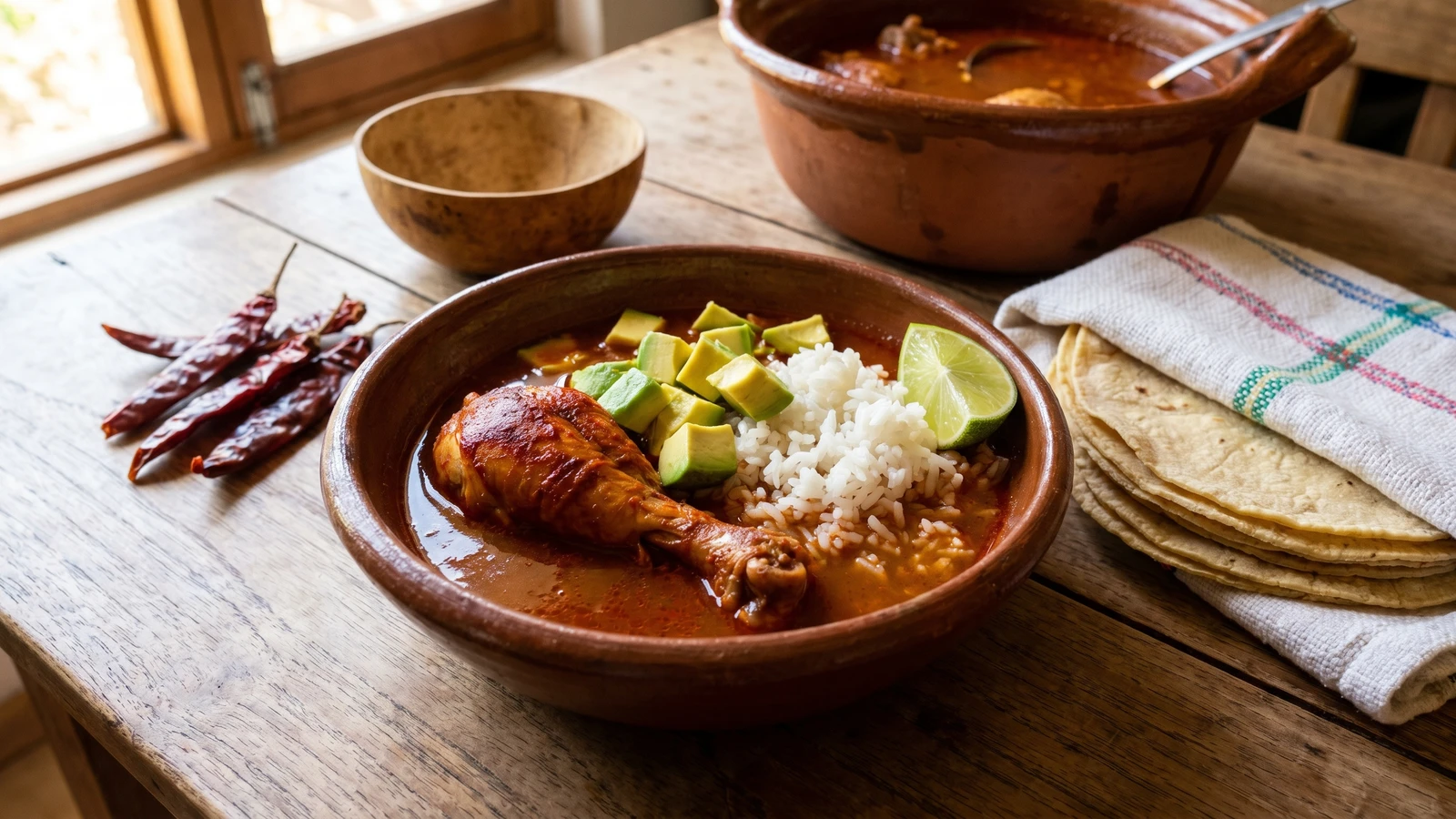
The Costa Chica's chile costeño chicken broth, spiced with ginger, clove, and cinnamon, ladled over white rice and ripe avocado. Afro-Mexican cooking from Guerrero's forgotten coast.
This is Guerrero. Not the Guerrero of Taxco silver and Acapulco hotels, but the Costa Chica: the stretch of Pacific coast between Acapulco and the Oaxacan border where Afro-Mexican communities have been cooking for centuries and where the rest of Mexico barely looks.
Chilate de pollo is the signature soup of that coast. The word 'chilate' comes from the Nahuatl 'chilatl,' chile water, and that is exactly what it is: a thin, clean, rust-red broth built on chile costeño, the small dried chile that grows along Guerrero's coast and gives this region its backbone flavor. You will not find chile costeño at most markets outside Guerrero and coastal Oaxaca. If you do find it, buy every bag they have.
The spicing is what tells you this is not the same pot as the rest of Guerrero. Ginger, clove, cinnamon. These are African-influenced aromatics carried into Mexican cooking by the Afro-descendant communities of towns like Cuajinicuilapa, Marquelia, and San Nicolás. The women who taught me this dish in the Costa Chica market at Ometepec did not call it African. They called it theirs. But the ginger and clove are not Mesoamerican, and they are not Spanish either. They arrived with the people who arrived in chains and made this coast their home. The food remembers what the history books forgot.
You serve it the way they serve it in the Costa Chica: white rice mounded in the bottom of a deep bowl, cubes of ripe avocado scattered over the rice, and the hot broth ladled on top so the avocado softens but does not melt. Corn tortillas on the side. Lime if you want it. Saber cocinar es saber vivir, and this dish is proof that the cooks of the Costa Chica have been living well on their own terms for a long time.
The Costa Chica, stretching from Acapulco southeast to Huatulco across the Guerrero-Oaxaca border, is home to Mexico's largest Afro-descendant population, the descendants of enslaved Africans brought to work colonial sugar plantations and cattle ranches beginning in the 16th century. Chilate, from the Nahuatl 'chilatl' (chile water), represents a culinary convergence point: a Mesoamerican broth technique married to African-influenced spicing, particularly the use of ginger (jengibre), clove (clavo), and cinnamon (canela), aromatics associated with West African and Caribbean cooking traditions that arrived with the African diaspora. The Afro-Mexican communities of the Costa Chica were not officially recognized by the Mexican constitution as a distinct ethnic group until 2019, and their culinary contributions to Mexican gastronomy remain largely undocumented outside the region.
Quantity
1 (about 3 1/2 pounds)
cut into 8 pieces, or use 3 1/2 pounds bone-in, skin-on chicken pieces
Quantity
10 cups
Quantity
1
halved crosswise
Quantity
1 medium
quartered
Quantity
2
Quantity
1 tablespoon, plus more to taste
Quantity
8
stemmed and seeded
Quantity
2
stemmed and seeded
Quantity
1-inch piece
peeled and roughly chopped
Quantity
4
Quantity
1 stick, about 3 inches
Quantity
4
Quantity
1/4 teaspoon
Quantity
3
peeled
Quantity
1/2 medium
roughly chopped
Quantity
2 medium
roasted on a comal until blackened
Quantity
1 tablespoon
Quantity
2 cups
Quantity
2
cut into 1/2-inch cubes
Quantity
for serving
Quantity
for serving
| Ingredient | Quantity |
|---|---|
| whole chickencut into 8 pieces, or use 3 1/2 pounds bone-in, skin-on chicken pieces | 1 (about 3 1/2 pounds) |
| cold water | 10 cups |
| head of garlic (for broth)halved crosswise | 1 |
| white onion (for broth)quartered | 1 medium |
| bay leaves | 2 |
| kosher salt | 1 tablespoon, plus more to taste |
| dried chile costeño rojostemmed and seeded | 8 |
| dried chile costeño amarillo (optional)stemmed and seeded | 2 |
| fresh gingerpeeled and roughly chopped | 1-inch piece |
| whole cloves | 4 |
| Mexican cinnamon (canela) | 1 stick, about 3 inches |
| whole black peppercorns | 4 |
| cumin seeds | 1/4 teaspoon |
| garlic cloves (for sauce)peeled | 3 |
| white onion (for sauce)roughly chopped | 1/2 medium |
| tomatoesroasted on a comal until blackened | 2 medium |
| lard (manteca de cerdo) | 1 tablespoon |
| long-grain white rice | 2 cups |
| ripe Hass avocadoscut into 1/2-inch cubes | 2 |
| lime wedges (optional) | for serving |
| corn tortillas (optional) | for serving |
Place the chicken pieces in a large pot. Cover with 10 cups of cold water. Add the halved garlic head, quartered onion, bay leaves, and salt. Bring to a gentle simmer over medium heat. Skim the foam that rises in the first ten minutes. Cold water is not a suggestion. It pulls the flavor out of the bones slowly. Boiling water seals the surface and gives you a thin, cloudy broth with no depth.
Reduce heat until the broth barely moves. You want lazy bubbles every few seconds. Cover partially and simmer for 45 minutes to one hour, until the chicken is cooked through and tender. If using a hen, allow a full two hours. Remove the chicken pieces and set them aside. Strain the broth through a fine-mesh sieve into a clean pot and discard the spent garlic, onion, and bay leaves. You should have about 8 cups of clean, golden broth.
Heat a dry comal or heavy skillet over medium. Toast the chile costeño rojo and amarillo, pressing them flat with a spatula, about 15 seconds per side. They are small and thin. They burn in seconds. The moment they puff and release a sharp, fruity, smoky smell, pull them off. In the same comal, toast the cloves, cinnamon stick, peppercorns, and cumin seeds for about 30 seconds, shaking the pan, until they smell warm and fragrant. Do not walk away from the comal. Burned spices are bitter spices and there is no way back.
Place the toasted chiles in a small bowl and cover with hot tap water. Let them soften for 15 minutes. They will not need long. Costeño chiles are thin and rehydrate quickly. Do not use boiling water. Boiling cooks the skin and pushes the flavor toward bitter.
While the chiles soak, place the whole tomatoes on the hot comal. Let them char on all sides, turning with tongs, about 8 to 10 minutes total. You want deep black blisters and soft, collapsing flesh. The charring concentrates the sweetness and adds a smoky note that balances the sharp bite of the costeño.
Drain the soaked chiles and place them in a blender. Add the toasted spices, the chopped ginger, the 3 peeled garlic cloves, the chopped half onion, the charred tomatoes, and one cup of the chicken broth. Blend on high until completely smooth. The ginger should disappear into the sauce, not sit in chunks. Strain through a fine-mesh sieve into a bowl, pressing hard on the solids. Discard the skins. The strained sauce should be a deep rust-red, thin, and fragrant with ginger and clove.
Heat the lard in the pot with the strained chicken broth over medium. When it shimmers, pour in the strained chile sauce. It will sputter and hiss. Let it fry in the lard for three to four minutes, stirring constantly, until the color darkens slightly and the raw edge of the chiles cooks off. Then stir the sauce into the rest of the broth. Bring to a gentle simmer. Taste for salt. The broth should be thin, not thick. This is caldo, not mole. The flavor is in the clarity: you taste the chile, then the ginger, then the clove in layers. If the broth is muddy, you did not strain well enough.
Place the chicken pieces back into the broth. Simmer for 15 minutes on low heat so the meat absorbs the chile and spice. The chicken should be warmed through and stained with the red broth. If you are using a whole chicken, you can remove the skin now or leave it. In the Costa Chica, they leave it.
While the broth simmers, rinse the rice in cold water until the water runs clear. In a medium saucepan, heat a teaspoon of lard over medium. Add the rice and stir for two minutes until the grains are coated and smell toasty. Add 3 cups of water and a teaspoon of salt. Bring to a boil, reduce to the lowest heat, cover tightly, and cook for 18 minutes without lifting the lid. Remove from heat and let it sit covered for 5 minutes, then fluff with a fork. The rice is not a side dish. It is the foundation of the bowl.
Mound a generous scoop of white rice in the center of each deep bowl. Place a piece or two of chicken alongside the rice. Scatter cubes of ripe avocado over the top. Ladle the hot red broth over everything, enough to come halfway up the rice. The broth melts the surface of the avocado and warms it without turning it to mush. Serve with lime wedges and warm corn tortillas. Cada estado, su propia cocina. This bowl belongs to the Costa Chica and nobody else.
1 serving (about 650g)
Culinary guides, cultural storytelling, and the editorial depth that makes cooking meaningful.
Discover Culinary ExplorerChef Lupita
Aguascalientes' Bajio pozole de lengua, built with cacahuazintle hominy, tender beef tongue, chile ancho and guajillo, with xoconostle brightness and table garnishes.

Chef Lupita
Veracruz's Gulf coast rice from Alvarado, built with seafood stock, tomato, chile chipotle, epazote, shrimp, fish, jaiba, and pulpo, served loose and brothy in a clay cazuela.

Chef Lupita
Costa Chica's wet salt-beef stew, built from chile costeño, guajillo, tomato, manteca, yuca, plantain, and masa dumplings, the ranching pot of Cuajinicuilapa and Pinotepa.

Chef Lupita
Michoacán's P'urhépecha atápakua is a masa-thickened sauce and stew at once, built with pork, chile guajillo, and hierbabuena added only at the end.