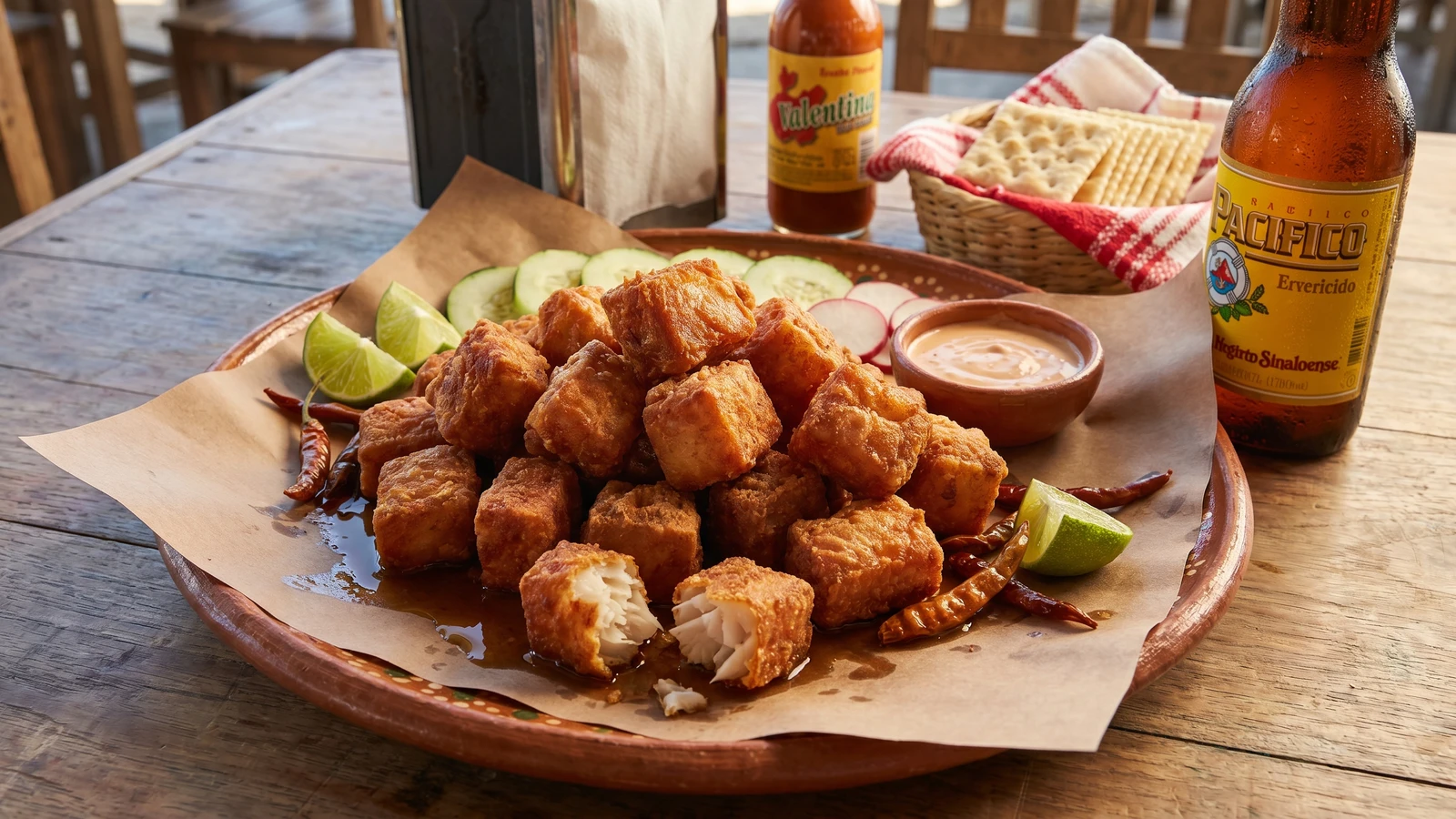
Sinaloa's coastal bar staple: cubes of corvina or robalo seasoned with mustard and dry spices, dredged in flour and cornmeal, fried gold and crisp. Lime, mayo-chipotle, and a cold Pacifico on the side.
Appetizers & Snacks
Mexican
Game Day
Outdoor Dining
BBQ
25 min
Active Time
15 min cook•40 min total
Yield4 to 6 servings
This is from Sinaloa. Specifically from the marisquerias and palapas along the Mazatlan boardwalk and the bar stools of Culiacan, where chicharron de pescado arrives at the table in a paper-lined basket the moment you order a beer. It is bar food, beach food, weekend food. Sinaloa lives off the Pacific and the cooks there know what to do with what comes off the boat.
The fish is corvina or robalo. Sometimes huachinango when the price is right. Firm white flesh that holds its shape in the oil. The seasoning is direct: yellow mustard, lime, Worcestershire, Maggi, salt, pepper, a few dry spices. No adobos, no slow marinades. Sinaloa cooks do not romanticize. The mustard is what holds the dredge to the fish and gives the chicharron its tang. The flour is cut with cornmeal because the bite under your teeth has to be sharp, almost rough. Anything softer and you have made fish nuggets, not chicharron.
The mayo-chipotle on the side is not Tex-Mex. It is what the marisquerias serve and it has been doing the job for decades. Smoky, hot, rich, the cold counterweight to the hot fish. Lime over everything. Cold beer in the other hand. This is a cuisine that knows what it is and does not apologize for liking what it likes. Saber cocinar es saber vivir.
Chicharron de pescado emerged from the marisqueria culture of Sinaloa's coastal cities in the second half of the 20th century, a casual format that grew alongside the state's commercial shrimp and finfish industries. Sinaloa is Mexico's leading seafood-producing state, and the abundance of corvina, robalo, and huachinango from both wild-caught Pacific fisheries and aquaculture made fried fish snacks a natural pairing for the cold-beer drinking culture of port cities like Mazatlan and Topolobampo. The use of yellow mustard and Maggi sauce as marinade ingredients reflects the broader northwestern Mexican palate, which absorbed industrial condiments earlier than the central and southern states and integrated them into a regional vocabulary that remains distinct from the cuisines of the interior.
The technique, the tradition, and the story behind every dish.
firm white fish fillets (corvina, robalo, or huachinango)
Quantity
1.5 pounds
cut into 1-inch cubes
yellow mustard
Quantity
2 tablespoons
fresh lime juice
Quantity
2 tablespoons, plus more for serving
Worcestershire sauce
Quantity
1 tablespoon
Maggi sauce
Quantity
1 tablespoon
kosher salt
Quantity
1 teaspoon, plus more to taste
freshly ground black pepper
Quantity
1 teaspoon
garlic powder
Quantity
1 teaspoon
onion powder
Quantity
1 teaspoon
smoked paprika
Quantity
1 teaspoon
ground chile de arbol
Quantity
1/2 teaspoon
all-purpose flour
Quantity
1.5 cups
fine cornmeal or masa harina
Quantity
1/2 cup
dried Mexican oregano
Quantity
1 teaspoon
crumbled
vegetable oil for frying
Quantity
about 4 cups
mayonnaise
Quantity
1 cup
chiles chipotle in adobo
Quantity
2, plus 1 tablespoon of the adobo
small garlic clove
Quantity
1
lime wedges (optional)
Quantity
for serving
sliced cucumber (optional)
Quantity
for serving
sliced radish (optional)
Quantity
for serving
saltine crackers (optional)
Quantity
for serving
Valentina or Huichol hot sauce (optional)
Quantity
for serving
Ingredient
Quantity
firm white fish fillets (corvina, robalo, or huachinango)cut into 1-inch cubes
1.5 pounds
yellow mustard
2 tablespoons
fresh lime juice
2 tablespoons, plus more for serving
Worcestershire sauce
1 tablespoon
Maggi sauce
1 tablespoon
kosher salt
1 teaspoon, plus more to taste
freshly ground black pepper
1 teaspoon
garlic powder
1 teaspoon
onion powder
1 teaspoon
smoked paprika
1 teaspoon
ground chile de arbol
1/2 teaspoon
all-purpose flour
1.5 cups
fine cornmeal or masa harina
1/2 cup
dried Mexican oreganocrumbled
1 teaspoon
vegetable oil for frying
about 4 cups
mayonnaise
1 cup
chiles chipotle in adobo
2, plus 1 tablespoon of the adobo
small garlic clove
1
lime wedges (optional)
for serving
sliced cucumber (optional)
for serving
sliced radish (optional)
for serving
saltine crackers (optional)
for serving
Valentina or Huichol hot sauce (optional)
for serving
Equipment Needed
•Heavy-bottomed deep pot or 12-inch cast iron skillet for frying
•Frying thermometer
•Kitchen spider or slotted spoon
•Wire rack set over a sheet pan
•Blender for the mayo-chipotle
Instructions
1
Cut and dry the fish
Pat the fish cubes dry with paper towels. Wet fish does not crisp. It steams in the oil and you end up with soggy chicharron, which is not chicharron at all. Spread the cubes on a plate lined with paper towels while you build the marinade.
Choose a fish with body. Corvina and robalo are what the marisquerias in Mazatlan use. Huachinango works. Tilapia falls apart in the oil and tastes like nothing. No me vengas con atajos.
2
Marinate the fish
In a wide bowl, whisk together the mustard, lime juice, Worcestershire, Maggi, salt, black pepper, garlic powder, onion powder, smoked paprika, and ground chile de arbol. The mustard is the anchor. It clings to the fish, helps the flour stick later, and gives the chicharron the tang that defines a Sinaloa version. Add the fish and turn each cube to coat. Let it sit for 15 minutes at room temperature, no longer. The lime is already working on the protein.
3
Make the mayo-chipotle
While the fish marinates, blend the mayonnaise, chipotles in adobo, the spoonful of adobo, and the garlic clove until smooth. Taste it. It should be smoky, hot enough to make you notice, and rich. If it tastes flat, add another half spoon of adobo and a pinch of salt. Refrigerate until you are ready to serve.
4
Build the dredge
In another wide bowl, whisk together the flour, cornmeal, oregano, and a generous pinch of salt. The cornmeal is what gives the crust its texture, that particular bite under your teeth that flour alone cannot give you. This is the trick the cooks at the boardwalk stalls in Mazatlan use, though they will not tell you unless you ask twice.
5
Heat the oil
Pour the vegetable oil into a heavy-bottomed pot or a deep cast iron skillet. You want the oil at least two inches deep. Heat over medium-high until it reaches 360F. If you do not have a thermometer, drop a pinch of flour in. It should sizzle aggressively and rise to the surface immediately. Cold oil makes greasy chicharron. Hot oil seals the crust before the fish overcooks. The temperature is the recipe.
6
Dredge and fry
Working in batches, lift the fish out of the marinade with a fork and let the excess drip off. Drop the cubes into the flour and turn until each one is fully coated. Shake off the loose flour. Lower them into the hot oil one piece at a time so they do not clump. Fry for 3 to 4 minutes, turning once, until the crust is deep gold and the cubes float and crackle when you tap them with the spider. Do not crowd the pot. Crowded oil cools, and cool oil makes soggy fish.
Bring the oil temperature back up between batches. Watch the thermometer. Drop in the next round only when you are back at 360F. Patience here is the difference between chicharron and fritura triste.
7
Drain and salt
Lift the fried fish out with a spider and transfer to a wire rack set over a sheet pan. Do not drain on paper towels. Paper towels trap steam and the bottoms turn soft. While the chicharron is still hot, hit each piece with a small pinch of salt and a squeeze of lime. The salt sticks to the hot oil and the lime brightens the whole thing. Asi se hace y punto.
8
Serve immediately
Pile the chicharron on a platter while it is still hot and crackling. Set out the mayo-chipotle, lime wedges, cucumber, radish, saltines, and Valentina or Huichol around it. This is bar food. It is meant to be eaten standing up, with a cold beer in the other hand, the moment it leaves the oil. Cold chicharron is dead chicharron.
Chef Tips
•The fish has to be firm and very fresh. Corvina, robalo, or huachinango are correct. Tilapia, basa, and swai are not. They fall apart in the oil and they taste like nothing. If your fish counter cannot get you a firm white Pacific fish, wait until it can.
•Yellow American-style mustard is what Sinaloa uses. Not Dijon, not whole grain, not honey mustard. The plain yellow stuff. It is part of the regional flavor profile and substituting it changes the dish.
•Mayo-chipotle keeps in the refrigerator for a week. Make a double batch. You will use it on tortas, on fries, on the next round of chicharron when you cannot stop making it.
•If you want to push it further, fry a handful of small whole chiles de arbol in the hot oil for 30 seconds at the very end and scatter them over the platter. That is how they do it at La Puntilla in Mazatlan.
Advance Preparation
•The mayo-chipotle can be made up to one week ahead and refrigerated. The flavor deepens after the first day.
•The dredge mix (flour, cornmeal, oregano, salt) can be whisked together and stored in a sealed jar at room temperature for a month.
•The fish itself does not wait. Marinate and fry it the same hour. Chicharron does not reheat. It loses its crackle within an hour and there is no recovering from it.
Frequently Asked Questions
Nutrition Information
1 serving (about 190g)
Calories
690 calories
Total Fat
52 g
Saturated Fat
6 g
Trans Fat
0 g
Unsaturated Fat
46 g
Cholesterol
115 mg
Sodium
925 mg
Total Carbohydrates
25 g
Dietary Fiber
2 g
Sugars
2 g
Protein
30 g
Where cooking meets culture.
Culinary guides, cultural storytelling, and the editorial depth that makes cooking meaningful.