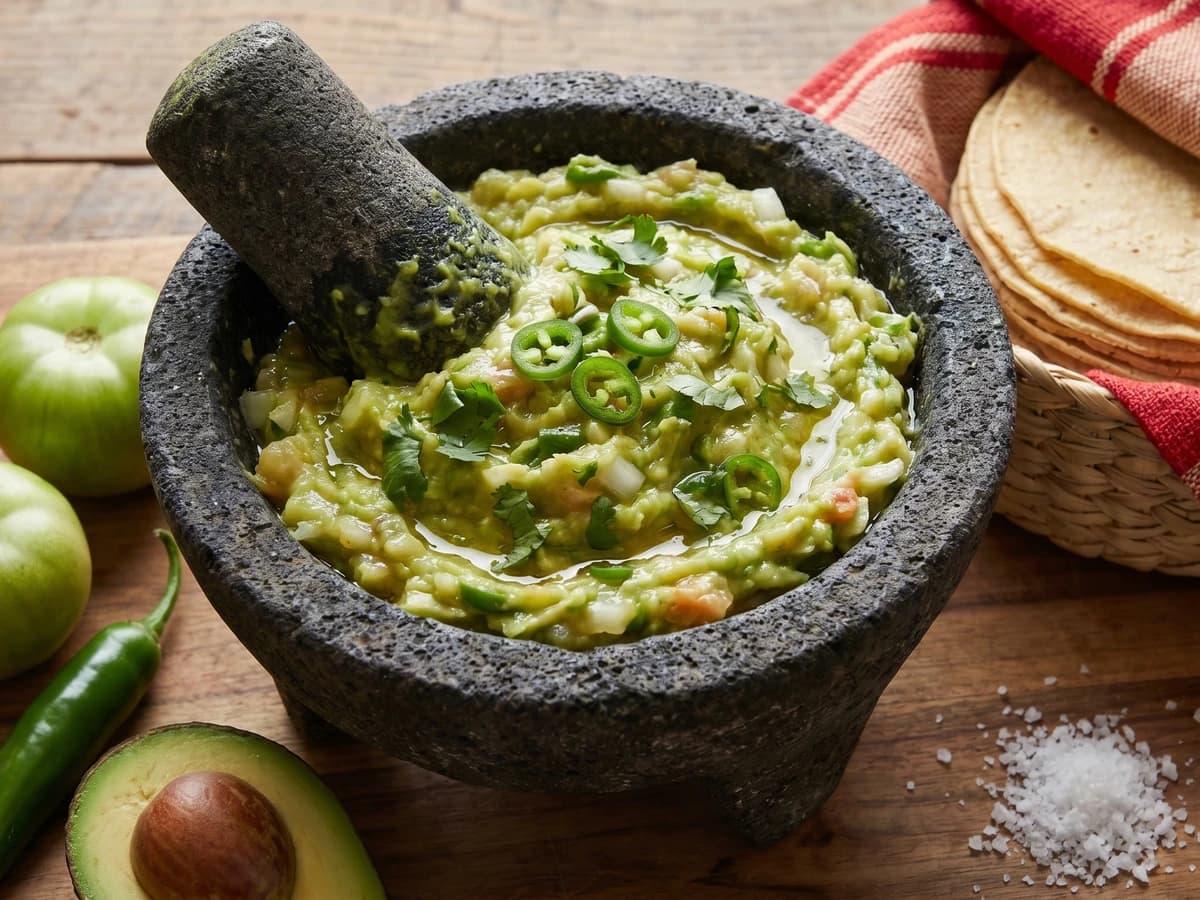
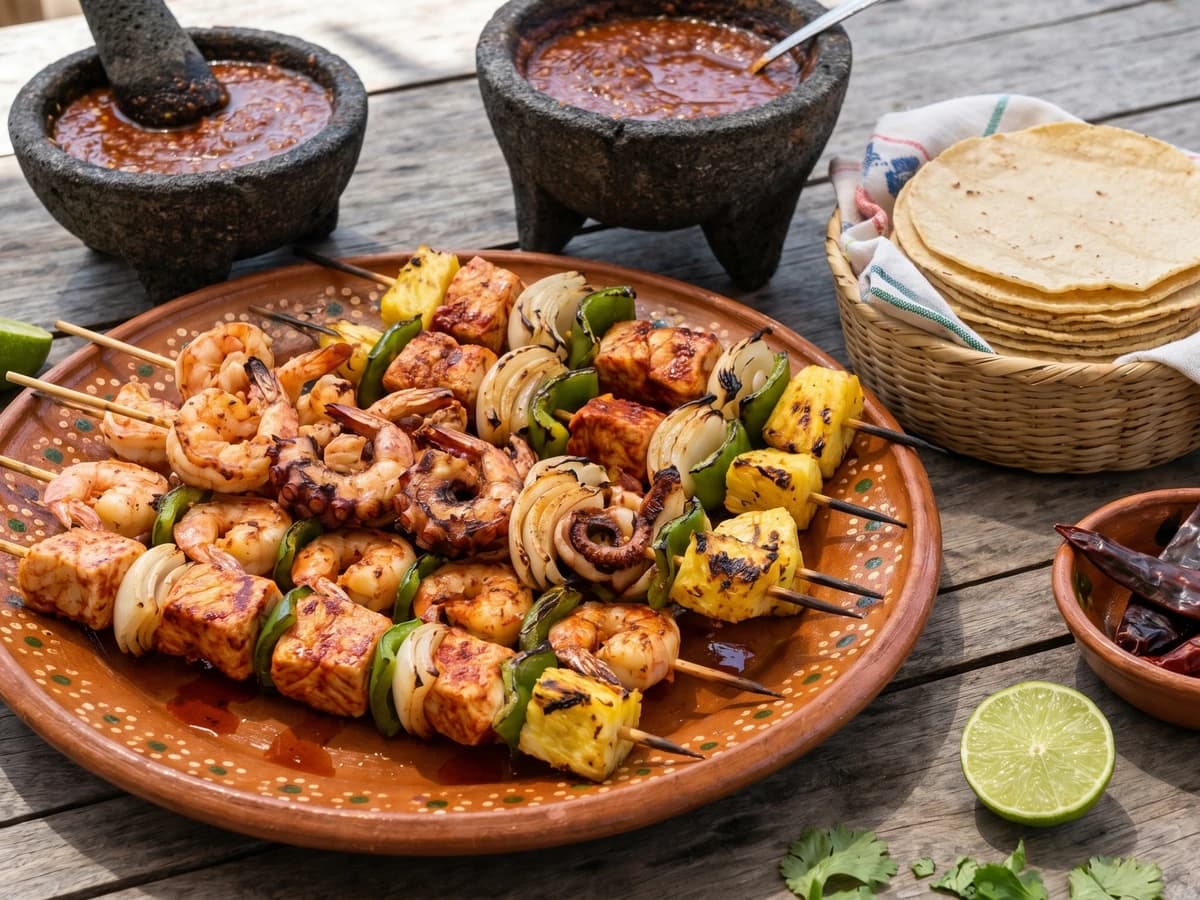
Nayarit's Pacific coast botana, cubes of firm white fish marinated with lime, garlic, and Salsa Huichol, double-dredged with masa harina and fried until the crust crackles.
Appetizers & Snacks
Mexican
Game Day
Outdoor Dining
Potluck
30 min
Active Time
18 min cook•48 min total
Yield6 servings
This is Nayarit, the Pacific coast from San Blas down through the palapas of Riviera Nayarit, where fish arrives in coolers before lunch and the table gets lime, onion, tostadas, and a bottle of Salsa Huichol before anyone asks for a menu.
Chicharrón de pescado is Nayarit's answer to pork chicharrón, but don't confuse the two. Here the crunch comes from firm white fish, lime and garlic, a double dredge, and oil kept hot enough to seal the crust before the fish dries out. Dorado, robalo, pargo, cabrilla, those are the fish that make sense on this coast. Ask the women at the fish stall what came in clean that morning. Si no conoces el mercado, no conoces la cocina.
The defining flavor is not some generic hot sauce. It is Salsa Huichol, born in Tepic, made with chile cascabel and vinegar, and used across Nayarit the way other regions use their house salsa. A spoonful goes into the marinade. More goes on the table. The fish comes out golden, rough-edged, salty, bright with lime, and meant to be eaten with your hands under a palapa or at a kitchen table with the doors open.
I learned this version from a woman near San Blas who fried fish for fishermen who had no patience for delicate food. She said the crust had to hold until the second beer. She was right. Cada estado, su propia cocina.
Nayarit's seafood cooking reflects the state's long Pacific identity, especially around San Blas, which became an important Spanish naval port in 1768 and connected local fishing communities to wider coastal trade. Salsa Huichol was created in Tepic in 1949 by Roberto Lopez Flores, and its chile cascabel base became part of the everyday table language of Nayarit marisquerias and home kitchens. The dish's name borrows the word chicharrón from pork rind because the goal is textural: a rough, crunchy exterior around tender fish, not a breaded fillet in the European style.
The technique, the tradition, and the story behind every dish.
skinless, cut into 1 1/2-inch cubes; dorado, robalo, pargo, or cabrilla
fresh Mexican lime juice
Quantity
1/2 cup
garlic cloves
Quantity
4
finely grated
Salsa Huichol
Quantity
1 tablespoon, plus more for serving
kosher salt
Quantity
1 1/2 teaspoons, plus more to finish
freshly ground black pepper
Quantity
1/2 teaspoon
dried Mexican oregano
Quantity
1 teaspoon
rubbed between your palms
all-purpose flour
Quantity
1 cup
cornstarch
Quantity
1/2 cup
masa harina
Quantity
1/2 cup
baking powder
Quantity
1 teaspoon
ground chile guajillo
Quantity
1 teaspoon
ground chile de arbol
Quantity
1/2 teaspoon
large eggs
Quantity
2
whole milk
Quantity
1/4 cup
vegetable oil or peanut oil
Quantity
6 cups
for frying
white onion
Quantity
1 small
thinly sliced
fresh cilantro leaves and tender stems
Quantity
1/2 cup
chopped
Mexican lime halves (optional)
Quantity
for serving
Salsa Huichol (optional)
Quantity
for serving
tostadas or warm corn tortillas (optional)
Quantity
for serving
Ingredient
Quantity
firm white Pacific fish filletsskinless, cut into 1 1/2-inch cubes; dorado, robalo, pargo, or cabrilla
2 pounds
fresh Mexican lime juice
1/2 cup
garlic clovesfinely grated
4
Salsa Huichol
1 tablespoon, plus more for serving
kosher salt
1 1/2 teaspoons, plus more to finish
freshly ground black pepper
1/2 teaspoon
dried Mexican oreganorubbed between your palms
1 teaspoon
all-purpose flour
1 cup
cornstarch
1/2 cup
masa harina
1/2 cup
baking powder
1 teaspoon
ground chile guajillo
1 teaspoon
ground chile de arbol
1/2 teaspoon
large eggs
2
whole milk
1/4 cup
vegetable oil or peanut oilfor frying
6 cups
white onionthinly sliced
1 small
fresh cilantro leaves and tender stemschopped
1/2 cup
Mexican lime halves (optional)
for serving
Salsa Huichol (optional)
for serving
tostadas or warm corn tortillas (optional)
for serving
Equipment Needed
•Sharp fillet knife
•Wide mixing bowls for marinating and dredging
•Heavy Dutch oven or deep clay cazuela suitable for frying
•Deep-fry thermometer
•Wire rack set over a sheet pan
•Kitchen spider or slotted spoon
Instructions
1
Cut the fish
Cut the fish into cubes about 1 1/2 inches wide. Keep them even so they fry at the same pace. Pat them very dry with a clean towel. Wet fish throws off the dredge and spits in the oil. A señora in San Blas will tell you the same thing before she lets you near her stove.
2
Marinate briefly
In a bowl, mix the lime juice, grated garlic, Salsa Huichol, salt, black pepper, and Mexican oregano. Add the fish and turn gently with your hands. Let it sit 15 minutes, no longer. Lime wakes up the fish and firms the surface, but leave it too long and you start making ceviche. This is chicharrón, not ceviche.
Use fresh lime juice, not bottled. Bottled lime tastes flat and metallic. If the limes at the market are dry, buy more and squeeze patiently.
3
Mix the dredge
In a wide dish, whisk together the flour, cornstarch, masa harina, baking powder, ground chile guajillo, and ground chile de arbol. The flour gives structure, the cornstarch gives crispness, and the masa harina gives the corn flavor that belongs on a Mexican table. Do not use bread crumbs. That is another dish.
4
Make the egg wash
In a second bowl, beat the eggs with the milk until loose and even. Set a wire rack over a sheet pan next to your dredging station. You need a place for the coated fish to rest before it goes into the oil. La cocina no es decoración, es trabajo.
5
Double dredge
Lift the fish from the marinade and let the excess drip back into the bowl. Dredge each piece in the flour mixture, dip it in the egg wash, then dredge it again, pressing lightly so the second coat clings. Set the pieces on the rack for 10 minutes. That short rest hydrates the coating and helps it fry into a rough, crunchy shell.
6
Heat the oil
Pour the oil into a heavy Dutch oven or deep cazuela and heat to 350F. The oil should be deep enough for the fish to float without touching the bottom. Use a thermometer if you have one. If you do not, drop in a pinch of dredge. It should bubble immediately and rise, not sink and sit there like a mistake.
7
Fry in batches
Fry the fish in small batches for 3 to 4 minutes, turning once, until the crust is deep golden and rough like pork chicharrón. Do not crowd the pot. Crowding drops the oil temperature and gives you greasy fish. The fish should sound lively in the oil, then quiet down as the crust sets. Drain on a rack, not paper towels, so the bottom stays crisp.
8
Salt and serve
Sprinkle the hot fish with a little salt as soon as it comes out of the oil. Pile it on a clay platter with sliced white onion, cilantro, lime halves, tostadas or warm corn tortillas, and a bottle of Salsa Huichol on the table. Eat it while the crust still snaps under your teeth. Recetas probadas y garantizadas.
Chef Tips
•Use firm white fish from the Pacific if you can: dorado, robalo, pargo, cabrilla. Tilapia works only if it is very fresh and thick-cut. It is a compromise, not an upgrade.
•Salsa Huichol belongs here because it belongs to Nayarit. If you cannot find it, look in a Mexican market before you substitute. Valentina or Tamazula will give heat and vinegar, but they will not give the same chile cascabel flavor.
•Do not marinate the fish for an hour. Lime is not passive. It changes the texture of the fish fast, and this dish needs a clean bite under the crust.
•Keep the oil at 350F. Below that, the coating drinks oil. Above 375F, the crust darkens before the fish cooks through. A thermometer is not weakness. It is discipline.
•Serve this as botana, not as a plated dinner pretending to be fine. Put the platter in the middle, onion and lime beside it, tostadas stacked in a basket, Salsa Huichol within reach. Así se hace y punto.
Advance Preparation
•Cut the fish up to 4 hours ahead, cover, and keep refrigerated over ice or in the coldest part of the refrigerator.
•Mix the dry dredge up to 1 day ahead and keep it covered at room temperature.
•Do not marinate or dredge the fish until shortly before frying. The lime and salt will draw out moisture, and moisture is the enemy of a crisp crust.
Frequently Asked Questions
Nutrition Information
1 serving (about 260g)
Calories
585 calories
Total Fat
26 g
Saturated Fat
5 g
Trans Fat
0 g
Unsaturated Fat
21 g
Cholesterol
125 mg
Sodium
1100 mg
Total Carbohydrates
52 g
Dietary Fiber
5 g
Sugars
2 g
Protein
38 g
Where cooking meets culture.
Culinary guides, cultural storytelling, and the editorial depth that makes cooking meaningful.