
Chef Jeong-sun
Albaechu-mul-kimchi (Baby Cabbage Water Kimchi)
Tender baby napa cabbage in a clear pear-garlic brine, lightly fermented until the broth turns clean and bright, the summer kimchi a beginner can make without a kimjang floor.
A cooking platform built around craft, culture, and the stories behind what we eat.
Created by
A clean Korean vegetable stock for soups, stews, and noodle bowls, drawing sweetness from radish and onion, body from shiitake, and clean sea depth from kelp without one bone in the pot.
The misunderstanding is that stock needs bones to be serious. Bones are only one road. Korean kitchens have always known other ones: radish for sweetness, dried shiitake for body, dasima (kelp) for the clean sea taste that lets a soup stand up straight. Vegetables are less forgiving than bones. Cut them too small and they collapse into a cloudy pot. Boil the kelp hard and it gives you slickness and bitterness. Draw everything out slowly and you get a broth that can carry mandu-guk, kalguksu, doenjang-jjigae, or a quiet bowl of juk.
In Master Seong-nyeo's kitchen, scallion roots were never thrown away. They went into a little bowl by the sink, scrubbed later, then into stock. A strict temple kitchen would leave them out, along with onion and garlic, because osinchae (five pungent vegetables) are avoided there. A home meatless stock can use them honestly. I give you both paths, because 시대가 바뀌면 음식도 바뀌어야 해요. When times change, food must change too.
Tonight this asks for patience, not skill: a 30-minute cold soak, a slow climb to a simmer, and the discipline to pull the kelp before the pot boils. Do not salt the base stock. Salt belongs to the soup or stew you make from it, because tomorrow's pot may need a different hand. Write down your yield. Memory is a borrowed bowl.
Buddhism was officially introduced to Goguryeo in 372, and Korean temple cooking grew from monastic practice that kept meat and fish out of the pot and often avoided osinchae, the five pungent vegetables. Chaeso yuksu is a modern practical name, not a court dish: yuksu comes from the Hanja for meat and water, but Korean cooks now use the word for many stocks, including kelp, anchovy, mushroom, and vegetable broths. A strict temple stock leaves out scallion root, garlic, and onion; the home version recorded here keeps scallion roots optional because Korean house kitchens saved them for sweetness.
Quantity
10 cups
Quantity
2 pieces, about 6 by 4 inches each, 20g total
wiped clean
Quantity
6 medium, about 20g
stems included
Quantity
350g
scrubbed or peeled and cut into 1/2-inch slabs
Quantity
1 medium, about 200g
quartered, peel left on if clean
Quantity
6 roots, about 10g
scrubbed well
| Ingredient | Quantity |
|---|---|
| cold water | 10 cups |
| dried kelp (dasima)wiped clean | 2 pieces, about 6 by 4 inches each, 20g total |
| dried shiitake mushrooms (mareun pyogo beoseot)stems included | 6 medium, about 20g |
| Korean radish (mu)scrubbed or peeled and cut into 1/2-inch slabs | 350g |
| onion (optional)quartered, peel left on if clean | 1 medium, about 200g |
| scallion roots (optional)scrubbed well | 6 roots, about 10g |
Wipe the kelp with a barely damp cloth, but do not wash off the pale powder on the surface. That powder is flavor. Rinse the dried shiitake briefly if dusty. Cut the radish into 1/2-inch slabs so it gives sweetness without falling apart and clouding the stock. Scrub the scallion roots until no grit remains.
Put the water, kelp, and dried shiitake in a 4-quart pot and let them soak 30 minutes. Cold water draws out the kelp and mushroom slowly, giving body before the fire ever starts. If you have time, cover the pot and soak it in the refrigerator overnight for a deeper stock.
Add the radish, onion, and scallion roots to the pot. For a strict temple-style stock, leave out the onion and scallion roots and add 100g more radish plus 2 extra shiitake stems instead. That keeps the broth sweet and full without using osinchae, the five pungent vegetables.
Set the pot over medium-low heat and bring it up slowly, about 20 minutes, until small bubbles gather around the edge. Lift out the kelp before the pot reaches a full boil. Boiled hard, kelp turns the broth slick and faintly bitter. Treated gently, it gives a clean sea backbone.
Keep the pot at a gentle simmer for 30 to 35 minutes more, with only small bubbles rising. Do not let it roll hard. The radish should look slightly translucent at the edges and the onion should slump. Do not add salt. This is a base, and the dish you cook tomorrow will decide its own seasoning.
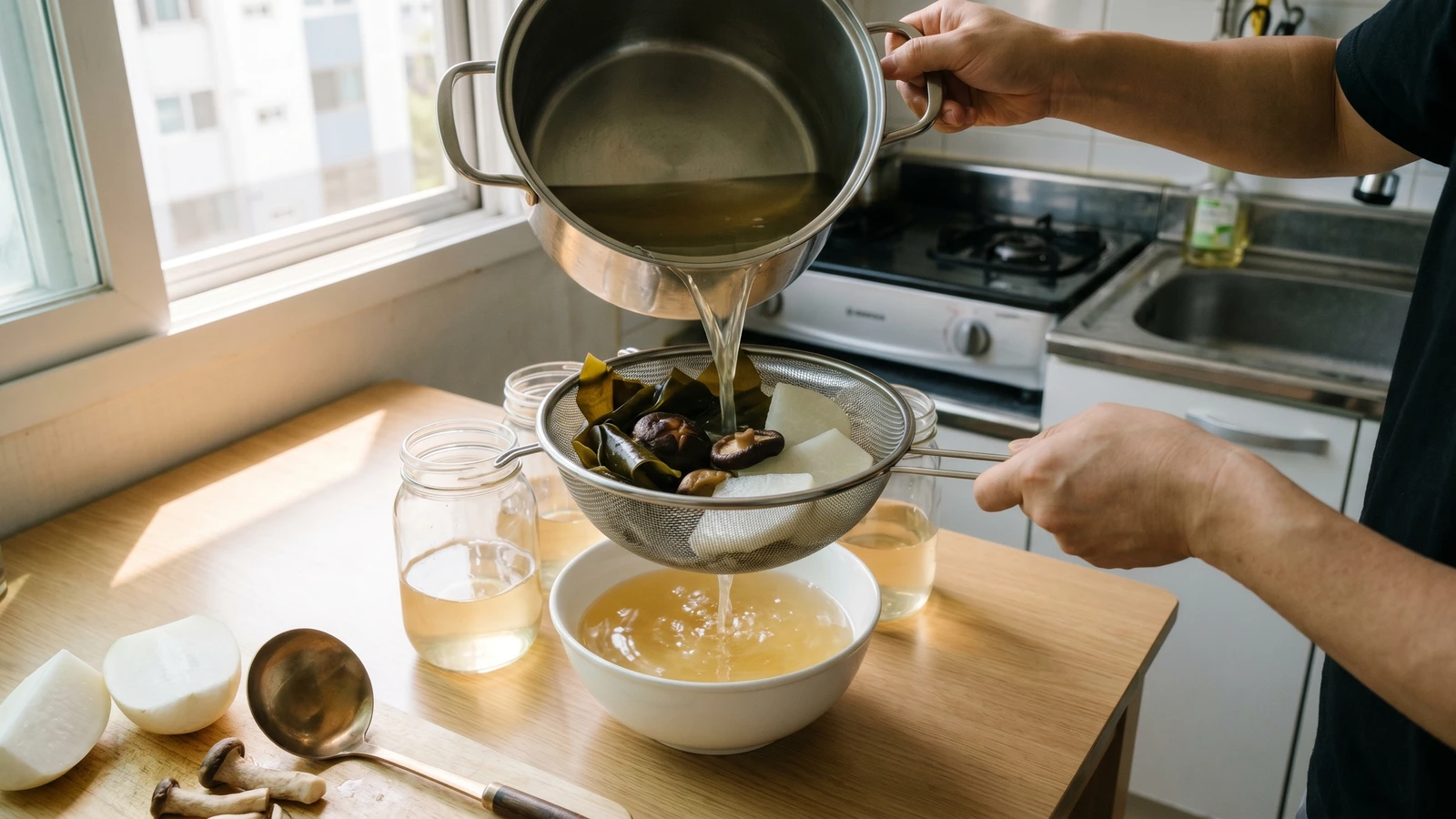
Strain the stock through a fine-mesh strainer into a large bowl or measuring jug. Do not press hard on the vegetables, or you push cloudiness and bitterness into the broth. You should have about 8 cups. If you have more, simmer the strained stock a few minutes to concentrate it; if you have less, add water back to 8 cups and write that down.
Cool the stock quickly, then refrigerate it in clean containers within 2 hours. It keeps 4 days in the refrigerator or 3 months in the freezer. Freeze some in 1-cup portions for jjigae and 2-cup portions for noodle bowls. That is how a weeknight cook thanks yesterday's cook.
1 serving (about 240g)
Culinary guides, cultural storytelling, and the editorial depth that makes cooking meaningful.
Discover Culinary ExplorerChef Jeong-sun
Tender baby napa cabbage in a clear pear-garlic brine, lightly fermented until the broth turns clean and bright, the summer kimchi a beginner can make without a kimjang floor.

Chef Jeong-sun
The kimchi from before chili, salted napa cabbage packed with radish, pear, jujube, and pine nuts in a clear brine that turns quietly tart in the jar.

Chef Jeong-sun
A pale summer cucumber kimchi, split and stuffed with radish and chives, then held in a cool pear brine so the cucumber stays clean, crunchy, and plainly itself.

Chef Jeong-sun
Flat spring bomdong cabbage, lightly brined and tucked into a clear pear-radish kimchi broth, made without chili and eaten young while the leaves still taste like spring.