
Chef Graziella
Cassata Gelata
Sicily's frozen treasure, where sheep's milk ricotta becomes ice cream studded with jewels of candied fruit and pistachios, embraced by tender sponge cake. Baroque simplicity, if such a thing exists.
A cooking platform built around craft, culture, and the stories behind what we eat.
Created by
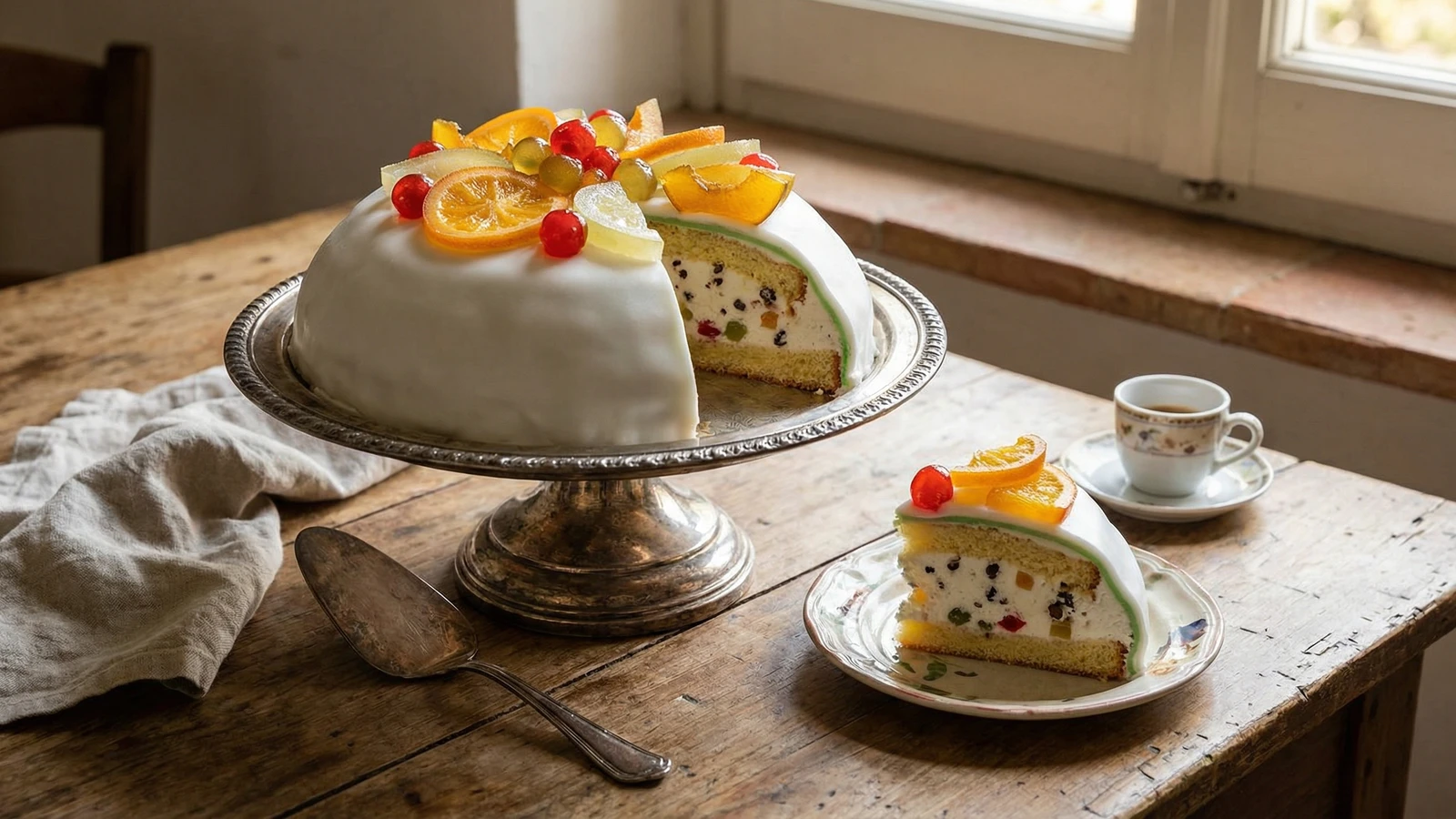
The great Easter cake of Sicily, where Arab confectionery traditions meet convent perfection. Sheep's milk ricotta, almond paste, and candied citrus beneath a crown of jeweled fruits.
Cassata is not a cake you make on a whim. It demands time, proper ingredients, and the understanding that Sicilian pastry exists at the intersection of Arab sophistication and Catholic devotion. The nuns who perfected this in Palermo's convents had nothing but time, and they used every hour of it.
The ricotta must be from sheep's milk. Cow's milk ricotta is too mild, too wet, too forgiving. Sicilian sheep's milk ricotta has tang and density that stands up to the sweetness of the candied fruits. If you cannot find it, strain the best whole-milk ricotta you can buy through cheesecloth for 24 hours. It will not be the same, but it will be acceptable.
The marzipan covering is not decoration. It seals the moisture in and creates a canvas for the white icing. The candied fruits on top are not garnish. They are the jewels in the crown, each one placed with the same care a Baroque craftsman would give to a church altar. This is a dessert that proves excess, when executed with precision, becomes its own form of restraint.
Cassata traces its origins to 10th-century Arab Sicily, where the Saracens introduced sugar cane, almonds, and candied citrus to the island. The name likely derives from the Arabic 'qas'ah,' the round bowl in which it was molded. Palermo's Convent of the Martorana perfected the marzipan covering in the 14th century, and the Baroque candied fruit decorations emerged two centuries later, transforming a simple ricotta cake into the architectural confection it remains today.
Quantity
4
at room temperature
Quantity
120g
Quantity
120g
sifted twice
Quantity
1 teaspoon
Quantity
pinch
Quantity
500g
drained overnight
Quantity
200g
sifted
Quantity
100g
diced small
Quantity
50g
diced small
Quantity
60g
chopped into small pieces
Quantity
1/2 teaspoon
Quantity
5 tablespoons total
Quantity
100g
Quantity
100ml
Quantity
300g
Quantity
300g
Quantity
2 tablespoons
Quantity
2-3 tablespoons
Quantity
few drops
Quantity
300g
sifted
Quantity
2-3 tablespoons
Quantity
for decoration
Quantity
for decoration
| Ingredient | Quantity |
|---|---|
| large eggsat room temperature | 4 |
| granulated sugar (for cake) | 120g |
| Italian 00 floursifted twice | 120g |
| vanilla extract | 1 teaspoon |
| fine sea salt | pinch |
| sheep's milk ricottadrained overnight | 500g |
| powdered sugar (for filling)sifted | 200g |
| candied orange peeldiced small | 100g |
| candied citrondiced small | 50g |
| bittersweet chocolatechopped into small pieces | 60g |
| ground cinnamon | 1/2 teaspoon |
| maraschino liqueur | 5 tablespoons total |
| granulated sugar (for syrup) | 100g |
| water (for syrup) | 100ml |
| almond flour | 300g |
| powdered sugar (for marzipan) | 300g |
| honey | 2 tablespoons |
| cold water | 2-3 tablespoons |
| green food coloring (optional) | few drops |
| powdered sugar (for icing)sifted | 300g |
| lemon juice | 2-3 tablespoons |
| assorted candied fruits | for decoration |
| candied violets or sugar flowers (optional) | for decoration |
Preheat your oven to 180°C (350°F). Butter and flour a 23cm springform pan. In a stand mixer fitted with the whisk attachment, beat the eggs and sugar on high speed for 10 to 12 minutes. The mixture must triple in volume and fall from the whisk in thick ribbons that hold their shape for several seconds. This is not negotiable. Under-beaten eggs produce a dense, sad cake.
Add the vanilla and salt to the egg mixture. Sift the flour over the batter in three additions, folding gently with a large rubber spatula after each. Fold from the bottom of the bowl upward, turning the bowl as you go. You are preserving the air you just spent 12 minutes beating in. Stop the moment no dry flour remains visible.
Pour the batter into the prepared pan and smooth the top gently. Bake for 22 to 25 minutes, until the cake is golden and springs back when touched lightly in the center. A toothpick inserted should emerge clean. Cool in the pan for 10 minutes, then unmold onto a rack. Cool completely. The cake is easier to slice when made a day ahead and wrapped tightly.
Push the drained ricotta through a fine-mesh sieve into a large bowl. This step is essential. Un-sieved ricotta produces a grainy filling that will betray you. Add the sifted powdered sugar and beat with a wooden spoon until smooth. Fold in the diced candied orange peel, citron, chocolate pieces, cinnamon, and maraschino liqueur. The filling should be thick enough to hold its shape.
Combine the sugar and water in a small saucepan. Bring to a boil, stirring until the sugar dissolves. Remove from heat and let cool to room temperature. Stir in the maraschino liqueur. The syrup should be fragrant but not overpowering.
Combine the almond flour and powdered sugar in a food processor. Pulse to blend. Add the honey and water one tablespoon at a time, pulsing until the mixture comes together into a smooth, pliable dough. Add a few drops of green food coloring if you wish to follow tradition. Knead briefly on a surface dusted with powdered sugar until uniform. Wrap tightly in plastic and let rest for 30 minutes.
Line a deep 20cm bowl with plastic wrap, leaving generous overhang. Roll out two-thirds of the marzipan between sheets of plastic wrap into a circle large enough to line the bowl with some overhang. Press it into the bowl, smoothing to eliminate air pockets. Slice the sponge cake horizontally into three layers. Line the marzipan with cake slices, cutting to fit and pressing gently to adhere. Brush generously with soaking syrup.
Spoon half the ricotta filling into the cake-lined bowl, spreading evenly. Add another layer of cake, brush with syrup, then add the remaining ricotta. Top with the final cake layer, pressing gently. Brush with the remaining syrup. Fold the marzipan overhang over the top. Roll out the remaining marzipan and place it over the top to seal completely. Cover with plastic wrap and refrigerate overnight.
Invert the cassata onto a serving plate and remove the plastic wrap. Whisk together the powdered sugar, lemon juice, and water until you have a smooth, pourable icing. It should coat the back of a spoon thickly. Pour over the cassata, using an offset spatula to spread it evenly over the top and sides. The icing should be opaque white and glossy. Let set for 30 minutes.
Arrange the candied fruits on top of the iced cassata. This is where your artistic eye matters. Traditional arrangements feature candied orange and citron slices, bright red cherries, and pale green citron in geometric or floral patterns. The fruits should be placed while the icing is slightly tacky so they adhere. Refrigerate for at least 2 hours before serving, but bring to cool room temperature 30 minutes before cutting.
1 serving (about 185g)
Culinary guides, cultural storytelling, and the editorial depth that makes cooking meaningful.
Discover Culinary ExplorerChef Graziella
Sicily's frozen treasure, where sheep's milk ricotta becomes ice cream studded with jewels of candied fruit and pistachios, embraced by tender sponge cake. Baroque simplicity, if such a thing exists.
Chef Graziella
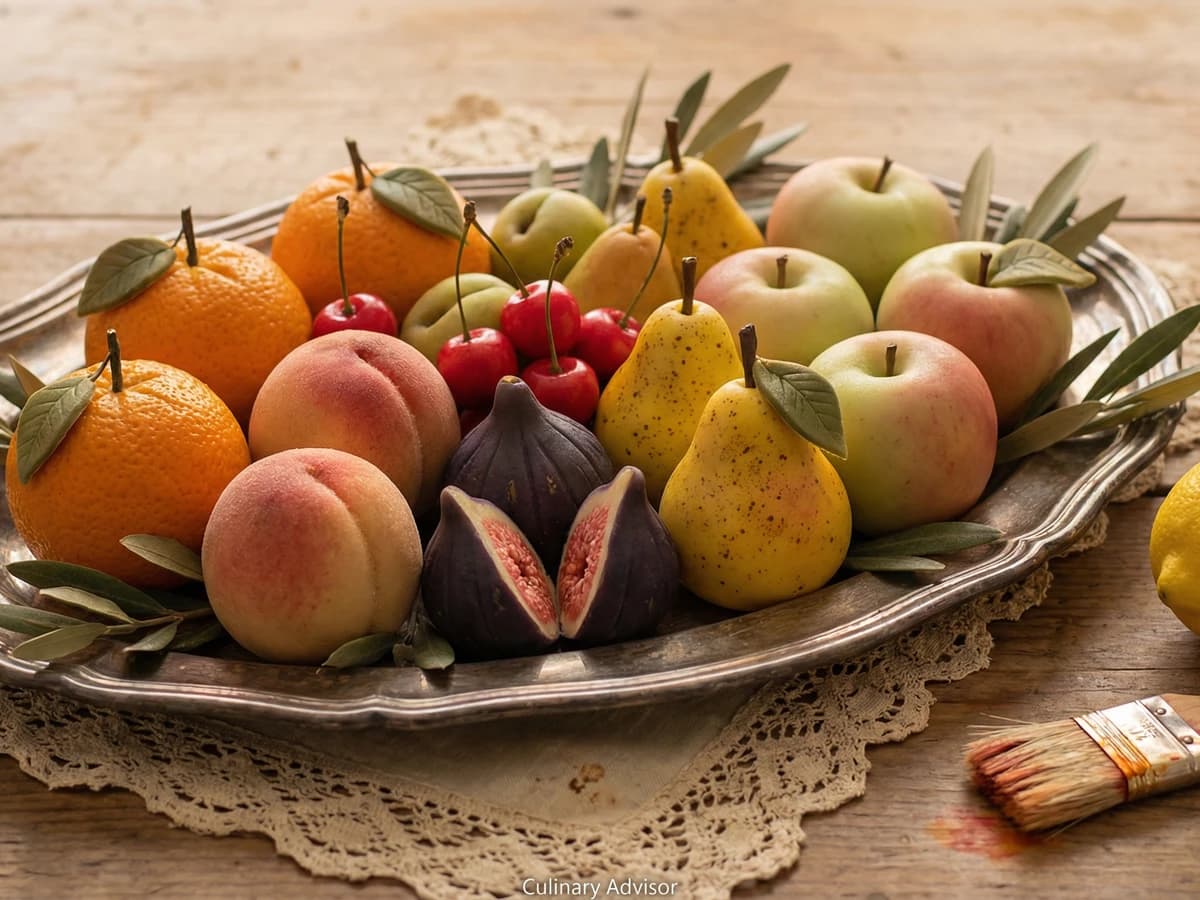
The marzipan fruits of Palermo, shaped and painted by hand until they deceive the eye. A tradition born in a convent garden, kept alive by Sicilian patience and the understanding that food can also be art.

Chef Graziella
The crystalline almond ice of Sicily, scraped by hand into rough flakes and served with soft brioche at dawn. In Catania, this is how mornings begin.

Chef Juliette
Five almond preparations, one discipline: remove the skins cleanly, dry every kernel through, then cut, toast, or cloak it in pale caramel without letting its fragrant oils escape.