Culinary Explorer

A cooking platform built around craft, culture, and the stories behind what we eat.
Discover Culinary Explorer
Carnitas Estilo Quiroga

Carnitas Estilo Quiroga

Created by

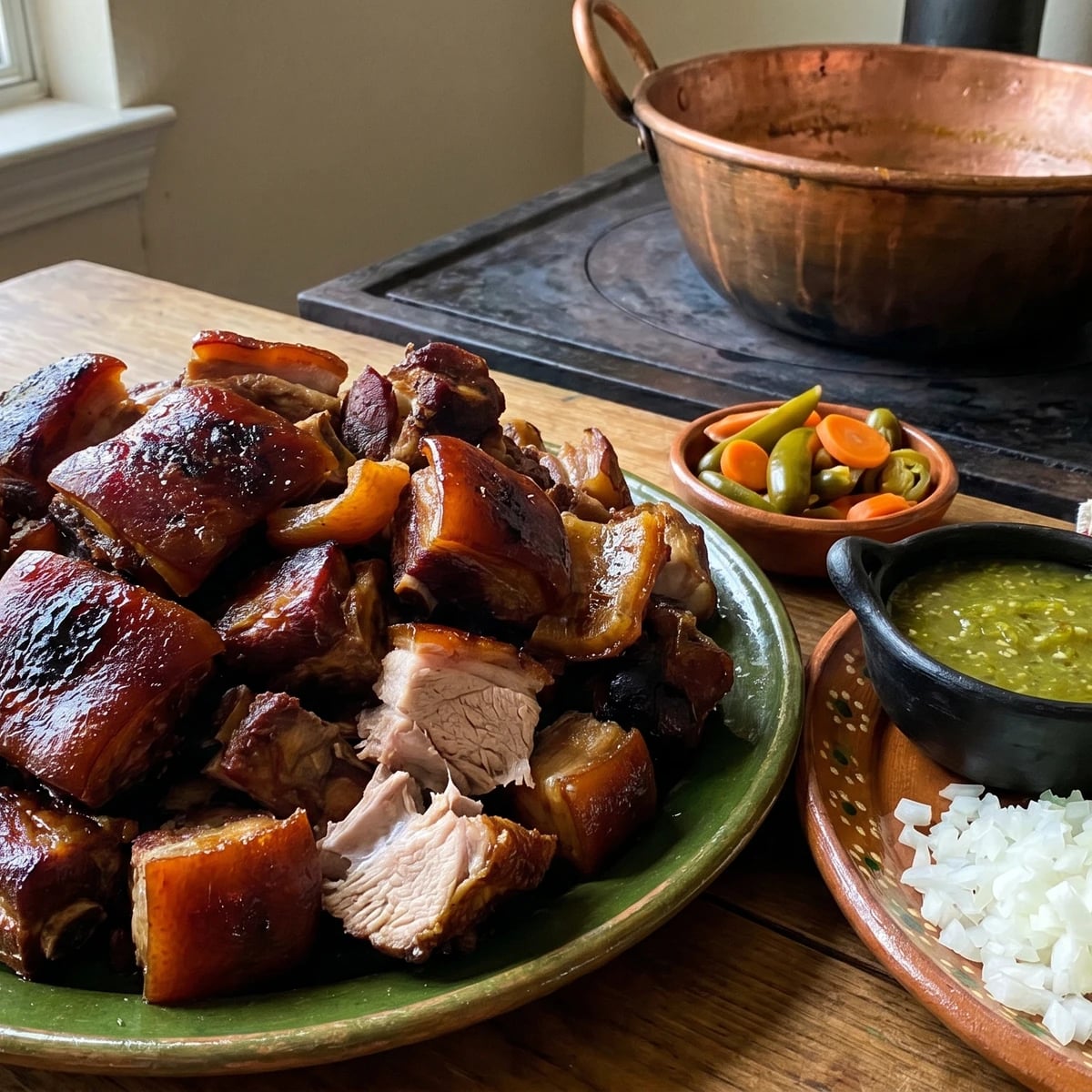
Quiroga's carnitas are Michoacán pork cooked in manteca de cerdo inside a copper cazo, worked patiently until the skin crackles, the edges darken, and the taco needs nothing but onion, cilantro, salsa, and lime.

Main Dishes
Mexican
Special Occasion
Comfort Food
Celebration
30 min
Active Time
3 hr 30 min cook4 hr total
Yield10 to 12 servings

Michoacán, specifically Quiroga on the road between Morelia and Lake Pátzcuaro, owns this carnitas tradition. You smell it before you see it: pork, manteca de cerdo, leña, copper, and corn tortillas warming on the comal. This is not food from a single Mexico. This is the P'urhépecha plateau and lake region speaking through a cazo de cobre.

Quiroga's carnitas live in the market and in the family party, sold by the kilo and carried home in paper with tortillas from the milpa. The technique belongs to the men at the copper cazos, yes, but the discipline of the table belongs to the cocineras tradicionales of Zacán, Janitzio, Cocucho, Cherán, and Uruapan, the women who have kept Michoacán's food memory intact dish by dish. They know what comes from the monte, what comes from the milpa, and what comes from the lago: kurucha and acúmara for fish meals, atápakua for deep P'urhépecha sauces, and pork for this celebration pot.

The fat is not a detail. La manteca es el sabor. The pork cooks slowly in lard until the water leaves, the milk sugars brown, and the meat begins to fry in its own richness. If you try to make this with a lean cut and a spoonful of oil, don't call it Quiroga. No me vengas con atajos.

My mother did not write this one from Jalisco. I wrote it myself after standing beside a cazo in Quiroga while a cook moved the meat with a wooden paddle and corrected every lazy assumption I had. Salt early. Watch the skin. Do not crowd the cazo. Save the lard. Saber cocinar es saber vivir.

Quiroga, formerly Cocupao, sits in the P'urhépecha region shaped by the pre-Hispanic Tarascan state, whose ruler was called the Cazonci, and later by Vasco de Quiroga's 16th-century pueblo-hospital system. Spanish pigs arrived in Michoacán after the conquest, while Santa Clara del Cobre's copper-working tradition supplied the cazos that made large-batch carnitas practical for markets and celebrations. In 2010, UNESCO recognized Traditional Mexican Cuisine through the Michoacán paradigm, citing the living transmission of milpa, market, and ceremonial cooking carried by cocineras tradicionales.

The technique, the tradition, and the story behind every dish.

Discover Culinary Explorer

Ingredients

mixed pork shoulder, pork belly, ribs, and skin-on leg

Quantity

6 pounds

cut into fist-sized pieces

manteca de cerdo (pork lard)

Quantity

4 pounds

enough to come halfway up the pork

coarse sea salt

Quantity

2 tablespoons, plus more to taste

head of garlic

Quantity

1

halved crosswise

white onion

Quantity

1 large

quartered

bay leaves

Quantity

2

fresh thyme

Quantity

2 sprigs

fresh marjoram

Quantity

2 sprigs

orange

Quantity

1

halved

whole milk

Quantity

1 cup

Mexican Coca-Cola made with cane sugar

Quantity

1/2 cup

water

Quantity

1/2 cup

pork cueritos or extra pork skin (optional)

Quantity

2 pounds

cut into wide strips

hand-pressed corn tortillas (optional)

Quantity

for serving

warmed on a comal

finely diced raw white onion (optional)

Quantity

for serving

chopped fresh cilantro (optional)

Quantity

for serving

lime wedges (optional)

Quantity

for serving

salsa verde de tomatillo and chile serrano (optional)

Quantity

for serving

pickled jalapeños and carrots (optional)

Quantity

for serving

Equipment Needed

  • Copper cazo de cobre from Santa Clara del Cobre or wide heavy Dutch oven
  • Long wooden spoon or carnitas paddle
  • Wire rack set over a sheet pan
  • Fine-mesh strainer for saving the lard
  • Comal for warming corn tortillas

Instructions

  1. 1

    Salt the pork

    Pat the pork pieces dry and season them all over with the coarse salt. Let them sit at room temperature for 30 minutes while you prepare the cazo. The salt starts working before the meat touches the fat. Do not skip the skin, the belly, or the ribs. Carnitas needs different textures in the same pot.

  2. 2

    Melt the manteca

    Set a copper cazo over a steady medium fire, or use a wide heavy Dutch oven if that is what your kitchen allows. Add the manteca de cerdo and melt it slowly. The fat should shimmer gently, not smoke. You want enough lard to come halfway up the meat once it goes in. Yes, that much. La manteca es el sabor.

    A copper cazo from Santa Clara del Cobre spreads heat beautifully, which is why Quiroga cooks use it. If you use enameled cast iron, keep the heat lower and stir more often.
  3. 3

    Add aromatics

    Lower in the garlic, onion, bay leaves, thyme, and marjoram. Squeeze the orange halves over the fat and drop the halves into the cazo. Let everything sizzle for two minutes so the lard takes on the aroma. This is not perfume. It is structure. The pork will taste flat without it.

  4. 4

    Start the confit

    Add the pork pieces carefully, skin side down where possible. The fat should bubble around the edges in a slow, steady rhythm. Pour in the water. Cook uncovered for 90 minutes, moving the pieces every 20 minutes with a wooden spoon or paddle. The meat should firm first, then slowly relax. That is the collagen beginning to surrender.

  5. 5

    Add milk and cola

    Stir together the whole milk and Mexican Coca-Cola, then pour the mixture around the edge of the cazo, not directly over one piece of meat. It will bubble hard for a moment. Let it. The milk helps the surface brown and the cane sugar deepens the mahogany edges. Use Mexican cola with cane sugar or leave it out. Corn syrup cola gives the wrong sweetness.

  6. 6

    Cook until tender

    Continue cooking for 60 to 75 minutes more, turning the pork gently so the pieces stay whole. The liquid will reduce and the fat will clear again. Test a shoulder piece with a fork. It should pull apart, but it should not collapse into shreds. Quiroga carnitas are sold in chunks, not as wet pulled pork.

  7. 7

    Brown the edges

    Raise the heat slightly for the final 20 to 30 minutes. Stir more often now. The pork will begin to fry in the clear lard, the skin will blister, and the edges will turn dark amber to mahogany. Watch closely. This is the moment that separates carnitas from boiled pork. Pull each piece as it reaches the color you want.

  8. 8

    Drain and rest

    Lift the carnitas onto a wire rack set over a tray or onto a clay platter lined with clean paper. Let them rest for 10 minutes. Strain the lard through a fine-mesh sieve while it is still fluid and save it. That lard is now seasoned with pork, orange, garlic, and time. It belongs in beans, atápakua, and the next cazo of carnitas.

  9. 9

    Serve like Quiroga

    Chop some pieces and leave others in rough chunks. Pile the carnitas high on a barro plate or serve them straight from the cazo. Put warm corn tortillas from the comal, raw white onion, cilantro, lime, salsa verde, and pickled jalapeños on the table. Each person builds a taco. Flour tortillas belong to the north. Here, the tortilla is corn from the milpa. Cada estado, su propia cocina.

Chef Tips

  • Ask the butcher for a mixed cut: shoulder for meat, belly for fat, ribs for flavor, and skin for crackle. If they offer you only lean pork loin, walk away. Lean carnitas is a contradiction.
  • Do not crowd the cazo. If the pork sits in a tight pile, it steams before it fries. Use a wider pot or cook in two batches.
  • Salsa verde is the right table salsa here: tomatillo, chile serrano, white onion, cilantro, and salt. Carnitas do not need cheese, crema, lettuce, or any of that noise.
  • If you are cooking outside over leña, keep the fire steady and modest. Big flames scorch the lard and blacken the pork before the inside is tender.
  • The copper cazo matters because it spreads heat evenly, but the principle matters more: slow confit first, browning at the end. Understand that and you can cook well in a city apartment too.

Advance Preparation

  • The pork can be cut and salted up to 12 hours ahead. Keep it covered in the refrigerator, then bring it toward room temperature for 45 minutes before cooking.
  • Carnitas are best the day they are made, but leftovers reheat well on a hot comal or in a 425F oven until the edges crisp again.
  • Strained carnitas lard keeps refrigerated for several months. Label it and guard it. A spoonful in beans is a quiet education.

Frequently Asked Questions

Nutrition Information

1 serving (about 300g)

Calories
790 calories
Total Fat
52 g
Saturated Fat
19 g
Trans Fat
0 g
Unsaturated Fat
28 g
Cholesterol
160 mg
Sodium
980 mg
Total Carbohydrates
33 g
Dietary Fiber
5 g
Sugars
6 g
Protein
43 g

Note: Chef personas and recipes are created with AI assistance. Cook with care: follow safe food-handling practices, check doneness with a thermometer when needed, and adapt for allergies and your kitchen.

Where cooking meets culture.

Culinary guides, cultural storytelling, and the editorial depth that makes cooking meaningful.

Discover Culinary Explorer

More from Kurucha Urapiti, Acúmara & Platos en Atápakua

Browse the full collection