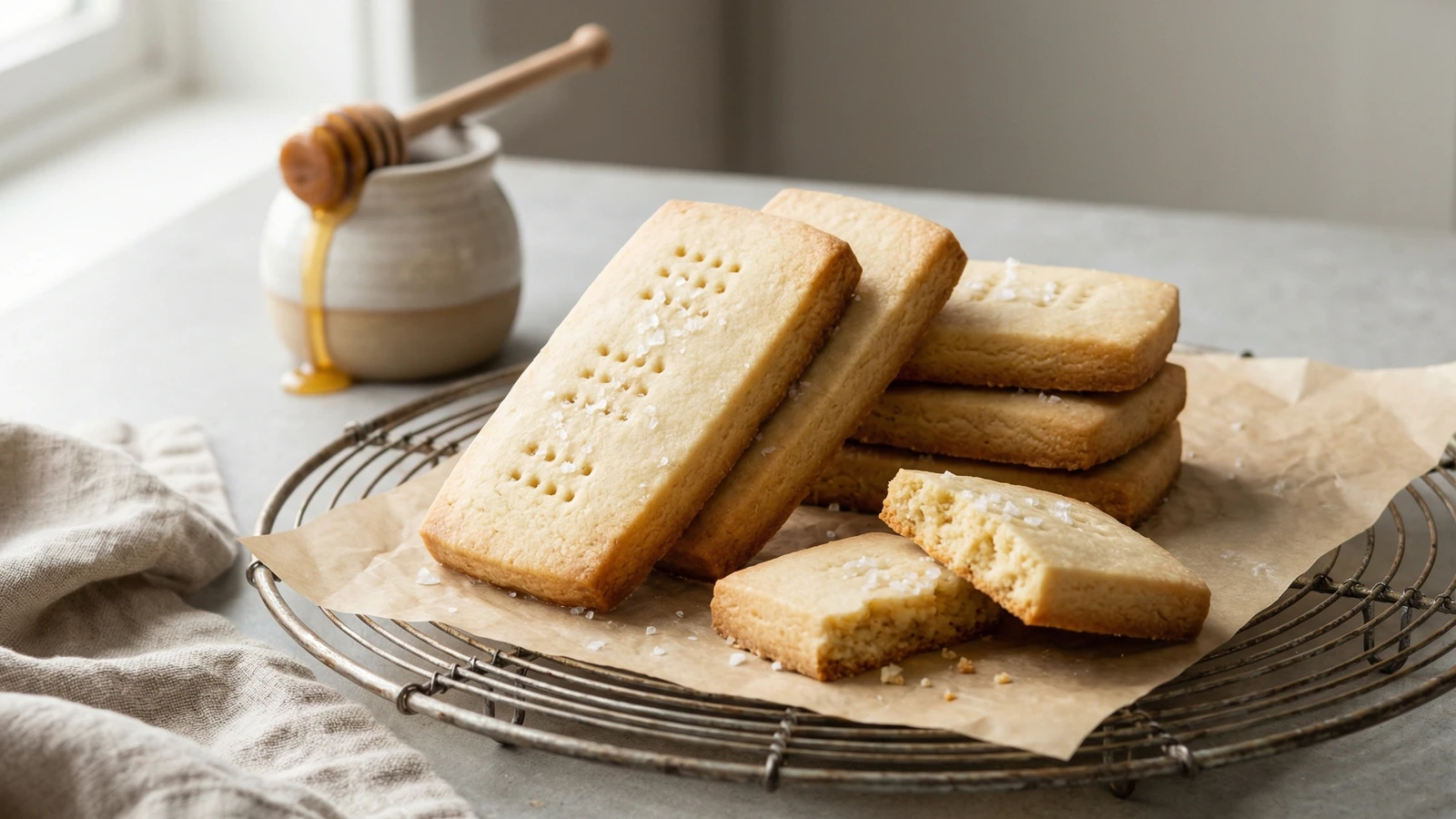
Tender, sandy shortbread transformed by honey taken to the edge of burnt, where sweetness becomes something deeper, more interesting, and entirely worth the extra five minutes at the stove.
Pastries & Cookies
American
Make Ahead
Dinner Party
20 min
Active Time
45 min cook•1 hr 5 min total
Yield24 cookies
Shortbread asks so little of you. Butter, flour, something sweet, a bit of salt. That simplicity is its genius and its trap. When a cookie has nowhere to hide, every ingredient must earn its place.
Caramelizing the honey changes everything. Raw honey is pleasant enough, floral and sweet in an uncomplicated way. But cook it until it darkens to the color of aged bourbon, and you've created something with real character. The sugars break down. Bitterness emerges at the edges. What was simply sweet becomes layered, almost smoky, with a depth that makes people pause mid-bite and ask what you've done.
This technique came to me from a beekeeper in Oregon who refused to let a single drop of her honey go unremarked upon. She'd cook it down for her morning toast, insisting the raw stuff was wasted on anything that wasn't medicine. I thought she was being precious until I tried it. That first batch of shortbread disappeared before it cooled.
The method requires attention but not skill. You'll stand at the stove for five minutes, watching the honey bubble and darken. That's the whole trick. The rest is standard shortbread procedure, which means pressing dough into a pan and waiting. American home bakers have made shortbread their own, and this version fits right into that tradition: simple technique, honest ingredients, results that punch well above their weight.
The technique, the tradition, and the story behind every dish.
Pour the honey into a small, light-colored saucepan. A light pan lets you watch the color change, which is your only reliable indicator. Set it over medium heat. The honey will thin out first, then begin to bubble actively around the edges. Swirl the pan occasionally but don't stir. After 4 to 6 minutes, the honey will darken from pale gold to deep amber, the color of maple syrup or aged bourbon. You'll smell it shift from sweet to toasty, with a hint of something almost burnt. That's exactly right. Remove from heat immediately.
If your honey starts to smoke or smells acrid, you've gone too far. Start over. Burnt honey is bitter in the wrong way.
2
Add cream and cool
Carefully pour the heavy cream into the hot honey. It will bubble and sputter, so stand back. Whisk until smooth. The cream prevents the caramelized honey from seizing into a hard candy when it cools. Transfer to a heatproof bowl and let it cool to room temperature, about 20 minutes. It should be pourable but not hot. Patience here matters.
3
Beat butter and honey
In a large bowl, beat the softened butter with an electric mixer until pale and fluffy, about 2 minutes. The butter should hold soft peaks when you lift the beater. Pour in the cooled caramelized honey and the fine sea salt. Beat until thoroughly combined, scraping down the sides of the bowl. The mixture will look glossy and smell like something you want to eat with a spoon. Resist.
4
Add dry ingredients
Whisk the flour and cornstarch together in a separate bowl. The cornstarch gives shortbread its characteristic sandy, melt-in-your-mouth texture. Add the dry ingredients to the butter mixture in two additions, mixing on low speed just until the dough comes together. It will look shaggy at first, then clump into a cohesive mass. Stop mixing the moment you see no dry streaks. Overworked shortbread turns tough.
5
Press into pan
Line a 9x13-inch baking pan with parchment paper, leaving overhang on the long sides for easy removal. Transfer the dough to the pan. Press it into an even layer using your hands first, then smooth the surface with the bottom of a measuring cup or a small offset spatula. The dough is forgiving. Take your time getting the thickness uniform, because uneven dough bakes unevenly. Refrigerate for at least 30 minutes or until firm to the touch.
For round shortbread wedges, press the dough into a 9-inch tart pan with a removable bottom instead.
6
Score and dock
Preheat your oven to 300°F. Remove the chilled dough from the refrigerator. Using a sharp knife or bench scraper, score the surface into 24 rectangles. Don't cut all the way through. These marks guide your breaking after baking. Then dock the entire surface with a fork, pressing the tines all the way to the bottom of the dough. The holes let steam escape so the shortbread stays flat and dense rather than puffing.
7
Bake low and slow
Bake for 40 to 50 minutes, rotating the pan halfway through. The shortbread is done when the edges are golden brown and the center looks dry and set but not dark. The top should be pale gold, never tan. Shortbread continues to firm as it cools, so err on the side of underdone if you're uncertain. A slightly soft center is better than an overbaked cookie.
8
Finish and cool
Remove from the oven and immediately sprinkle the surface with flaky sea salt. The warmth helps it adhere. While the shortbread is still hot, trace your scored lines with a sharp knife, cutting cleanly through to the bottom. Let it cool completely in the pan, at least one hour. The cookies will crisp as they cool. Lift the whole slab out using the parchment overhang, then break or cut along your lines into individual pieces.
Chef Tips
•The honey variety matters. Buckwheat honey, dark and almost molasses-like, caramelizes into something deeply complex. Wildflower or clover work beautifully. Avoid delicate honeys like acacia, which lose their character when cooked.
•Softened butter means room temperature, not squishy. Press a finger into the butter. It should yield without being greasy. If your butter is too warm, the dough will be sticky and the cookies will spread too thin.
•These cookies store beautifully. Keep them in an airtight container at room temperature for up to two weeks. The honey acts as a humectant, keeping them tender long after regular shortbread would have gone stale.
•For gifting, stack the cookies in a parchment-lined tin. They're sturdy enough to ship without crumbling, which makes them ideal for holiday boxes.
Advance Preparation
•The dough can be pressed into the pan, covered tightly with plastic wrap, and refrigerated for up to 3 days before baking.
•Unbaked dough freezes well for up to 2 months. Thaw overnight in the refrigerator before scoring, docking, and baking.
•Baked shortbread keeps in an airtight container at room temperature for 2 weeks, or frozen for 3 months.
Frequently Asked Questions
Nutrition Information
1 serving (about 30g)
Calories
135 calories
Total Fat
8 g
Saturated Fat
5 g
Trans Fat
0 g
Unsaturated Fat
3 g
Cholesterol
22 mg
Sodium
70 mg
Total Carbohydrates
15 g
Dietary Fiber
0 g
Sugars
6 g
Protein
1 g
Where cooking meets culture.
Culinary guides, cultural storytelling, and the editorial depth that makes cooking meaningful.