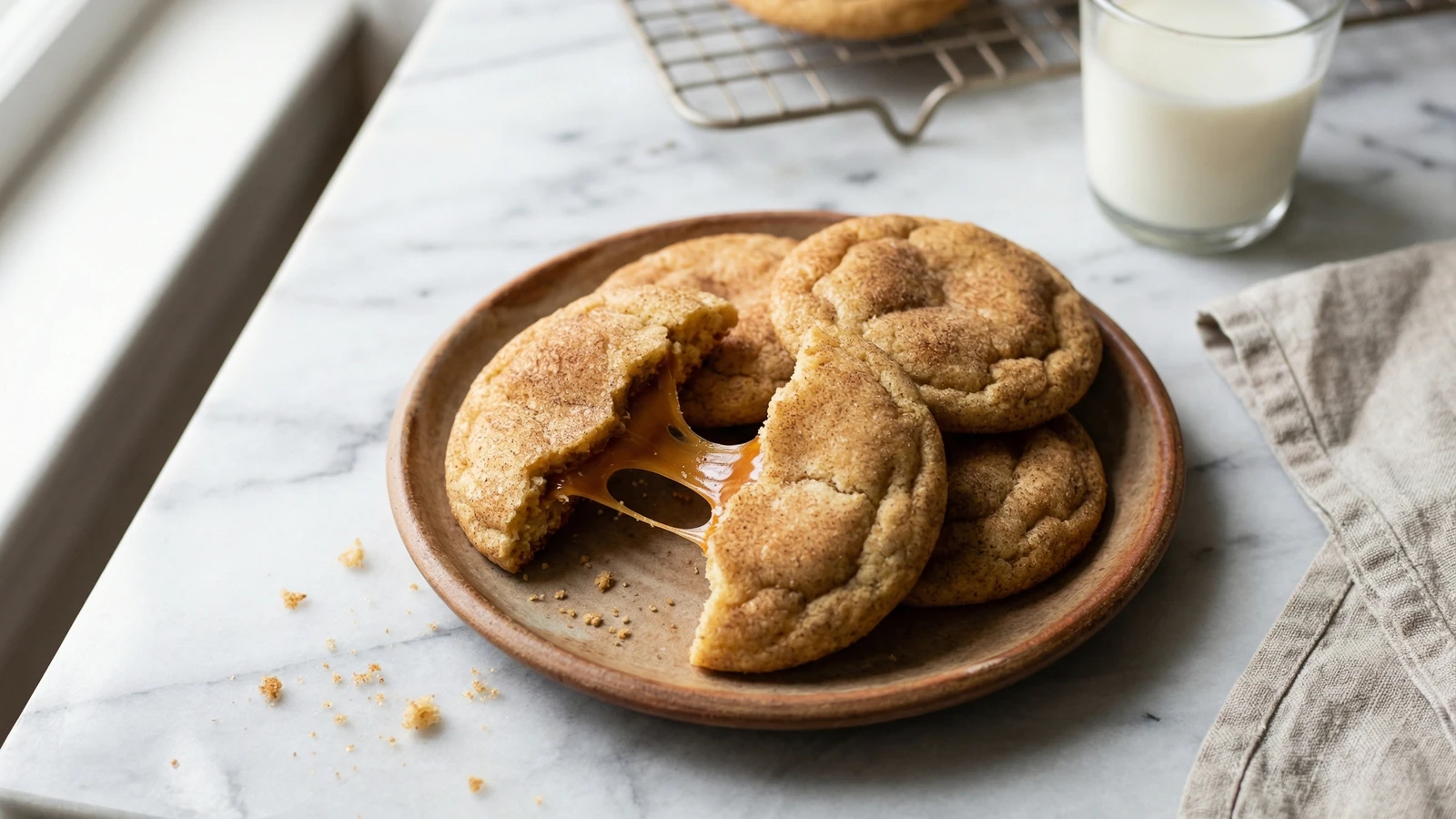
Classic snickerdoodles concealing molten caramel hearts, their crackled cinnamon-sugar exteriors giving way to stretchy, golden pools of sweetness when broken open warm from the oven.
Pastries & Cookies
American
Make Ahead
Holiday
30 min
Active Time
12 min cook•2 hr total
Yield24 cookies
The snickerdoodle is among America's oldest cookies, arriving with German and Dutch settlers who baked what they called schneckennudeln. New England claimed it, stripped away the pretension, and gave us this: a soft, pillowy cookie rolled in cinnamon sugar with a distinctive tang from cream of tartar. It requires no chocolate, no nuts, no fancy additions. Just butter, sugar, and spice doing honest work.
Some traditions beg to be improved. Stuffing these cookies with soft caramel transforms a beloved classic into something theatrical. The technique is simple. You wrap a square of caramel inside the dough, seal it tight, and let the oven do its work. As the cookie bakes, that caramel softens into a molten pocket. Break one open while still warm and you'll understand why these have become legendary at holiday cookie exchanges.
The cream of tartar matters here. It gives snickerdoodles their subtle tang and helps create that signature crackled top. Don't substitute baking powder. The flavor won't be right and neither will the texture. These cookies should be soft in the center, slightly chewy at the edges, with a sugary crust that shatters against your teeth before the caramel hits your tongue.
The technique, the tradition, and the story behind every dish.
Whisk together the flour, cream of tartar, baking soda, and salt in a medium bowl. Set this aside. The cream of tartar will look like fine white powder, almost like cornstarch. Smell it. That subtle tartness is what separates a true snickerdoodle from an ordinary sugar cookie.
2
Cream butter and sugar
In a large bowl, beat the softened butter and sugar together with an electric mixer on medium speed until light and fluffy, about 3 minutes. The mixture should pale in color and increase in volume. Scrape down the sides of the bowl at least once. This aeration is what gives your cookies their tender crumb.
Properly softened butter should give slightly when pressed but hold its shape. If it's too soft, your cookies will spread too thin to contain the caramel.
3
Add eggs and vanilla
Add the eggs one at a time, beating well after each addition. Add the vanilla and mix until combined. The mixture may look slightly curdled after the eggs go in. This is normal. It will smooth out when the flour joins.
4
Build the dough
Add the flour mixture to the butter mixture in two additions, mixing on low speed just until combined after each. Stop the mixer the moment the flour disappears. Overworked dough produces tough cookies. The dough should be soft but not sticky, pulling cleanly away from the bowl.
5
Chill the dough
Cover the bowl tightly with plastic wrap and refrigerate for at least 1 hour, or up to 24 hours. Cold dough is essential for this recipe. It firms up the butter so you can wrap it around the caramels without the dough sticking to your hands or tearing. Warm dough cannot contain a secret.
If you're in a rush, spread the dough on a sheet pan and freeze for 20 minutes. Check that it's firm enough to handle before proceeding.
6
Prepare for assembly
When ready to bake, position racks in the upper and lower thirds of your oven and heat to 375°F. Line two baking sheets with parchment paper. Combine the sugar and cinnamon for coating in a shallow bowl, mixing well with your fingers until no cinnamon streaks remain. Unwrap all 24 caramels now. You'll want them ready.
7
Wrap the caramels
Scoop about 2 tablespoons of dough for each cookie. Flatten the dough into a disc in your palm. Place one caramel in the center. Bring the edges of the dough up and around the caramel, pinching firmly to seal. Roll between your palms to form a smooth ball. The caramel should be completely encased with no thin spots. Any gaps will leak during baking.
Work quickly. Your hands warm the dough. If it becomes sticky, refrigerate the remaining dough for 10 minutes before continuing.
8
Coat in cinnamon sugar
Roll each dough ball generously in the cinnamon-sugar mixture, coating all sides. Place on prepared baking sheets, spacing 3 inches apart. These cookies spread. Overcrowding leads to merged cookies and uneven baking. Eight cookies per standard sheet is plenty.
9
Bake to perfection
Bake for 10 to 12 minutes, rotating the pans front to back and switching racks halfway through. The cookies are done when the edges are set and beginning to turn golden but the centers still look slightly underdone and puffed. They will crack across the top in that classic snickerdoodle pattern. Remove from oven when the cracks appear.
Underbaking is your friend here. The cookies firm as they cool, and the caramel stays soft and gooey. Overbaked cookies have hard, chewy caramel that sticks to your teeth.
10
Cool and serve
Let cookies cool on the baking sheet for 5 minutes. This rest period allows the caramel to settle from molten lava to stretchy, gooey gold. Transfer to a wire rack to cool further if you can resist them. Serve warm for maximum drama. Break one open at the table and watch the caramel stretch. This is the moment you've been working toward.
Chef Tips
•Kraft caramels or similar soft, individually wrapped squares work perfectly. Avoid hard caramels or caramel bits, which won't melt into that gooey center. The caramel should be soft enough to dent with your fingernail.
•For even softer caramel centers, microwave each unwrapped candy for 3 seconds before wrapping. This helps them melt more thoroughly during the short bake time.
•The cinnamon-sugar coating can be made more complex. Add a pinch of cardamom or a scrape of fresh nutmeg for a spiced variation that nods to the cookie's European ancestry.
•Store cooled cookies in an airtight container at room temperature for up to 4 days. To revive the gooey centers, microwave individual cookies for 8 to 10 seconds before serving.
•These freeze beautifully. Freeze baked and cooled cookies in a single layer, then transfer to freezer bags. Thaw at room temperature and warm briefly in a 300°F oven for 3 minutes to restore the caramel's stretch.
Advance Preparation
•Dough can be made and refrigerated up to 3 days ahead. Let it sit at room temperature for 15 minutes before scooping if very firm.
•Assembled unbaked cookie balls can be frozen on a sheet pan, then transferred to freezer bags for up to 2 months. Bake from frozen, adding 2 minutes to the bake time.
•The cinnamon-sugar coating can be mixed weeks in advance and stored in an airtight jar.
Frequently Asked Questions
Nutrition Information
1 cookie (about 45g)
Calories
240 calories
Total Fat
9.8 g
Saturated Fat
6 g
Trans Fat
0 g
Unsaturated Fat
3.5 g
Cholesterol
22 mg
Sodium
266 mg
Total Carbohydrates
36 g
Dietary Fiber
0.5 g
Sugars
23 g
Protein
2.8 g
Where cooking meets culture.
Culinary guides, cultural storytelling, and the editorial depth that makes cooking meaningful.