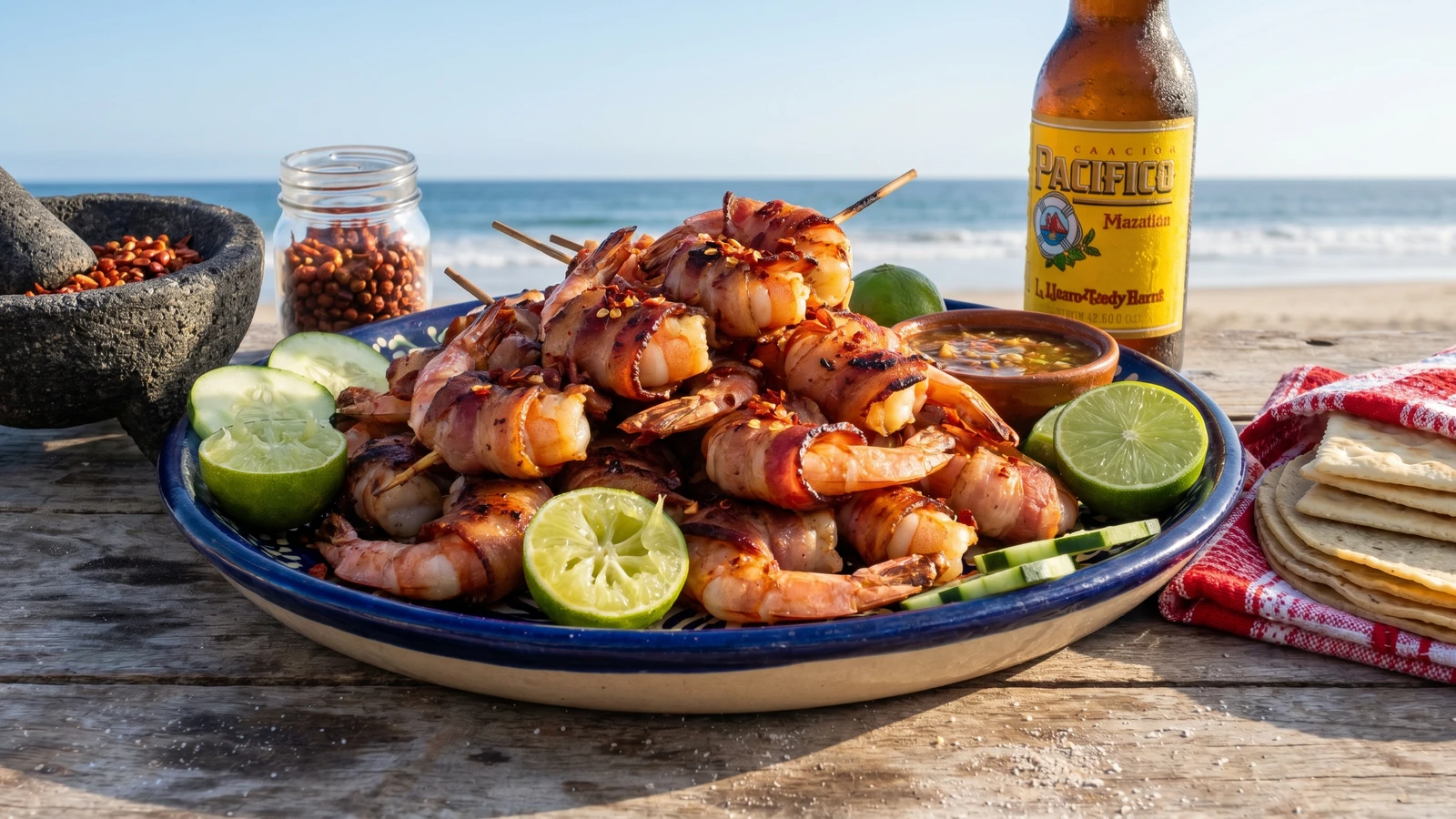
Sinaloa's grilled beach snack: large Pacific shrimp wrapped tight in bacon, charred over mesquite, finished with fresh lime and crushed chiltepín. Bacon does the seasoning. The wild chile does the rest.
Appetizers & Snacks
Mexican
BBQ
Outdoor Dining
Dinner Party
25 min
Active Time
12 min cook•37 min total
Yield4 to 6 servings
This is a Sinaloa dish. Specifically, it belongs to the beach palapas and the marisquerias of Mazatlán, Altata, and Teacapán, where the shrimp comes off the boats in the morning and the grills are lit by noon. The northwest coast eats shrimp the way central Mexico eats corn, every day, every which way, and this is one of the simplest and most direct preparations in the repertoire.
The ingredients are short. Large Pacific shrimp, smoked bacon, lime, and chiltepín. That is the dish. The bacon does the work that aromatics and marinades do in other recipes: it salts the shrimp, fats the shrimp, smokes the shrimp. You do not need a complicated rub. You need good shrimp and the discipline to leave them alone. If your shrimp is sad and gray, no amount of bacon will fix it. Si no conoces el mercado, no conoces la cocina.
The chiltepín is what makes this northern. It is the wild bird's-eye chile that grows on shrubs across Sonora and the northern reaches of Sinaloa, picked by hand, sold by the gram in small glass jars. The heat is bright and brief and it does not linger like a serrano or an arbol. Crushed over hot bacon and lime, it is the finish that locates this dish on the map. Cada estado, su propia cocina, and this one belongs to the coast.
My mother never made these. They are not jalisciense. I learned them on a folding chair under a palapa in Altata, watching a cook named Doña Reyna thread shrimp onto skewers while her husband tended the mesquite. She told me the only rule that mattered: do not overcook the shrimp. The bacon can wait. The shrimp cannot. Recetas probadas y garantizadas.
Sinaloa is the largest shrimp-producing state in Mexico, accounting for over half of the country's farmed and wild-caught output, and shrimp has anchored the coastal economy since the establishment of industrial fisheries in the Gulf of California in the early 20th century. The bacon-wrapped preparation is a relatively recent fusion, traceable to the rise of beachfront marisquerías and palapa-style restaurants in the 1970s and 1980s, when Sinaloan cooks adapted the American-influenced 'shrimp en brocheta' format to local taste by finishing with chiltepín. The chiltepín itself, Capsicum annuum var. glabriusculum, is the only chile native to and still harvested wild across Mexico's northwest, considered by botanists to be the oldest cultivated form of the species and protected under designation of origin in parts of Sonora.
The technique, the tradition, and the story behind every dish.
hand-pressed corn tortillas or saltines (optional)
Quantity
for serving
sliced cucumber (optional)
Quantity
for serving
cold Pacifico (optional)
Quantity
for the cook
Ingredient
Quantity
large Pacific shrimp (16/20 count)peeled and deveined, tails left on
1 1/2 pounds
thin-cut smoked bacon
12 ounces (about 16 to 20 slices)
fresh lime juice
2 tablespoons
garlic clovesfinely grated
2
kosher salt
1 teaspoon
freshly ground black pepper
1/2 teaspoon
dried chiltepínlightly crushed
2 teaspoons, plus more for the table
neutral oilfor the grill
1 tablespoon
lime halves (optional)
for serving
salsa Huichol or salsa de chiltepín (optional)
for serving
hand-pressed corn tortillas or saltines (optional)
for serving
sliced cucumber (optional)
for serving
cold Pacifico (optional)
for the cook
Equipment Needed
•Charcoal grill, ideally with mesquite
•Wooden skewers (soaked thirty minutes) or doubled metal skewers
•Sharp paring knife for butterflying the bacon strips if needed
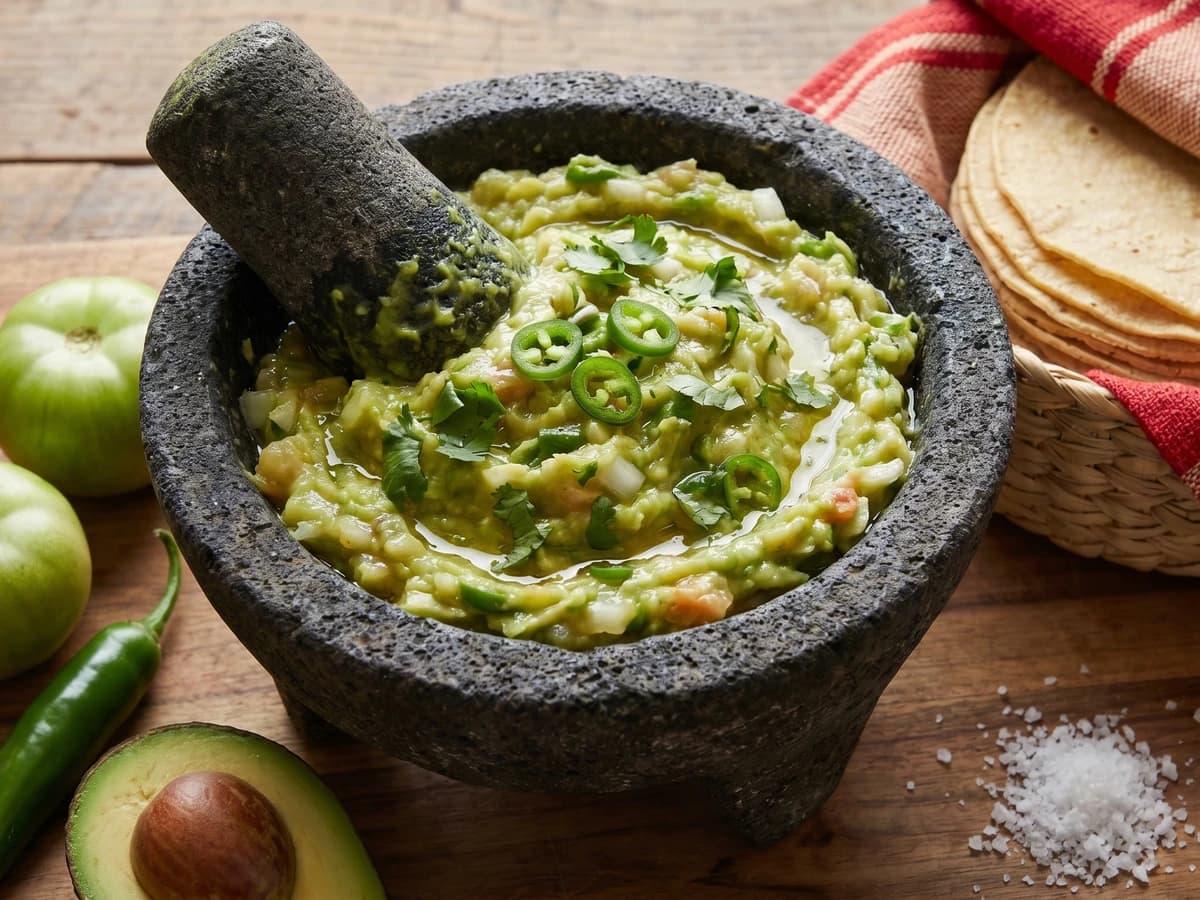
•Molcajete for crushing the chiltepín
•Long tongs and a heat-safe basting brush
Instructions
1
Light the mesquite
Build a charcoal fire with mesquite and let it burn down until the coals glow red under a thin coat of gray ash. This is the wood that grows wild across northern Sinaloa and Sonora and it is the wood that gives this dish its smoke. Gas works in a pinch, but you will be cooking shrimp wrapped in bacon, not camarones al chiltepín. There is a difference and your tongue will know it.
Set the coals to one side of the grill so you have a hot zone for searing the bacon and a cooler zone to finish the shrimp without burning. The bacon fat drips and flares. Plan for it.
2
Season the shrimp lightly
Pat the shrimp dry with paper towels. In a wide bowl, toss them with the lime juice, grated garlic, salt, and pepper. Let them sit for ten minutes while the coals settle. The bacon brings smoke and salt. The shrimp only need a little support underneath that. Heavy seasoning here fights the chiltepín at the finish.
3
Wrap each shrimp
Cut each slice of bacon in half crosswise so you have short strips. Lay one strip flat, place a shrimp at one end, and roll the bacon tight around the body of the shrimp, leaving the tail exposed. The bacon should overlap itself once. If a shrimp is very large, use a full slice. Thread three or four wrapped shrimp onto each soaked wooden skewer or doubled metal skewer, pushing the skewer through both ends of the bacon so it cannot unwrap on the grill.
Soak wooden skewers in cold water for thirty minutes before threading. Dry skewers burn through and dump your shrimp into the coals. No me vengas con atajos.
Use thin-cut bacon, not thick-cut. Thick bacon will not crisp before the shrimp overcook. The two have to finish at the same moment.
4
Grill over the coals
Brush the grill grate with the neutral oil. Lay the skewers over the hot coals. The bacon fat will drip and flare. That is part of it. Cook for three to four minutes per side, turning once, until the bacon is crisp and mahogany on the outside and the shrimp curl into tight C shapes. A C is done. An O is overcooked. The tail meat should be opaque white, not gray. Total time on the grill is six to eight minutes, no more.
5
Crush the chiltepín
While the shrimp cook, crush the chiltepín in a molcajete or between your fingers. Chiltepín is the wild bird's-eye chile that grows on shrubs across Sonora and northern Sinaloa, and it is what makes this dish belong to that coast. The heat is sharp and clean and it disappears in a few seconds. That is the signature. A serrano or arbol is not a substitute. If you cannot find chiltepín, find a Mexican grocer who sells it dried in small jars or order it from Sonora. It keeps for a year in a sealed jar.
6
Finish and serve at the table
Pull the skewers off the grill and slide the shrimp onto a wide platter. Squeeze fresh lime over the top while the bacon is still hot. Scatter the crushed chiltepín across the shrimp, generously. Put more chiltepín, lime halves, and a bottle of salsa Huichol on the table. Eat with your fingers, hot, with cold beer and the people you cooked for. Asi se hace y punto.
Chef Tips
•Buy your shrimp from a fishmonger who knows the boats. 16/20 count means sixteen to twenty shrimp per pound, and that is the right size for this. Smaller shrimp dry out before the bacon crisps. Larger shrimp leave the bacon flabby. The size is the recipe.
•Mesquite charcoal is non-negotiable for the proper version. It is what burns on the Sinaloa coast and it gives a sharp, dry smoke that pairs with bacon fat in a way oak or hickory does not. If your supermarket only carries briquettes, find a Mexican grocer or order online. La manteca es el sabor, but here, el humo también lo es.
•Chiltepín is sold whole and dried in small jars at any decent Mexican grocer or specialty spice shop. Do not substitute cayenne, red pepper flakes, or sriracha. None of those are chiltepín and the dish will lose its identity. If you cannot get chiltepín, make something else and come back to this when you can.
Advance Preparation
•The shrimp can be peeled, deveined, and seasoned up to four hours ahead. Hold them on ice in the refrigerator until you are ready to wrap.
•The skewers can be assembled up to two hours ahead and refrigerated, covered. Beyond two hours the bacon starts to draw moisture out of the shrimp and the texture suffers.
•Crush the chiltepín just before serving. Pre-crushed chiltepín loses its sharpness within an hour.
Frequently Asked Questions
Nutrition Information
1 serving (about 190g)
Calories
350 calories
Total Fat
23 g
Saturated Fat
7 g
Trans Fat
0 g
Unsaturated Fat
14 g
Cholesterol
250 mg
Sodium
1720 mg
Total Carbohydrates
1 g
Dietary Fiber
0 g
Sugars
0 g
Protein
36 g
Where cooking meets culture.
Culinary guides, cultural storytelling, and the editorial depth that makes cooking meaningful.