
Chef Juliana
Beijinho de Coco
You already learned brigadeiro. This is the same pan lesson with coconut: stir until it pulls from the bottom, cool, roll, and crown each sweet with one clove.
A cooking platform built around craft, culture, and the stories behind what we eat.
Created by
The fancy sweet on the wedding tray is not a spell. Cook walnuts with condensed milk to the ponto, shape, dip, and let the sugar coat do its quiet work.
You look at the tray of wedding sweets and think, isso não é pra mim. Too polished, too white, too much like something made by a person born knowing where the fondant ends and panic begins. Good. Let's take that excuse apart.
A camafeu is a celebration sweet, yes, but celebration food still belongs to the same kitchen as the pê-efe. A gente eats rice, beans, a piece of meat or an egg, something green, and then, when the table asks for it, something sweet made by hand. Comida de verdade doesn't mean joyless food. It means you know what went into the pan.
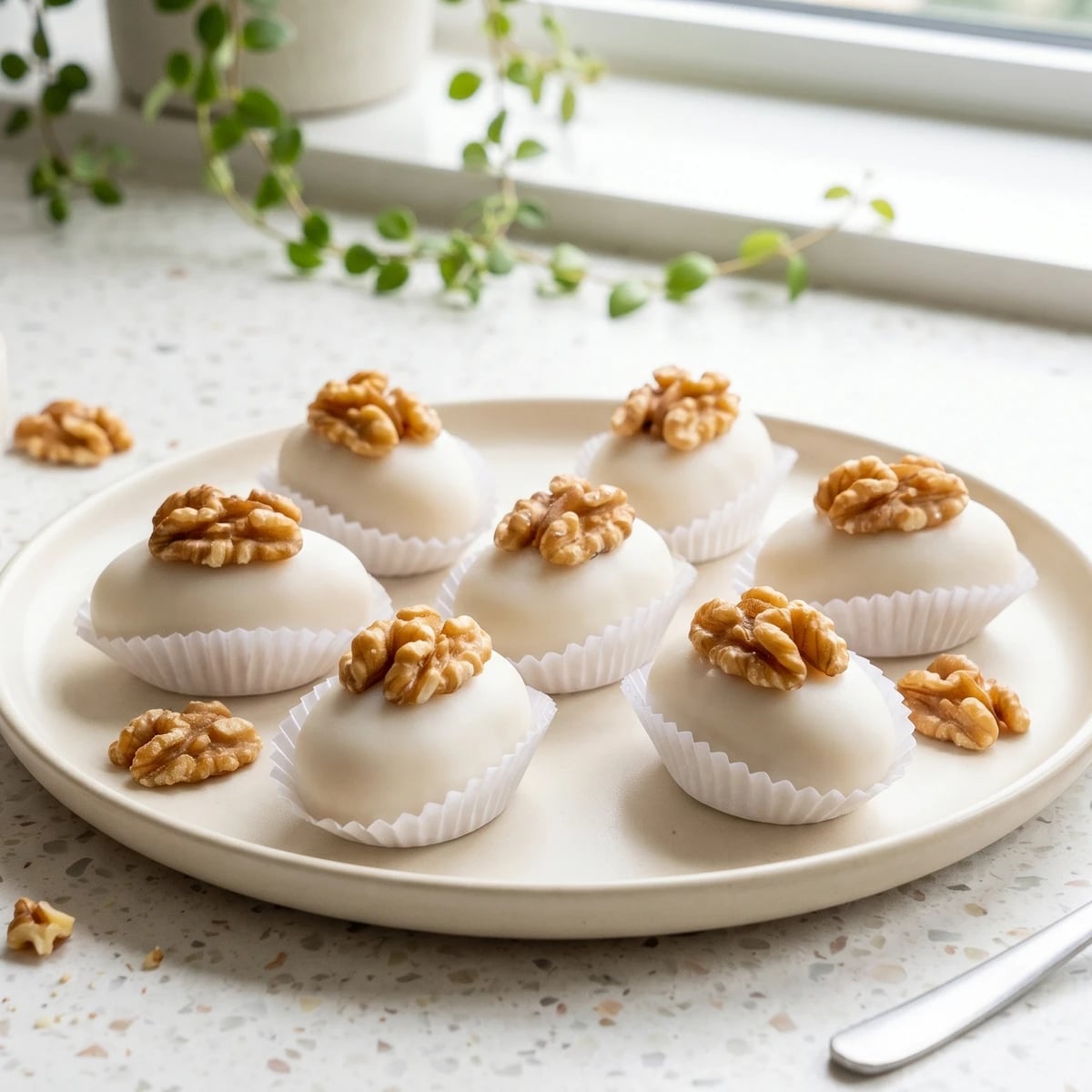
The method is simpler than the outfit. You grind walnuts so they bind into the condensed milk. You cook the mixture until it pulls from the bottom of the pan, because that ponto is what lets the sweet hold its oval shape. You dip it in warm fondant thin enough to coat, not drown, then press a walnut half on top while the shell is still tacky.
Anota aí: this is not hard, it's sequential. One pan, one bowl, your hands, and a little patience. Cozinhar não é dom, é um aprendizado. Even the wedding sweet can be desgourmetizado.
Camafeu de nozes belongs to the Brazilian tradition of doces finos, the small decorated sweets served at weddings, baptisms, and formal family parties, especially in urban confectionery tables of the twentieth century. Its name comes from the cameo jewel, because the oval sweet with a walnut half on top echoes the shape of a carved brooch. The walnut and fondant coating show the European confectionery influence that Brazilian home cooks folded into local celebration tables, often with condensed milk doing the practical binding work.
Quantity
2 cups
1 1/2 cups finely ground for the dough, 1/2 cup reserved as neat halves for topping
Quantity
1 can (395g)
Quantity
1 tablespoon, plus more for greasing hands
Quantity
1 pinch
Quantity
2 cups
sifted
Quantity
3 tablespoons
Quantity
1 teaspoon
Quantity
28
for topping
| Ingredient | Quantity |
|---|---|
| walnuts1 1/2 cups finely ground for the dough, 1/2 cup reserved as neat halves for topping | 2 cups |
| sweetened condensed milk | 1 can (395g) |
| unsalted butter | 1 tablespoon, plus more for greasing hands |
| fine salt | 1 pinch |
| confectioners' sugarsifted | 2 cups |
| whole milk | 3 tablespoons |
| lemon juice | 1 teaspoon |
| walnut halvesfor topping | 28 |
Pick out 28 good-looking walnut halves for the tops, then grind the rest until fine but not oily. Stop while the nuts still look fluffy and sandy. If you grind too long, they release oil and turn into paste, and then the dough gets heavy before it even reaches the pan.
Put the condensed milk, ground walnuts, butter, and salt in a heavy pan over medium-low heat. Stir constantly with a silicone spatula, scraping the bottom and corners, until the mixture thickens, turns glossy, and pulls away from the pan in one soft mass, about 10 to 12 minutes. This is the ponto. Stop too soon and the sweets slump; cook too far and they turn chewy in the wrong way.
Scrape the dough onto a buttered plate and spread it into a thick layer. Let it cool until you can touch it without flinching, about 30 minutes. Warm dough sticks to your hands and loses shape, so let the heat leave first. A little waiting here saves a lot of muttering later.
Butter your hands lightly and roll small portions into ovals about 1 1/2 inches long. Set them on parchment paper. Keep the shapes simple, like little smooth stones. If your hands get sticky, wash them, dry them, and butter them again. More butter on top of old sugar makes a mess, not a solution.
Set a heatproof bowl over a pan of barely simmering water. Add the sifted confectioners' sugar, milk, and lemon juice, and stir until smooth, white, and pourable, about 3 minutes. It should fall from the spoon in a ribbon and coat the back of it. Too thick and it clumps; too thin and it runs off like rain on a window.
Dip each oval into the warm fondant with a fork, let the excess drip back into the bowl, then slide it onto parchment. Press a walnut half on top while the coating is still tacky. Work calmly, reheating the fondant over the water if it starts to stiffen. Sugar sets when it cools, because sugar is bossy like that.
Leave the sweets at room temperature until the coating is dry to the touch, about 30 minutes. Don't stack them early. The shell needs time to firm up so the camafeus look neat and travel well to the party, even if the first two disappear in the kitchen.
1 serving (about 33g)
Culinary guides, cultural storytelling, and the editorial depth that makes cooking meaningful.
Discover Culinary Explorer
Chef Juliana
You already learned brigadeiro. This is the same pan lesson with coconut: stir until it pulls from the bottom, cool, roll, and crown each sweet with one clove.

Chef Juliana
You think tiny wrapped wedding sweets are for people with magic hands. They're not. They're sponge, filling, glaze, and patience, taught in plain steps until they behave.

Chef Juliana
You think party sweets are for the aunt who never measures. They're not. Cook real strawberry into condensed milk, watch the ponto, and the pink one on the birthday tray is yours.

Chef Juliana
You don't need candy hands or birthday confidence. Blend, bake gently, chill properly, and you get brigadeiro you can slice, proof that dessert is learned the same way as rice.