
Chef Lupita
Aguascalientes Beef Tongue Pozole (Pozole de Lengua)
Aguascalientes' Bajio pozole de lengua, built with cacahuazintle hominy, tender beef tongue, chile ancho and guajillo, with xoconostle brightness and table garnishes.
A cooking platform built around craft, culture, and the stories behind what we eat.
Created by
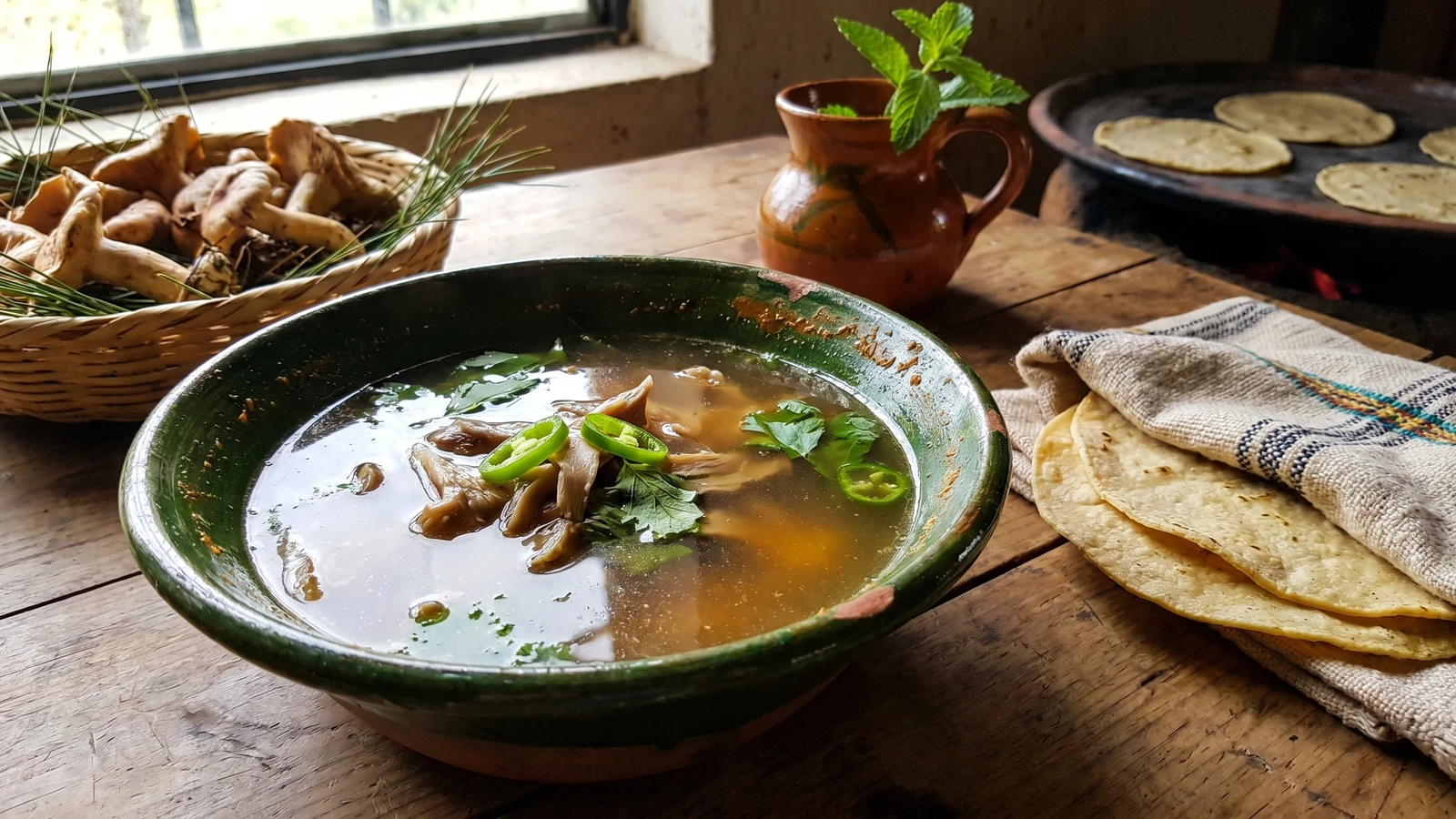
Michoacán's Meseta P'urhépecha rainy-season caldo, built with foraged terekuas, chile perón verde, garlic, epazote, and a clean forest broth that tastes like the pine floor after the first storms.
Michoacán, the Meseta P'urhépecha, the pine forests above towns like Cherán, Nahuatzen, and Paracho. That is where this caldo lives. The mushrooms come with the rains, carried in baskets to the market still smelling of wet needles and dark soil. Terekuas, flor de tierra, earth flowers. You do not separate this soup from that geography and still call it the same thing.
I learned this kind of broth from cocineras who sorted mushrooms faster than I could write their names down. They knew which ones wanted a quick simmer, which ones needed more time, which ones never entered the pot. The technique is not complicated, but it is disciplined: onion softened in manteca de cerdo, garlic crushed with chile perón verde, mushrooms cooked until they give their own juice, then water, epazote, and silence. Let the forest speak. No me vengas con atajos.
If it is not rainy season and the market has no proper terekuas, make another soup. Mexican grandmothers cook with what the season gives, not with fantasy. If you cannot identify the mushrooms, buy them from someone who can. Saber cocinar es saber vivir, and living includes knowing when not to cook something.
The Meseta P'urhépecha of Michoacán sits in a pine-oak highland band around towns such as Cherán, Nahuatzen, and Paracho, where rainy-season mushroom gathering has long been part of household cooking and market exchange. In 2010, UNESCO inscribed Traditional Mexican Cuisine on the Representative List of the Intangible Cultural Heritage of Humanity using the Michoacán paradigm, and the cocineras tradicionales of P'urhépecha communities were central to showing that this cuisine survives through women, milpa, nixtamal, forest foods, and communal transmission. Terekua mushroom caldo belongs to that rainy-season food system, when the forest gives and the pot follows.
Quantity
1 1/2 pounds
identified by an expert, brushed clean and torn into large pieces
Quantity
2 tablespoons
Quantity
1 medium
finely chopped
Quantity
5
peeled
Quantity
2
stemmed, 1 chopped and 1 thinly sliced
Quantity
1 1/2 teaspoons, plus more to taste
Quantity
8 cups
Quantity
3
Quantity
1 small sprig
optional and only if genuine
Quantity
for serving
| Ingredient | Quantity |
|---|---|
| fresh edible terekua mushroomsidentified by an expert, brushed clean and torn into large pieces | 1 1/2 pounds |
| manteca de cerdo | 2 tablespoons |
| white onionfinely chopped | 1 medium |
| garlic clovespeeled | 5 |
| fresh chile perón verdestemmed, 1 chopped and 1 thinly sliced | 2 |
| kosher salt | 1 1/2 teaspoons, plus more to taste |
| water | 8 cups |
| fresh epazote sprigs | 3 |
| fresh nurite from the Meseta P'urhépecha (optional)optional and only if genuine | 1 small sprig |
| warm hand-pressed corn tortillas (optional) | for serving |
Spread the mushrooms on a tray and look at every piece. Use only edible mushrooms identified by someone who knows the Meseta forest, a trusted forager, a cocinera tradicional, or a serious mercado vendor. Brush away pine needles and soil with a dry towel or soft brush. If a mushroom is slimy, worm-eaten, or uncertain, throw it out. No caldo is worth poisoning your family.
Tear large mushrooms into rough pieces with your hands and leave small ones whole. Do not slice everything into neat supermarket pieces. The uneven edges give the broth body and let the mushrooms show what they are. If they are gritty, rinse quickly in a bowl of cold water, lift them out, and dry them well. Do not soak them.
In a molcajete, crush the garlic, the chopped chile perón verde, and 1 teaspoon of the salt into a rough paste. The chile should smell green and sharp, not aggressive. This caldo is not about proving how much heat you can survive. Not all Mexican food is hot. The chile wakes the mushroom, that is its job.
Set a wide clay cazuela or heavy pot over medium heat and melt the manteca de cerdo. Add the onion and cook for 5 minutes, stirring with a wooden spoon, until it turns translucent and sweet. Do not brown it. Add the garlic and chile paste and cook for 1 minute, just until the raw edge leaves. La manteca es el sabor, even in a forest caldo. A spoonful is enough.
Add the torn terekuas and the remaining 1/2 teaspoon salt. Stir until every piece is glossed with the onion, garlic, chile, and lard. At first the pot will look dry. Then the mushrooms will give up their own liquid. Cook 8 to 10 minutes, stirring often, until that liquid darkens slightly and smells like wet pine, garlic, and earth. This is where the broth begins, before water enters the pot.
Pour in the 8 cups water and add the sliced chile perón verde. Scrape the bottom of the cazuela with the spoon. Bring to a gentle simmer, then lower the heat and cook uncovered for 18 to 20 minutes. The broth should turn pale amber, with small beads of manteca on the surface and mushroom pieces floating near the top. Taste for salt. A weak broth means you were timid with the salt.
Add the epazote sprigs and simmer for 5 more minutes. If you have true nurite from the Meseta, bruise the sprig between your fingers and add it during the final minute only. If you do not have nurite, leave it out. Do not replace it with mint, oregano, or whatever herb is sitting in your refrigerator. Nurite is nurite. Substitute nothing.
Remove the herb stems. Ladle the caldo into deep green-glazed Michoacán clay bowls, making sure each serving gets plenty of mushrooms and a little chile. Serve with warm hand-pressed corn tortillas from the comal. No crema. No shredded cheese. This is a clean Meseta broth, not a disguise for dairy. Cada estado, su propia cocina.
1 serving (about 475g)
Culinary guides, cultural storytelling, and the editorial depth that makes cooking meaningful.
Discover Culinary ExplorerChef Lupita
Aguascalientes' Bajio pozole de lengua, built with cacahuazintle hominy, tender beef tongue, chile ancho and guajillo, with xoconostle brightness and table garnishes.

Chef Lupita
Veracruz's Gulf coast rice from Alvarado, built with seafood stock, tomato, chile chipotle, epazote, shrimp, fish, jaiba, and pulpo, served loose and brothy in a clay cazuela.

Chef Lupita
Costa Chica's wet salt-beef stew, built from chile costeño, guajillo, tomato, manteca, yuca, plantain, and masa dumplings, the ranching pot of Cuajinicuilapa and Pinotepa.

Chef Lupita
Michoacán's P'urhépecha atápakua is a masa-thickened sauce and stew at once, built with pork, chile guajillo, and hierbabuena added only at the end.