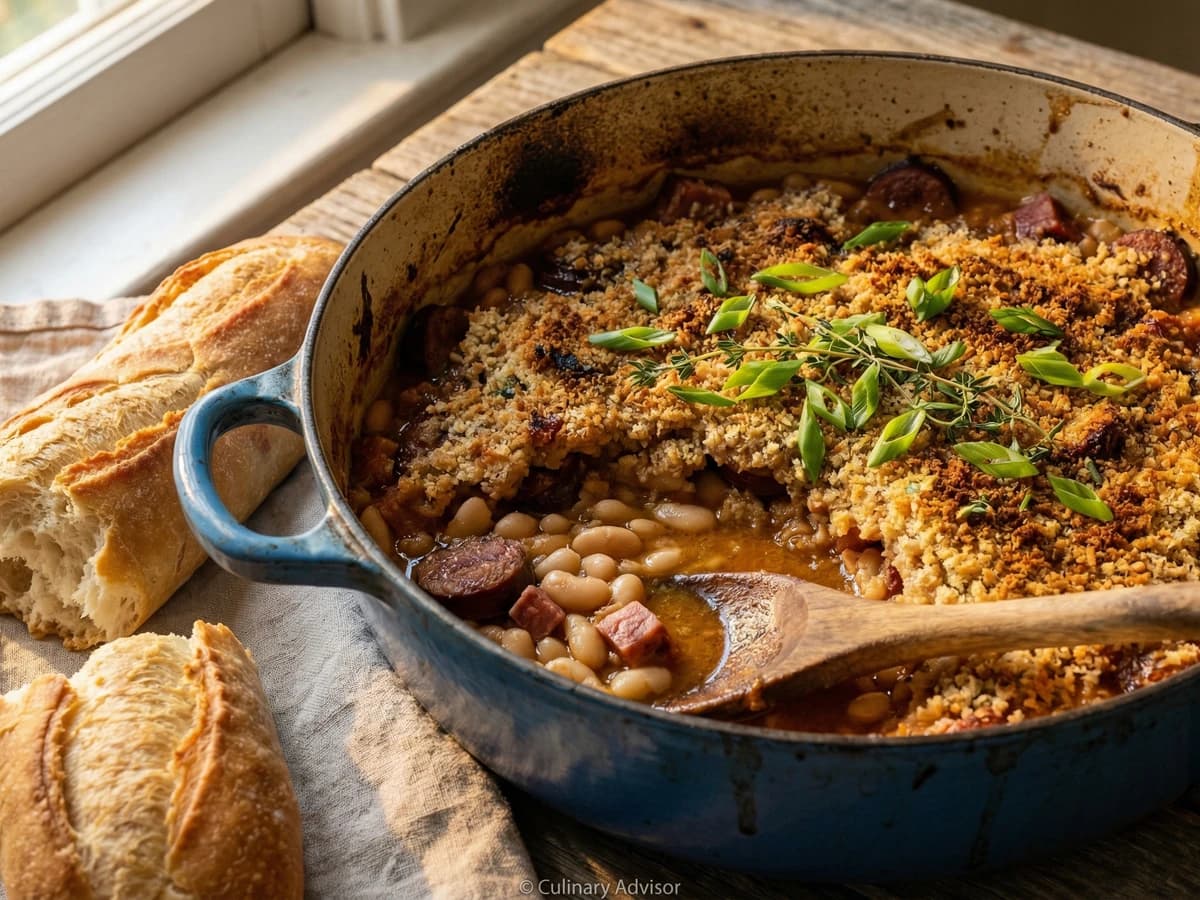
Louisiana's beloved rice dressing, loaded with seasoned ground meat, tender giblets, and the holy trinity, baked until the top gets golden and slightly crispy while the inside stays moist and impossibly flavorful.
Main Dishes
Cajun
Thanksgiving
Christmas
Holiday
45 min
Active Time
1 hr 15 min cook•2 hr total
Yield12 servings
Every Thanksgiving and Christmas, this dish appears on Louisiana tables from Shreveport to the Gulf. We call it rice dressing, not stuffing, because we bake it in its own pan where it can develop that beautiful golden crust on top. My grandmother Evangeline made it with whatever the men brought home from hunting: duck, goose, sometimes just chicken. The giblets were never wasted. That's the bayou way.
The secret lives in building flavor at every step. You season the meat before it browns. You cook the trinity until those onions turn sweet and translucent. You fold everything together with stock that carries the richness of the giblets. Then you bake it until the top gets crusty while the inside stays moist. At Lagniappe, we serve this alongside roasted turkey, but I've watched guests eat it as the main course, coming back for thirds.
This is not a subtle dish. The cayenne wakes up your palate, the three peppers create depth, and the liver gives it that characteristic richness that separates real Cajun rice dressing from plain old rice. If you've never cooked with giblets before, trust me on this. They transform the dish from good to unforgettable.
The technique, the tradition, and the story behind every dish.
Place gizzards in a small saucepan and cover with salted water by two inches. Bring to a boil, then reduce to a gentle simmer. Cook for 45 minutes to an hour until tender when pierced with a fork. Add the livers during the last 15 minutes only. Livers cook quickly and turn grainy if overcooked. Drain, let cool slightly, then chop everything fine. The gizzards should be in pieces no bigger than a pea.
Save that cooking liquid. It's essentially giblet stock, and you can use it in place of some of the chicken stock for even deeper flavor.
2
Season and brown the meat
Combine the ground pork and beef in a large bowl. Season with half the salt and half the cayenne, black pepper, and white pepper. Mix with your hands until the seasonings are distributed throughout. Heat oil in your largest cast iron skillet or Dutch oven over medium-high heat. Add the meat mixture, breaking it into small pieces as it cooks. Let it develop some color before stirring. You want brown bits, not gray steamed meat. Cook until no pink remains, about 12 minutes.
Don't crowd the pan. If your skillet isn't big enough, brown the meat in two batches. Crowded meat steams instead of browns, and you lose all that flavor development.
3
Build the trinity
Push the meat to the edges of the pan or remove it temporarily. Add the onions, celery, and bell peppers to the center. Sprinkle with the remaining salt and seasonings. Cook, stirring frequently, until the onions turn translucent and sweet, about 10 to 12 minutes. The vegetables should soften but still have a little texture. Add the garlic and the white parts of the green onions. Cook another 2 minutes until fragrant. Your kitchen should smell like Louisiana now.
4
Combine with rice
Preheat your oven to 350°F. Add the chopped giblets and bay leaves to the skillet, stirring everything together with the meat and vegetables. Fold in the cooked rice, working gently so the grains don't turn to mush. Pour in the warm chicken stock and stir until everything is evenly moistened. The mixture should be wet but not soupy. Taste now and adjust seasoning. This is your last chance before it goes in the oven.
5
Bake until golden
Transfer the mixture to a buttered 9x13 inch baking dish, spreading it evenly. Dot the top with butter pieces. Bake uncovered for 35 to 45 minutes until the top develops golden brown spots and the edges start to crisp. The butter will melt into the surface and help create that beautiful crust. Let it rest for 10 minutes before serving.
For extra crispiness on top, run it under the broiler for 2 to 3 minutes at the end. Watch it like a hawk, because it goes from golden to burned in seconds.
6
Finish and serve
Remove the bay leaves. Scatter the green onion tops and fresh parsley over the surface. The bright green against the golden brown is how you know it's right. Serve generous spoonfuls alongside your holiday bird, or honestly, just eat it on its own. At Lagniappe, we put a fried egg on top for brunch service. Good food is honest food, and this dish doesn't need anything fancy to shine.
Chef Tips
•If giblets intimidate you, start with just the gizzards. They have a mild, meaty flavor that's less intense than liver. Once you're comfortable, add the livers. That's where the real depth comes from.
•Make your rice a day ahead and refrigerate it uncovered. Cold, slightly dried rice absorbs the seasonings better and holds its shape during baking. Fresh hot rice turns to mush.
•The three pepper blend (cayenne, black, white) is traditional Cajun seasoning. Each one hits your palate differently: cayenne brings upfront heat, black pepper adds earthiness, white pepper creates a slow burn at the back of your throat.
•This dish reheats beautifully. Add a splash of stock before covering with foil and warming in a 325°F oven. The leftovers are almost better than the first day.
•For a richer version, replace half the chicken stock with the giblet cooking liquid. Four generations of Boudreaux cooks taught me never to throw away good stock.
Advance Preparation
•Giblets can be cooked and chopped up to 2 days ahead. Store refrigerated in their cooking liquid.
•The entire dish can be assembled through step 4, covered tightly, and refrigerated overnight. Add 10 to 15 minutes to the baking time if going directly from the refrigerator to the oven.
•Baked dressing keeps refrigerated for up to 4 days. Reheat covered at 325°F with a splash of stock to restore moisture.
Frequently Asked Questions
Nutrition Information
1 serving (about 230g)
Calories
395 calories
Total Fat
24 g
Saturated Fat
9 g
Trans Fat
0 g
Unsaturated Fat
13 g
Cholesterol
185 mg
Sodium
450 mg
Total Carbohydrates
20 g
Dietary Fiber
2 g
Sugars
2 g
Protein
22 g
Where cooking meets culture.
Culinary guides, cultural storytelling, and the editorial depth that makes cooking meaningful.