Culinary Explorer
A cooking platform built around craft, culture, and the stories behind what we eat.
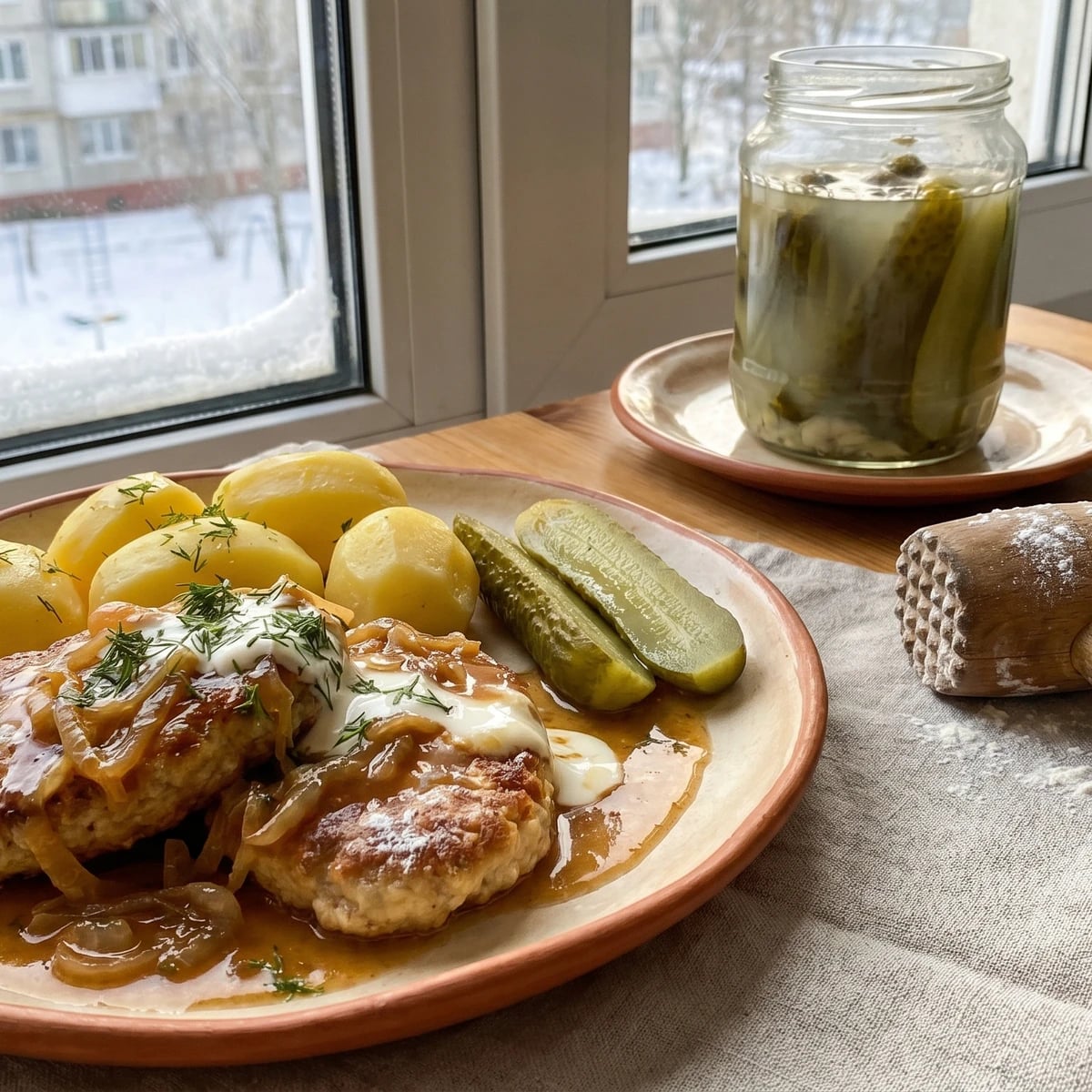
Bytky Ukrainski (битки українські, pounded cutlets)
Created by Chef Lesia
The first sound is the meat against the board: flat, sharp, changing as the fibres loosen. Fry the cutlets fast, then let onion gravy do the soft finishing.
The meat tells you when it has given in. At first the mallet hits the board with a hard slap, all resistance and bounce; then the sound drops lower, softer, and the slice spreads under your hand like dough that has stopped fighting. That is the dish. Not the gravy, though the gravy is lovely. The pounding is the promise that a cheap cut will eat tender on a Tuesday night.
Bytky are not minced kotlety. They are whole pieces of beef or pork, beaten thin, dusted with flour, fried quickly for colour, then tucked under onions until the sauce goes glossy and brown at the edges. My Aunt Nadia once wrote only, "beat it until it sounds right," which was completely useful to her and deeply annoying to me until I stood there and listened. The sound changes. Your hands learn it.
The one why is simple: pounding breaks the long muscle fibres before heat can tighten them, so the pan gives you flavour instead of toughness. Fry for colour only, then let the onion gravy finish the work slowly. Serve with potatoes, buckwheat kasha, or a fermented cucumber from the jar, something sharp beside something soft. Make the full pan. One lonely cutlet has no future at my table.
Ingredients
beef top round, rump, or pork shoulder steaks
Quantity
900g
cut into 6 slices about 1 cm thick, across the grain
fine sea salt
Quantity
1 1/2 teaspoons
divided
black pepper
Quantity
1 teaspoon
freshly ground
| Ingredient | Quantity |
|---|---|
| beef top round, rump, or pork shoulder steakscut into 6 slices about 1 cm thick, across the grain | 900g |
| fine sea saltdivided | 1 1/2 teaspoons |
| black pepperfreshly ground | 1 teaspoon |
Where cooking meets culture.
Culinary guides, cultural storytelling, and the editorial depth that makes cooking meaningful.
Discover Culinary Explorer