Culinary Explorer

A cooking platform built around craft, culture, and the stories behind what we eat.
Discover Culinary Explorer
Burro de Machaca Sonorense

Burro de Machaca Sonorense

Created by

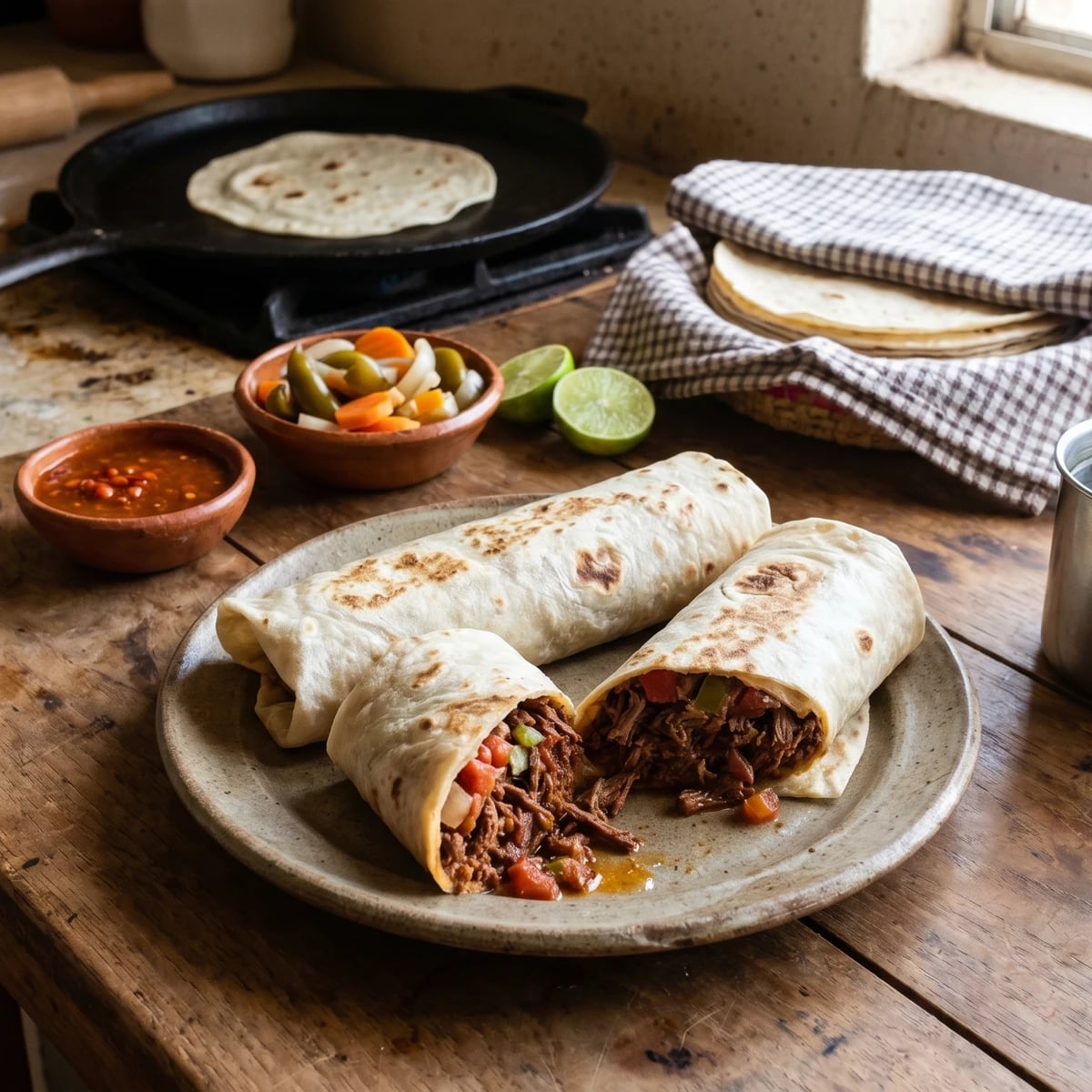
Sonora's original burro: pounded sun-dried beef simmered with onion, tomato, and chile colorado, then rolled tight in a paper-thin flour tortilla cooked on a dry comal. The cattle country breakfast that built the north.

Sandwiches & Wraps
Mexican
Weeknight
Make Ahead
Budget Friendly
45 min
Active Time
30 min cook1 hr 15 min total
Yield6 burros

This is from Sonora. Cattle country, the open desert north, the land of vaqueros and mesquite fires and tortillas de harina that the rest of Mexico still does not fully understand. The burro de machaca is one of Sonora's foundational dishes and it has nothing to do with the foil-wrapped monsters served in California.

Machaca is dried beef. Before refrigeration, the ranchers of Sonora and Chihuahua salted and air-dried lean cuts of beef in the desert sun so the meat would survive the long rides between ranches. To eat it, you pound it. The word comes from machacar, to pound. Pounded machaca, rehydrated in a sofrito of onion, tomato, garlic, fresh chile verde del norte, and chile colorado, becomes one of the most flavorful guisos in northern Mexico.

The tortilla is the other half of the story. The Sonoran flour tortilla, the tortilla de harina sonorense, is paper-thin, soft, and large. Made with manteca, never shortening. Hand-stretched, never pressed. The sobaquera version, draped over the cook's forearm to thin it, is the highest expression of the form. The flour tortilla is a Noroeste birthright, not a Tex-Mex shortcut. Anyone who tells you otherwise has not eaten in Hermosillo.

My mother was from Jalisco and her flour tortillas were small and thick. The first time I ate a real burro de machaca was at a roadside carreta outside Ciudad Obregon, sitting on a plastic stool watching a senora stretch tortillas the size of dinner plates over her forearm. I asked her what she put in the dough. She said: harina, manteca, sal, agua caliente. Nothing else. The technique is the recipe. Cada estado, su propia cocina.

Machaca emerged in colonial-era Sonora and Chihuahua as a preservation method tied to the cattle ranches the Spanish established across the northern frontier in the 17th and 18th centuries; salted, sun-dried beef survived the long distances between ranchos and mining settlements where fresh meat could not. The flour tortilla itself is a Noroeste invention, born when Spanish wheat thrived in Sonora's irrigated valleys while corn struggled, and it became the staple grain of the north in a way it never did in central or southern Mexico. The chimichanga, often miscredited to Tucson, has documented Sonoran roots as the chivichanga, a fried burro that crossed into Arizona along with the Sonoran cooks who shaped the cuisine of the borderlands.

The technique, the tradition, and the story behind every dish.

Discover Culinary Explorer

Ingredients

machaca (shredded sun-dried beef)

Quantity

8 ounces

pounded fine in a molcajete or with a meat mallet

manteca de cerdo (pork lard)

Quantity

3 tablespoons

white onion

Quantity

1 medium

finely chopped

garlic cloves

Quantity

3

finely chopped

ripe Roma tomatoes

Quantity

2 medium

finely chopped

fresh chile Anaheim or chile verde del norte

Quantity

2

roasted, peeled, seeded, and chopped

dried chile colorado (chile California or northern guajillo)

Quantity

2

stemmed and seeded

hot water (for soaking the chile)

Quantity

1 cup

dried Mexican oregano (oregano del monte)

Quantity

1 teaspoon

kosher salt

Quantity

1/2 teaspoon, plus more to taste

freshly ground black pepper

Quantity

to taste

large handmade flour tortillas (tortillas de harina sonorenses, 10 to 12 inches)

Quantity

6

all-purpose flour (for tortillas)

Quantity

3 cups

kosher salt (for tortillas)

Quantity

1 teaspoon

manteca de cerdo (for tortillas)

Quantity

1/3 cup

very warm water (for tortillas)

Quantity

3/4 cup

salsa de chiltepin (optional)

Quantity

for serving

pickled jalapenos and carrots (chiles en escabeche) (optional)

Quantity

for serving

lime halves (optional)

Quantity

for serving

Equipment Needed

  • Heavy molcajete or meat mallet for pounding the machaca
  • Dry cast iron comal, 12-inch minimum
  • Wooden rolling pin (palote) for the tortillas
  • Wide cast iron or heavy skillet for the guiso
  • High-powered blender
  • Fine-mesh strainer

Instructions

  1. 1

    Mix the tortilla dough

    In a wide bowl, whisk the flour with the salt. Cut in the lard with your fingers until the mixture looks like coarse meal. Pour in the warm water and bring it together with one hand. Turn it onto the counter and knead for eight minutes, until the dough is smooth, elastic, and gives back when you press it. Cover with a clean cloth and rest for 30 minutes. The lard and the rest are what make a Sonoran tortilla. Without them you have a tortilla; with them you have a tortilla sonorense.

    Manteca, not vegetable shortening. The flour tortilla del norte gets its flavor and its fold from pork lard. La manteca es el sabor and Sonora knows it.
  2. 2

    Pound the machaca

    While the dough rests, place the dried beef in a molcajete or on a thick cutting board. Pound it with the tejolote, a meat mallet, or the bottom of a heavy skillet until the strands break apart into fine, almost fluffy threads. Real machaca is dried hard. The pounding is not optional. It is the step that gave the dish its name, from machacar, to pound. Skip it and you will be chewing leather.

  3. 3

    Prepare the chile colorado

    Toast the dried chile colorado on a dry comal over medium heat for about 20 seconds per side, until fragrant. Soak in the hot water for 15 minutes, until soft. Transfer to a blender with the soaking liquid and blend until smooth. Strain through a fine-mesh sieve to remove the skins. You want a clean red puree. This is the chile that gives the burro its color and the depth that separates a real machaca guisada from a sad scramble.

  4. 4

    Roll the tortillas

    Divide the rested dough into six equal balls. Cover with the cloth so they do not dry out. On a lightly floured counter, roll each ball into a thin round about 10 to 12 inches across. The Sonoran tortilla is paper-thin. You should almost see the counter through it. Stretch with your hands at the end if you need to. Stack them with sheets of parchment between each one and keep them covered.

    If your tortilla looks like a thick disc, you have not stretched it enough. The sobaquera tradition in Sonora gets its name from being draped over the cook's forearm to thin it. You do not need to go that far, but think large and thin, not small and puffy.
  5. 5

    Cook the tortillas

    Heat a dry comal or heavy skillet over medium-high until very hot. Cook each tortilla for about 30 seconds on the first side, until it bubbles and the underside shows light brown spots. Flip and cook 30 seconds more. The tortilla should still be soft and pliable, never crisp. Stack them in a clean cloth as you go. They steam each other and stay supple. A burro made with a brittle tortilla cracks the second you fold it.

  6. 6

    Build the guiso

    Heat the lard in a wide cast iron or heavy skillet over medium. Add the onion and cook five minutes, until soft and translucent. Add the garlic and cook 30 seconds. Stir in the chopped tomato and the roasted Anaheim. Cook another five minutes, until the tomato breaks down and the mixture pulls away from the pan. This is the base. In Sonora they call it a sofrito norteno, and it carries the dish.

  7. 7

    Add the machaca and chile

    Stir the pounded machaca into the sofrito. The dried beef will drink up the moisture from the tomato. Pour in the strained chile colorado puree, the oregano, salt, and a few grinds of black pepper. Cook over medium-low for 8 to 10 minutes, stirring often, until the mixture is moist but not wet. The machaca should be tender, the chile should have darkened, and the lard should glisten at the edges of the pan. Taste for salt. Machaca is already salty from the curing, so go easy.

  8. 8

    Roll the burros

    Warm a tortilla briefly on the comal so it is supple. Lay it flat. Spoon about half a cup of the machaca guisada in a line down the center, leaving two inches clear at the bottom and on each side. Fold the bottom up over the filling. Fold both sides in. Roll up and away from you, tight. A Sonoran burro is rolled tight and slim, not stuffed like a football. The tortilla does most of the work. The filling is the seasoning.

  9. 9

    Finish on the comal

    Place each rolled burro seam-side down on the hot dry comal for about a minute per side, until the tortilla picks up a few brown spots and the seam seals shut. This is how they serve them at the carretas outside Hermosillo. Eat them with salsa de chiltepin, pickled jalapenos, and a squeeze of lime. Asi se hace y punto.

Chef Tips

  • Real machaca is dried beef, not the wet shredded beef sold in some Mexican markets in the United States as 'machaca.' Look for carne seca or machaca norteno at a Mexican carniceria. If you can only find the moist version, it will work, but you are eating ropa vieja in a Sonoran costume.
  • The chile colorado of the north is what other regions call chile California or a sweeter, milder cousin of guajillo. If your store sells only guajillo, use it and reduce it slightly. A substitution is a compromise, not an upgrade.
  • Do not stuff the burro. A Sonoran burro is rolled tight and elegant. Half a cup of filling per tortilla is plenty. The tortilla and the guiso are equal partners. The Mission burrito is a different dish from a different country.

Advance Preparation

  • The machaca guisada can be made one day ahead and refrigerated. Reheat in a skillet with a teaspoon of lard before rolling the burros.
  • The tortilla dough can rest up to two hours at room temperature, covered. After that, refrigerate up to one day and bring back to room temperature before rolling.
  • Cooked tortillas keep wrapped in a clean cloth at room temperature for several hours, or frozen between sheets of parchment for up to a month. Reheat on a dry comal.

Frequently Asked Questions

Nutrition Information

1 serving (about 180g)

Calories
530 calories
Total Fat
25 g
Saturated Fat
10 g
Trans Fat
0 g
Unsaturated Fat
14 g
Cholesterol
45 mg
Sodium
1330 mg
Total Carbohydrates
50 g
Dietary Fiber
3 g
Sugars
3 g
Protein
25 g

Note: Chef personas and recipes are created with AI assistance. Cook with care: follow safe food-handling practices, check doneness with a thermometer when needed, and adapt for allergies and your kitchen.

Where cooking meets culture.

Culinary guides, cultural storytelling, and the editorial depth that makes cooking meaningful.

Discover Culinary Explorer

More from Noroeste Burritos, Tacos & Handhelds

Browse the full collection