Culinary Explorer

A cooking platform built around craft, culture, and the stories behind what we eat.
Discover Culinary Explorer
Burro de Carne con Chile Colorado Sonorense

Burro de Carne con Chile Colorado Sonorense

Created by

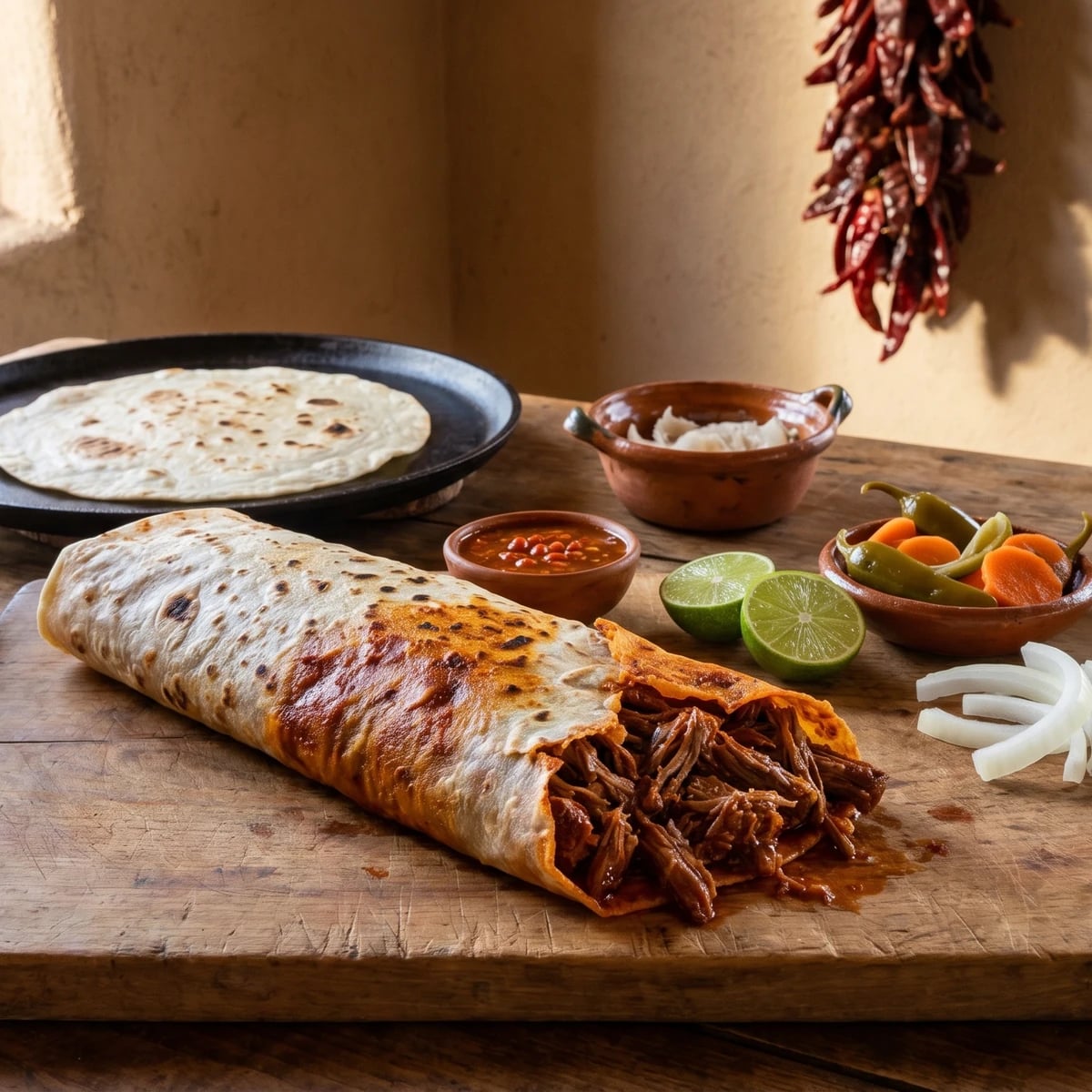
Sonora's stewed-beef burro, beef chuck braised low and slow in toasted chile colorado with garlic, cumin, and lard, then folded inside a paper-thin sobaquera flour tortilla. The desert on a plate.

Sandwiches & Wraps
Mexican
Weeknight
Make Ahead
Comfort Food
30 min
Active Time
2 hr 30 min cook3 hr total
Yield6 burros

This is a Sonoran dish. Not a Tex-Mex burrito, not a California Mission burrito, not whatever the gringos have been calling a burrito for the last fifty years. The burro belongs to the Noroeste, to the cattle country of Sonora that stretches from Hermosillo north to the Arizona border, where wheat grows where corn cannot and where the flour tortilla is not a substitute for anything. It is a birthright.

The filling is beef chuck and chile colorado. Not 'red chile.' Chile colorado, the long, deep-red dried Anaheim that ranchers in Magdalena and Caborca have been hanging in ristras outside their kitchens for generations. You toast it on a comal, soak it, blend it with garlic and cumin and oregano, strain it, and fry it in lard with the seared beef. Then you let it braise for two hours until the meat falls apart and the chile clings to every shred. There are no tomatoes in this. There is no cheddar in this. There is no rice in this. The Sonoran burro is austere on purpose.

The tortilla is the other half of the dish. A real sobaquera is twelve to fourteen inches across, paper-thin, made with manteca, stretched by hand over the cook's forearm, which is why it is called sobaquera, from sobaco, armpit. The senoras outside the Hermosillo airport make these in front of you, slapping the dough between their palms and stretching it across the back of their wrists until it is translucent. If you cannot find a real one, look for a Sonoran tortilleria. Do not substitute a small supermarket flour tortilla and call it a burro. That is something else.

My mother was from Jalisco and never made burros. I learned this dish on the road, in a kitchen in Hermosillo, from a woman named Dona Chela who fed cowboys for forty years and who told me, while she stretched a sobaquera over her arm, that the burro is the food of people who work outside in the sun. It travels. It holds. It feeds you for the whole afternoon. Cada estado, su propia cocina, and this one belongs to Sonora.

The burro and its smaller cousin the burrito originated in the wheat-growing valleys of Sonora and Chihuahua, where Spanish colonists introduced wheat in the 16th century and where the climate proved hostile to the corn that defined cuisine further south. By the 19th century, Sonoran cooks had developed the sobaquera, a tortilla so large and thin that mineworkers and vaqueros could wrap a full meal inside it and carry it into the field, the origin of the Spanish verb 'aburrarse,' to load up like a burro. The chimichanga, often miscredited to Tucson, was being fried in Sonora as 'chivichanga' decades before it crossed the border, and the burro percheron, the oversized stuffed burro of Hermosillo street carts, predates and is structurally distinct from the San Francisco Mission burrito it is sometimes confused with.

The technique, the tradition, and the story behind every dish.

Discover Culinary Explorer

Ingredients

beef chuck roast

Quantity

3 pounds

cut into 1-inch cubes

dried chile colorado (chile California or chile Anaheim seco)

Quantity

12

stemmed and seeded

dried chile guajillo

Quantity

4

stemmed and seeded

garlic cloves

Quantity

6

peeled

whole cumin seed

Quantity

1 tablespoon

toasted

dried Mexican oregano (oregano sonorense if available)

Quantity

1 teaspoon

whole cloves

Quantity

2

kosher salt

Quantity

1 tablespoon, plus more to taste

manteca de cerdo (pork lard)

Quantity

3 tablespoons

white onion

Quantity

1 medium

finely diced

all-purpose flour

Quantity

2 tablespoons

bay leaf

Quantity

1

beef broth or water

Quantity

2 cups

sobaquera or burro-sized flour tortillas (12 to 14 inches)

Quantity

6 large

warmed

frijoles puercos or refried pinto beans (optional)

Quantity

for serving

salsa de chiltepin (optional)

Quantity

for serving

lime wedges (optional)

Quantity

for serving

Equipment Needed

  • Heavy 6-quart Dutch oven or wide cazuela
  • Cast iron comal or heavy skillet for toasting chiles and warming tortillas
  • High-powered blender
  • Fine-mesh strainer for the chile puree
  • Two forks for shredding the beef

Instructions

  1. 1

    Toast the chiles

    Heat a dry comal or heavy skillet over medium. Toast the chile colorado and chile guajillo separately, pressing them flat with a spatula for about 20 seconds per side. The skin will pucker and go fragrant. Do not let them blacken. Chile colorado is the chile of Sonora, the long, deep-red dried Anaheim that hangs in ristras outside ranch kitchens from Hermosillo to Magdalena. Get this step right and the rest of the dish takes care of itself.

    If your store sells the chile labeled 'California' or 'Anaheim seco,' that is the same chile. Sonorenses call it colorado. Asi se hace y punto.
  2. 2

    Soak and blend the chile paste

    Place the toasted chiles in a heatproof bowl and cover with hot tap water. Hot, not boiling. Let them soften for 20 minutes. Drain and transfer to a blender with the garlic, toasted cumin, oregano, cloves, salt, and one cup of fresh hot water. Blend on high for two full minutes until completely smooth. Push it through a fine-mesh strainer into a bowl, pressing hard on the solids. The skins of the chile colorado are tough and they will leave grit if you skip the straining.

  3. 3

    Sear the beef

    Pat the beef cubes dry with paper towels. Wet meat will not brown. In a heavy 6-quart Dutch oven, melt the lard over medium-high heat until it shimmers. Working in two batches so the pot is not crowded, sear the beef on all sides until it has a deep brown crust, about 6 minutes per batch. Transfer to a plate. La manteca es el sabor and the fond at the bottom of the pot is the foundation of the stew.

  4. 4

    Build the stew base

    Lower the heat to medium. Add the diced onion to the pot and cook in the rendered lard for 5 minutes, scraping up the browned bits from the bottom. The onion should turn translucent and pick up the color of the fond. Sprinkle in the flour and stir for one minute. This is how it is done in Sonoran ranch kitchens. The flour thickens the chile colorado into a clinging sauce instead of a soup, and it is the technique that separates a real burro filling from a watery one.

  5. 5

    Fry the chile paste

    Pour the strained chile colorado puree into the pot. It will sputter against the hot lard. Cook for 5 to 7 minutes, stirring constantly, until the puree darkens from bright red to a deeper brick color and you see the fat starting to separate at the edges. This step is not optional. Raw chile puree tastes like raw chile puree. Fried chile puree tastes like the inside of a Sonoran ranch kitchen.

  6. 6

    Braise the beef

    Return the seared beef and any juices on the plate to the pot. Add the bay leaf and the beef broth. The liquid should come about halfway up the meat. Bring to a low simmer, cover partially, and cook for 2 hours over low heat. Stir every 30 minutes so nothing sticks. The beef is ready when it falls apart at the touch of a fork and the chile sauce has thickened around it. Taste for salt now. The dish should taste assertive. The tortilla wraps it and the salt has to carry through the wheat.

  7. 7

    Shred and finish

    Pull out the bay leaf. With two forks, shred the beef directly in the pot, working it back into the chile colorado sauce until the filling is uniformly coated and most of the larger chunks have surrendered. The texture should be wet but not soupy, the meat glistening with chile-stained fat. If it looks dry, add a splash of broth. If it looks loose, simmer uncovered for a few more minutes.

  8. 8

    Warm the sobaquera tortillas

    Heat a dry comal over medium. Lay one sobaquera flat on the comal and warm for about 15 seconds per side, just until it is pliable and lightly spotted. Do not toast it crisp. The Sonoran flour tortilla is meant to fold around the filling without breaking. If you bought your tortillas frozen or vacuum-packed, they will need a little longer. The right tortilla is paper-thin, large enough to cover a dinner plate, and made with manteca. If yours is not, find a different supplier.

  9. 9

    Build the burro

    Lay a warm sobaquera flat on the counter. Spoon a generous line of beef in chile colorado across the lower third, leaving room at the sides. Add a spoonful of frijoles puercos if you are using them. Fold the sides in over the filling, then roll from the bottom up into a tight cylinder. The burro should hold its own weight when you lift it. No foil. No double tortilla. The sobaquera is the architecture. Serve immediately with salsa de chiltepin and lime on the side. Recetas probadas y garantizadas.

Chef Tips

  • Chile colorado is the same chile as the dried California or dried Anaheim sold in most supermarkets. Sonorenses call it colorado because of the deep red it gives. If you can find chile colorado from Sonora itself, the flavor is more concentrated and the color is darker. A Mexican grocery is your best chance.
  • Do not skip the straining step after blending the chile. The skins of dried chile colorado are tougher than guajillo or ancho and they will leave a gritty texture in the sauce. A fine-mesh strainer and a few minutes of pushing on the solids is the difference between a smooth braise and a sandy one.
  • If you cannot find a true sobaquera, look for a Sonoran-style flour tortilla made with manteca and at least 12 inches across. A thick, doughy supermarket flour tortilla will tear under the weight of the filling and the dish stops being a burro. No me vengas con atajos.
  • The salsa de chiltepin on the table is non-negotiable in Sonora. Chiltepin is the small wild chile of the Sonoran Desert, hot and grassy, picked from bushes in the sierra. A few crushed chiltepines in lime juice and salt is all the salsa this dish needs.

Advance Preparation

  • The chile colorado paste can be made up to three days ahead and refrigerated in a sealed jar. The flavor deepens overnight and the second day is arguably better than the first.
  • The braised beef filling can be made two days ahead and reheated gently with a splash of broth. Many Sonoran cooks make it the day before specifically because the chile and the beef marry overnight.
  • Do not assemble the burros in advance. The sobaquera will go soggy. Warm the tortillas and roll the burros to order.

Frequently Asked Questions

Nutrition Information

1 serving (about 400g)

Calories
1050 calories
Total Fat
55 g
Saturated Fat
19 g
Trans Fat
1 g
Unsaturated Fat
33 g
Cholesterol
175 mg
Sodium
2080 mg
Total Carbohydrates
78 g
Dietary Fiber
9 g
Sugars
7 g
Protein
53 g

Note: Chef personas and recipes are created with AI assistance. Cook with care: follow safe food-handling practices, check doneness with a thermometer when needed, and adapt for allergies and your kitchen.

Where cooking meets culture.

Culinary guides, cultural storytelling, and the editorial depth that makes cooking meaningful.

Discover Culinary Explorer

More from Noroeste Burritos, Tacos & Handhelds

Browse the full collection