
Chef Lupita
Aporreadillo Michoacano con Huevo
Michoacán's Tierra Caliente almuerzo, where salted beef is softened, pounded, fried in lard, folded with egg and chile perón salsa, then served beside morisqueta like a proper working table.
A cooking platform built around craft, culture, and the stories behind what we eat.
Created by
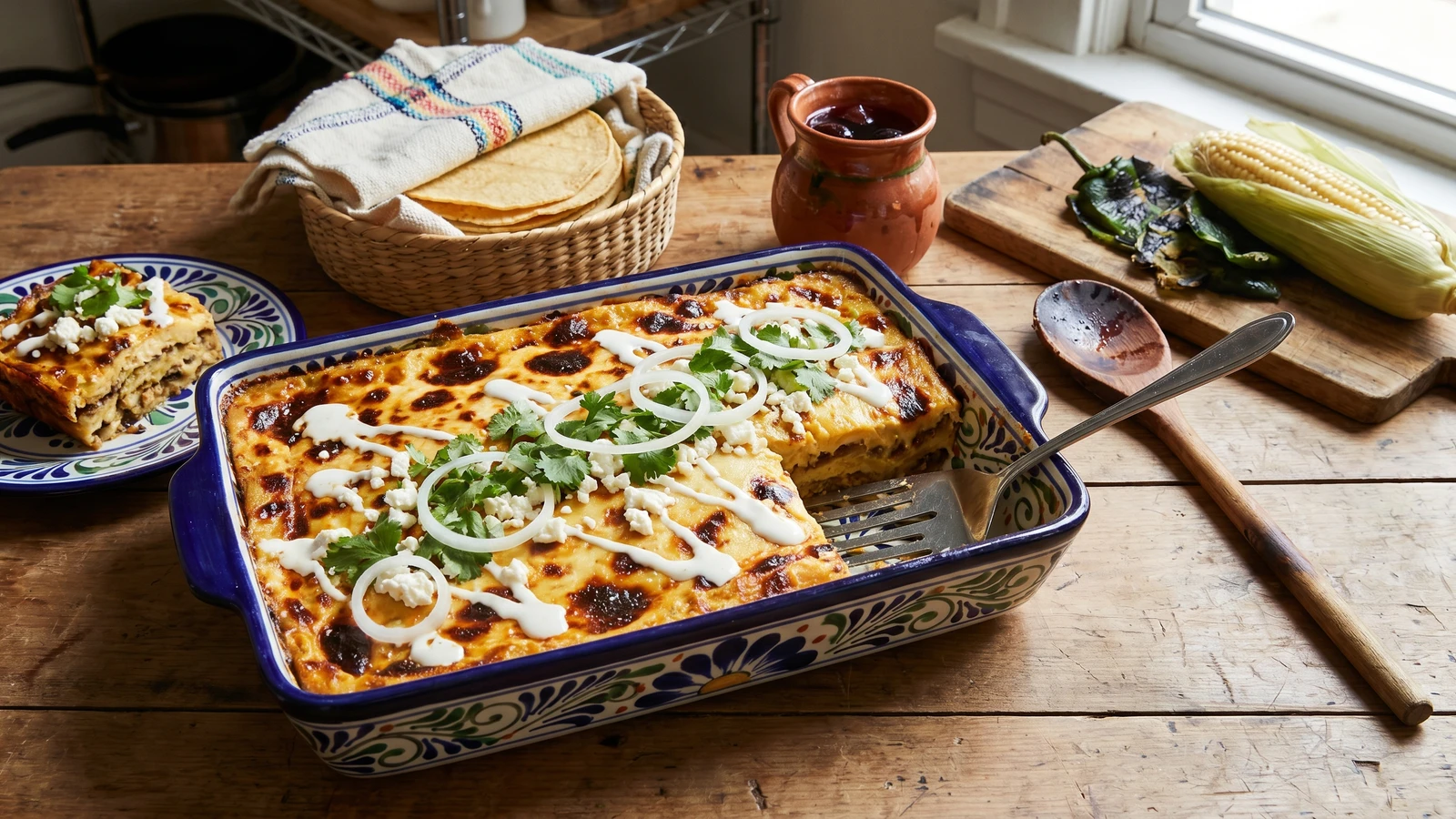
Mexico City's layered tortilla casserole, built on charred rajas poblanas, sweet elote, shredded chicken, and salsa verde, blanketed in crema and queso Oaxaca and baked until the edges crackle and the corners bubble.
This is a Ciudad de México dish. Specifically a chilango home-kitchen dish, the kind of recipe that lives in the notebooks of mothers across the Valle de México and gets pulled out for a birthday lunch, a baptism, or any Sunday when the family is coming over and there is leftover chicken in the refrigerator. People also call it pastel azteca. Same dish. Different name.
The foundation is rajas poblanas. Charred chile poblano, peeled and torn into strips, cooked down with onion and lard until the smoke softens into something sweet. Without proper rajas, this is just a casserole with chicken in it. With proper rajas, it is a budín. The chile has to be blackened over an open flame and sweated under a towel. Not roasted in the oven. Not blistered in a pan. Charred. The skin has to come off in sheets. That smoke is the dish.
My mother made this almost every other Sunday with whatever chicken she had poached for caldo earlier in the week. She wrote the recipe in the margin of her notebook with no measurements, just the order of the layers and a note that said 'no escatimes en el queso Oaxaca,' do not skimp on the queso Oaxaca. She was right about that. Queso Oaxaca is what melts into the strings between the layers and makes a budín pull apart properly when you serve it. Mozzarella will not do this. Monterey Jack will not do this. La cocina no es decoración, es trabajo, and the work here is in the layering and the cheese.
The elote is in season from late spring through early fall in central Mexico. If your corn is good, the budín is alive. If your corn is starchy and tired, leave it out and add another poblano. Mexican grandmothers cook with what the mercado is selling today.
Budín azteca, also called pastel azteca, is a 20th-century Mexico City invention that adapted the layered architecture of Italian lasagna to the indigenous tortilla, the pre-Columbian chile poblano of the central highlands, and the colonial-era queso Oaxaca developed by Dominican friars in the Etla valley. The dish appeared in middle-class chilango cookbooks beginning in the 1940s and 1950s, when published recipe collections aimed at urban housewives, such as the early editions of Josefina Velázquez de León's regional volumes, helped codify it as a casero classic. The 'azteca' name is a romantic mid-century branding gesture rather than a historical claim: the dish has no pre-Columbian precedent and is entirely a product of mestizo home cooking in the Valle de México.
Quantity
1 (about 4 pounds)
or 2 pounds bone-in skinless thighs and breasts
Quantity
1 medium
halved, for poaching
Quantity
1
thinly sliced, for the rajas
Quantity
1
halved crosswise, for poaching
Quantity
2
for the salsa verde
Quantity
2
Quantity
1 tablespoon, plus more to taste
Quantity
6
Quantity
2 tablespoons
Quantity
2 cups
cut from about 3 ears, or thawed frozen corn
Quantity
1 1/2 pounds
husked and rinsed
Quantity
3
stemmed (use 2 for less heat)
Quantity
1/2 cup, packed
Quantity
1 cup
reserved from poaching the chicken
Quantity
18 to 20
day-old preferred
Quantity
as needed
for lightly frying the tortillas
Quantity
1 1/2 cups
Quantity
1 pound
pulled into thin strands
Quantity
1/2 cup
crumbled, for finishing
Quantity
for serving
Quantity
for serving
| Ingredient | Quantity |
|---|---|
| whole chickenor 2 pounds bone-in skinless thighs and breasts | 1 (about 4 pounds) |
| white onionhalved, for poaching | 1 medium |
| small white onionthinly sliced, for the rajas | 1 |
| head of garlichalved crosswise, for poaching | 1 |
| garlic clovesfor the salsa verde | 2 |
| bay leaves | 2 |
| kosher salt | 1 tablespoon, plus more to taste |
| fresh chile poblano | 6 |
| manteca de cerdo (pork lard) | 2 tablespoons |
| fresh elote kernelscut from about 3 ears, or thawed frozen corn | 2 cups |
| tomatilloshusked and rinsed | 1 1/2 pounds |
| fresh chile serranostemmed (use 2 for less heat) | 3 |
| fresh cilantro leaves and tender stems | 1/2 cup, packed |
| chicken brothreserved from poaching the chicken | 1 cup |
| corn tortillasday-old preferred | 18 to 20 |
| neutral oilfor lightly frying the tortillas | as needed |
| crema mexicana | 1 1/2 cups |
| queso Oaxacapulled into thin strands | 1 pound |
| queso fresco (optional)crumbled, for finishing | 1/2 cup |
| fresh cilantro leaves (optional) | for serving |
| sliced raw white onion (optional) | for serving |
Place the chicken in a large stockpot with the halved onion, halved head of garlic, bay leaves, and salt. Cover with cold water by two inches. Bring to a gentle simmer over medium heat. Skim the gray foam that rises in the first ten minutes. Lower the heat and cook at a lazy simmer for 35 to 40 minutes for a whole bird, 25 minutes for thighs and breasts, until the meat pulls away from the bone. Cold water start and low heat give you tender meat and clean broth. A rolling boil gives you stringy chicken and cloudy water.
Lift the chicken out and let it cool until you can handle it. Pull the meat off the bones in long, irregular shreds. Discard the skin and bones, or save the bones for stock. You should have about 4 cups of shredded meat. Season it with a pinch of salt and a ladle of the warm broth so it does not dry out while you build the rest of the dish.
This is the soul of the dish. Place the poblanos directly on a gas burner over a high flame, or under a hot broiler. Turn them every couple of minutes with tongs until the skin is blackened and blistered all the way around. The flesh underneath should still be firm, not collapsed. Drop them into a bowl and cover with a kitchen towel. Let them sweat for 15 minutes. The steam trapped under the towel lifts the skin off the flesh.
Peel the burnt skin off the poblanos with your fingers. Slit each chile open, scrape out the seeds and veins, and tear or cut the flesh into strips about half an inch wide. These are your rajas. They should look ragged, not uniform. Industrial precision is not the style of this kitchen.
Melt the lard in a wide skillet over medium heat. Add the thinly sliced white onion and cook until soft and translucent, about five minutes. Add the rajas and the elote kernels. Cook together for another five to seven minutes, stirring occasionally, until the corn picks up a little color and the rajas have absorbed the onion and the lard. Season with salt. Taste. The rajas should be smoky, the corn sweet, and the onion barely there. Set aside.
Place the tomatillos and serranos in a saucepan, cover with water, and bring to a simmer. Cook for eight to ten minutes, until the tomatillos turn from bright green to a dull olive green and feel soft when poked. Drain. Transfer to a blender with the two raw garlic cloves, cilantro, one cup of the reserved chicken broth, and a teaspoon of salt. Blend until smooth but not foamy. Taste for salt. The salsa should be tart, herbaceous, and have enough heat to make itself known.
Heat a thin film of neutral oil in a small skillet over medium-high heat. One by one, dip each tortilla into the hot oil for about five seconds per side, just until they are pliable but not crisp. Drain on paper towels. This is the step nobody wants to do, and it is the step that keeps the budín from turning into a soggy mess. A raw tortilla goes limp in the oven. A lightly fried tortilla holds its structure and tastes like a tortilla. No me vengas con atajos.
Heat the oven to 375F. Spread half a cup of the salsa verde across the bottom of a 9-by-13-inch ceramic baking dish. Lay down a layer of tortillas, overlapping them and tearing pieces to fill the gaps. Spoon over a third of the shredded chicken, a third of the rajas and elote mixture, a generous ladle of salsa verde, a drizzle of crema, and a handful of queso Oaxaca. Repeat for two more layers. Finish with a top layer of tortillas, the last of the salsa verde poured over so every tortilla is touched, the rest of the crema in long ribbons, and all the remaining queso Oaxaca piled on top.
Bake uncovered for 30 to 35 minutes. The cheese on top should melt into a golden blanket with dark spots at the edges, the salsa should bubble up through the corners, and the whole dish should smell like a fonda at lunchtime. If the top browns too fast, tent with foil for the last ten minutes. Pull it out and let it rest for ten minutes before serving. A budín cut straight from the oven slides apart. A rested budín holds its layers.
Scatter the crumbled queso fresco, fresh cilantro leaves, and a few rings of raw white onion across the top. Bring the whole baking dish to the table and serve it family style, cutting generous squares with a spatula. Recetas probadas y garantizadas.
1 serving (about 460g)
Culinary guides, cultural storytelling, and the editorial depth that makes cooking meaningful.
Discover Culinary ExplorerChef Lupita
Michoacán's Tierra Caliente almuerzo, where salted beef is softened, pounded, fried in lard, folded with egg and chile perón salsa, then served beside morisqueta like a proper working table.

Chef Lupita
Guerrero's Costa Grande aporreado is salted cecina pounded soft, scrambled with egg, and finished in a red guajillo and chile de árbol salsa loud with garlic and cilantro.

Chef Lupita
Los Altos de Chiapas turns two-night fermented white corn into a tart-sweet atole, cooked with canela and piloncillo, then poured hot into jícaras for desayuno.

Chef Lupita
Oaxaca's Mixteca region ferments nixtamalized masa for days until it turns tart and alive, then simmers it with piloncillo and canela into a thick, warm atole served at first light in clay.