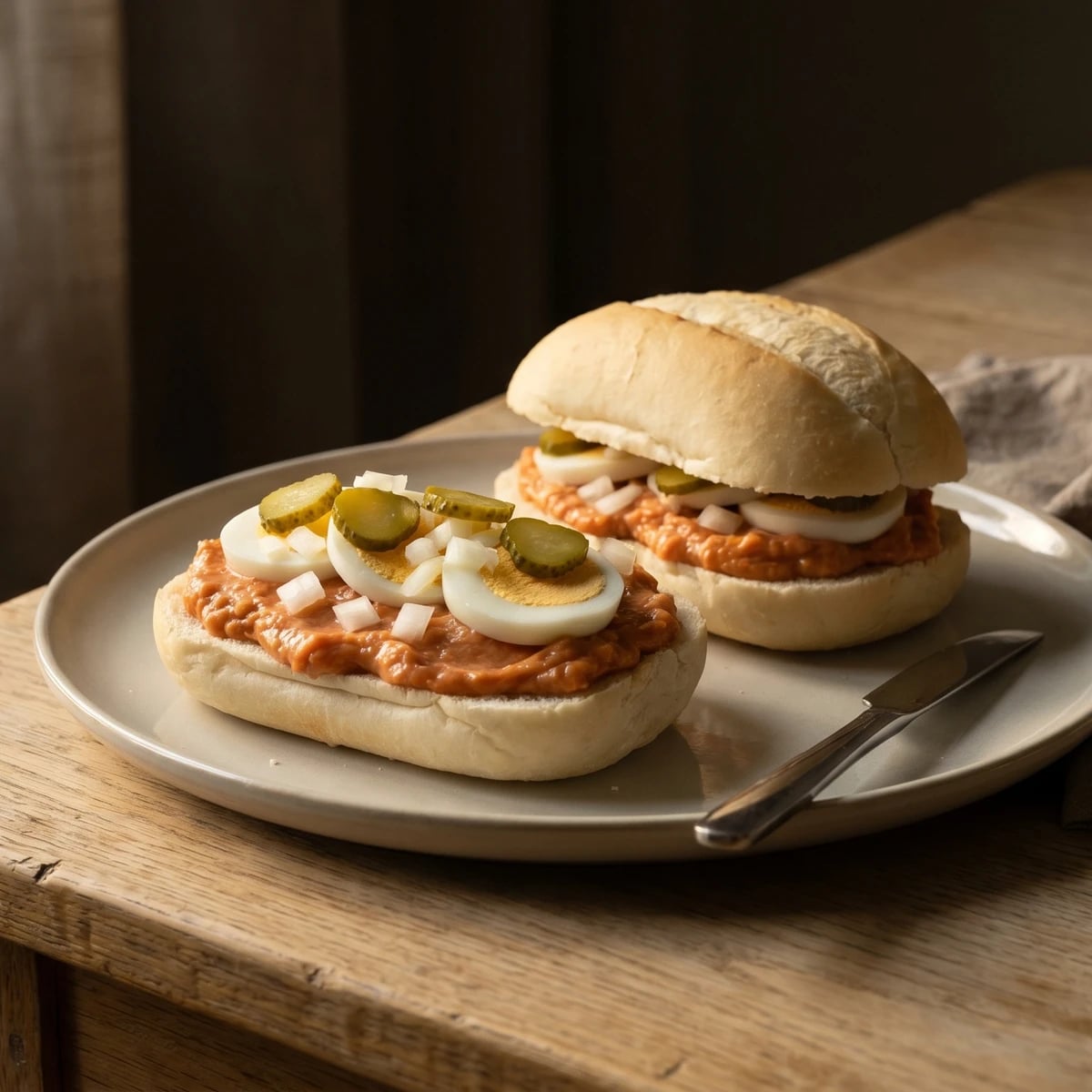
The name borrows a little French theatre and a little Belgian history, but the sandwich is pure Dutch lunchroom: raw spiced beef, soft bread, egg, onion, pickle, no flinching.
Sandwiches & Wraps
Dutch
Quick Meal
Budget Friendly
25 min
Active Time
10 min cook•35 min total
Yield4 sandwiches
The name already tells you this sandwich has been travelling under a borrowed coat. Filet americain sounds as if it should arrive with jazz, chrome, and a New York appetite, but in the Dutch lunchroom it sits quietly between cheese and kroketten, spread thick on a soft broodje, a small white roll, with egg, onion, and augurk, pickle. Very Dutch, for obvious reasons: we took the dramatic name and turned it into lunch.
But let me tell you a secret. The surprise is not that the beef is raw. Northern Europe has never been shy about preservation, curing, salting, chopping, and eating meat close to its source. The surprise is the texture. Dutch filet americain is not steak tartare in evening dress; it is finer, softer, seasoned all the way through, almost a spread. That is why the beef must be lean, cold, and freshly chopped, and why the sauce must season rather than drown it. If the meat is poor, the sandwich has nowhere to hide.
Hou het altijd simpel, always keep it simple. Buy a piece of lean beef from a butcher you trust, keep everything cold, chop it fine, season it cleanly, and eat it the day it is made. The onion brings sharpness, the egg gives calm richness, and the pickle cuts through with vinegar. History and cookery, they cannot be separated, but neither should they keep you from lunch.
Filet americain belongs to the Belgian and Dutch family of raw chopped beef dishes that developed from nineteenth-century steak tartare and French restaurant service. Belgian chef Joseph Niels is often credited with formalising filet americain prepare at Restaurant Canterbury in Brussels in 1926, seasoning raw beef into a ready-to-eat preparation rather than serving the seasonings separately. In the Netherlands the dish became a butcher-shop and lunchroom staple after the Second World War, smoother and more spreadable than tartare, usually eaten on a soft roll with boiled egg, raw onion, and pickle.
The technique, the tradition, and the story behind every dish.
Put the trimmed beef in the freezer for 15 minutes, just until firm at the edges but not frozen. Cold beef cuts cleanly and stays clean-tasting; warm beef smears, and a raw sandwich forgives less than a stew.
Use only whole-muscle beef from a butcher you trust, and tell them you will eat it raw. Do not use supermarket minced beef here; once meat is ground, its surface has been multiplied, and that is not the bargain we want.
2
Chop it fine
Slice the chilled beef thinly, then cut the slices into narrow strips and chop across them with a sharp knife until the texture is very fine but still alive, not paste. If using a grinder, pass it once through the fine plate into a cold bowl. Keep the bowl over ice if your kitchen is warm.
3
Season the spread
Stir together the mayonnaise, ketchup, mustard, Worcestershire sauce, chopped capers, paprika, cayenne, salt, and a few turns of black pepper. Fold in the chopped beef until the seasoning is even and the mixture looks rosy-orange and glossy. Taste a tiny amount and adjust salt, mustard, or pepper; the flavour should be bright, savoury, and gently sharp, not sweet.
4
Build the broodjes
Butter the split rolls lightly if you like, then spread each one generously with filet americain. Lay sliced hard-boiled egg over the beef, scatter with finely diced onion, and tuck in the sliced augurken, pickles. Close the rolls only loosely. This is a sandwich that wants to show its face.
5
Serve at once
Serve immediately, while the beef is still cool and the onion still sharp. If the sandwiches must wait, keep the filet americain covered in the refrigerator and assemble at the last minute. Bread is patient. Raw beef is not.
Chef Tips
•Ask for lean beef from a single whole cut, not minced beef from the case. Filet americain is only as good as the trust between you and the butcher.
•Keep everything cold: knife, bowl, meat, and finished spread. This is not fussiness; it is flavour and safety in the same gesture.
•A soft white broodje is the lunchroom choice. A crusty roll fights the spread and squeezes it out the sides, which is dramatic but not useful.
•Eat it the day you make it. Leftover filet americain should be covered, refrigerated, and used within 24 hours, but the best sandwich is the first one.
Advance Preparation
•The eggs can be boiled up to two days ahead and kept refrigerated in their shells.
•The onion and pickles can be prepared a few hours ahead, but chop the beef and mix the filet americain shortly before serving.
•Do not freeze finished filet americain; the texture turns watery and the seasoning goes dull.
Frequently Asked Questions
Nutrition Information
1 serving (about 250g)
Calories
445 calories
Total Fat
20 g
Saturated Fat
6 g
Trans Fat
0 g
Unsaturated Fat
13 g
Cholesterol
165 mg
Sodium
870 mg
Total Carbohydrates
39 g
Dietary Fiber
2 g
Sugars
8 g
Protein
29 g
Where cooking meets culture.
Culinary guides, cultural storytelling, and the editorial depth that makes cooking meaningful.