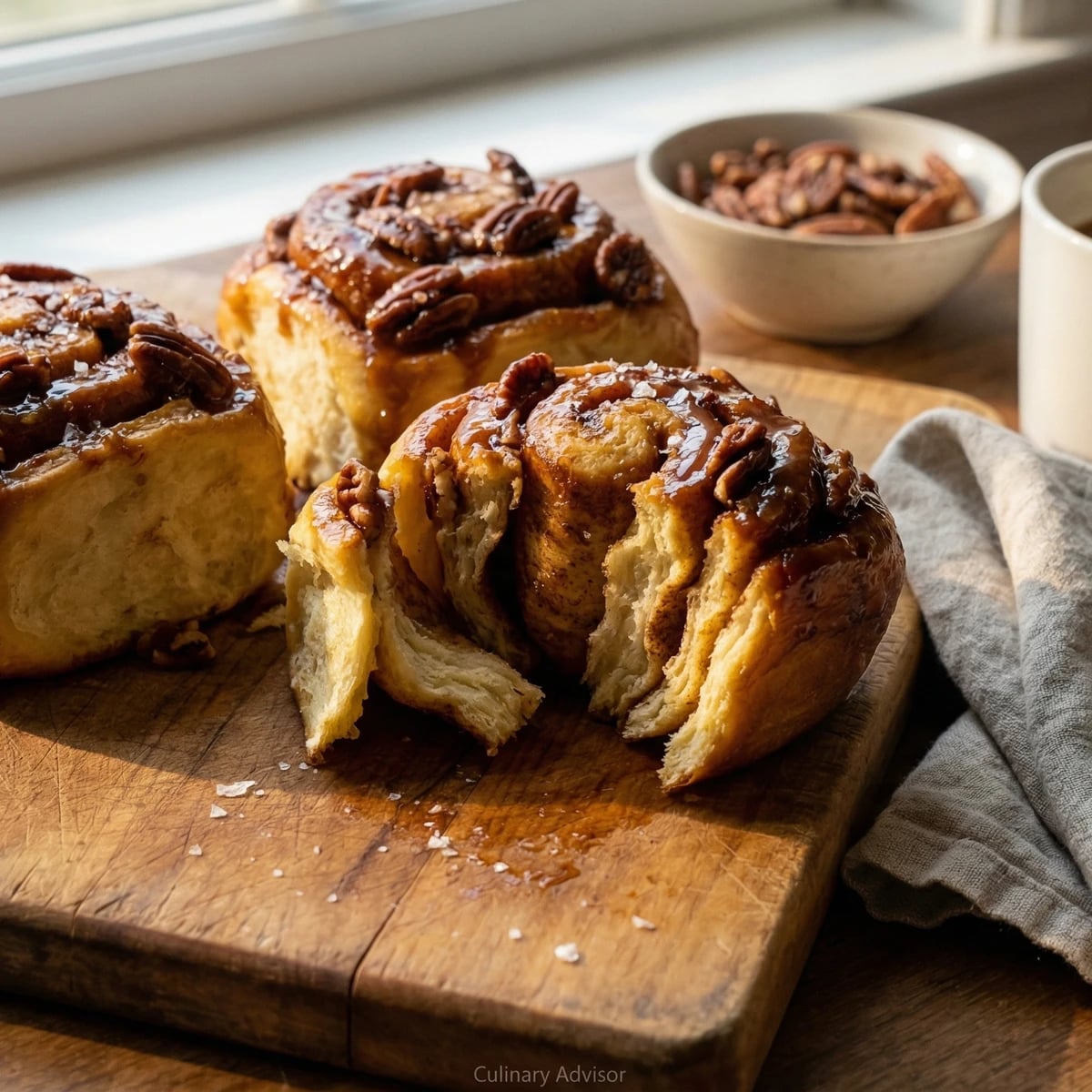
Buttery laminated dough spiraled with bourbon-kissed pecans and dark brown sugar, inverted from the pan with a sticky caramel crown that makes your whole kitchen smell like Sunday morning in New Orleans.
Pastries & Cookies
Southern
Special Occasion
Make Ahead
2 hr
Active Time
28 min cook•14 hr total
Yield12 morning buns
Good pastry takes patience. That's the first thing you learn when you start working with laminated dough. You can't rush butter. You can't hurry yeast. And you sure can't shortcut the folds that create those flaky, shatteringly tender layers.
These morning buns are the kind of project I save for weekends when I've got nowhere to be. The dough comes together quick, but then it needs time in the cold to develop, to let the gluten relax and the butter firm up. I start it Saturday afternoon, let it rest overnight, and by Sunday morning my house smells like heaven: butter caramelizing, pecans toasting, bourbon burning off and leaving behind nothing but warmth and sweetness.
The secret here is Louisiana cane syrup in the pan coating. Regular corn syrup will work, but cane syrup has this deep, almost smoky sweetness that pairs with bourbon like old friends. And the pecans, you toast them first. Always toast your nuts. Raw pecans taste like cardboard compared to toasted ones. Five minutes in a dry skillet changes everything.
At Lagniappe, we serve these on special Sundays. People drive across the Quarter for them. But here's the thing: they're not difficult. They're just slow. There's a difference. If you can fold a letter and roll out dough, you can make morning buns that rival any bakery. You just have to give them the time they deserve.
The technique, the tradition, and the story behind every dish.
•Large baking sheet or serving platter for inverting
Instructions
1
Make the dough
In a large bowl, whisk together the flour, granulated sugar, yeast, and one teaspoon salt. Make a well in the center. Add lukewarm milk, egg, and two tablespoons softened butter. Stir with a wooden spoon until a shaggy dough forms, then turn out onto a clean surface. Knead for five minutes until smooth and slightly tacky but not sticky. The dough should spring back when you poke it.
Lukewarm means 100-110F. Too hot kills the yeast, too cold and it won't activate. Your wrist is a good thermometer: it should feel like bathwater.
2
Chill the dough
Pat the dough into a rough rectangle about one inch thick. Wrap tightly in plastic wrap and refrigerate for at least one hour or overnight. The gluten needs to relax and the dough needs to firm up before you start laminating. Overnight is better if you have the patience.
3
Prepare the butter block
Place the cold laminating butter between two sheets of parchment paper. Pound it with your rolling pin to soften it slightly, then roll it into a 6-inch square about half an inch thick. The butter should be pliable but still cold, like clay you can bend without it cracking. Refrigerate while you roll out the dough.
This step is where most people fail. If your butter is too cold, it shatters. Too warm, it squishes out. You want it cold enough to hold its shape but flexible enough to fold without breaking.
4
Enclose the butter
Roll the chilled dough into a rectangle about 12 by 8 inches on a lightly floured surface. Place the butter square in the center. Fold the dough over the butter like you're wrapping a present: bring the two short ends to meet in the middle, then fold one side over the other. Pinch the seams to seal. You've just made your first envelope.
5
First fold
Turn the dough seam-side down. Roll it out gently into a long rectangle, about 18 by 8 inches. Don't press too hard or the butter will squeeze out. You should see the butter staying in distinct layers. Fold the dough in thirds like a business letter: bottom third up, top third down over it. This is your first turn. Wrap in plastic and refrigerate for thirty minutes.
If the butter starts breaking through the dough or getting soft and greasy, stop immediately and refrigerate for fifteen minutes. Cold butter is the whole game here.
6
Complete the lamination
Repeat the rolling and folding process two more times, chilling for thirty minutes between each turn. After three turns total, you have created dozens of alternating layers of butter and dough. That's what gives morning buns their flaky soul. Wrap the dough tightly and refrigerate for at least two hours or overnight.
7
Toast the pecans
While the dough rests, toast your pecans. Put them in a dry skillet over medium heat, stirring often, until they're fragrant and a shade darker, about five minutes. The kitchen should smell nutty and rich. Let them cool completely, then chop roughly. You want some larger pieces for texture.
8
Make the filling
Combine one cup brown sugar, three tablespoons bourbon, cinnamon, nutmeg, and half teaspoon salt in a bowl. The bourbon should make the sugar clump together slightly. This mixture goes inside your rolls. Set aside one cup of the chopped pecans for the filling.
9
Prepare the pan coating
Melt six tablespoons butter in a small saucepan over medium heat. Add half cup brown sugar, cane syrup, and two tablespoons bourbon. Stir until the sugar dissolves and the mixture bubbles gently, about two minutes. Divide this sticky caramel among twelve muffin cups, about one tablespoon each. Sprinkle the remaining chopped pecans into the cups. These become the crown of your buns when you flip them out.
10
Roll and fill the dough
Roll the laminated dough into a rectangle about 18 by 12 inches. Spread the four tablespoons softened butter across the entire surface. Scatter the brown sugar filling evenly over the butter, then press the reserved cup of pecans into the filling. Starting from a long edge, roll the dough into a tight spiral. Use both hands to keep it even and snug.
11
Cut and place
Using a sharp knife or unflavored dental floss, cut the log into twelve equal pieces, each about one and a half inches thick. Place each spiral cut-side down into a prepared muffin cup, pressing gently. The buns will look small, but they rise dramatically.
12
Proof the buns
Cover the muffin tin loosely with plastic wrap or a clean kitchen towel. Let the buns rise in a warm spot until they've puffed up and filled the cups, about one to one and a half hours. They should look pillowy and slightly domed. Don't rush this step.
If your kitchen is cold, turn your oven on for two minutes, then turn it off and put the covered pan inside. The residual warmth creates a perfect proofing environment.
13
Bake until golden
Preheat your oven to 375F. Bake the morning buns for 25 to 28 minutes until they're deeply golden brown on top and the caramel is bubbling up around the edges. The kitchen will smell like butter, bourbon, and toasted pecans. That's how you know you're close.
14
Invert immediately
Let the buns cool in the pan for exactly three minutes. No longer. The caramel is still liquid and the pecans will release cleanly. Place a large baking sheet or serving platter over the muffin tin and flip with confidence. Lift the tin away and admire your work: sticky, caramelized tops studded with toasted pecans. Sprinkle with flaky salt while still warm. Serve within the hour for the best experience.
Chef Tips
•Use good bourbon, something you'd actually drink. The cheap stuff tastes harsh even after baking. I keep a bottle of Maker's Mark in the kitchen just for cooking.
•If you're intimidated by laminating dough, you can use store-bought puff pastry in a pinch. It won't have that yeasty depth, but it'll still be delicious. No shame in shortcuts when you're learning.
•The three-minute window for inverting is real. Wait too long and the caramel hardens, gluing your buns to the pan. Ask me how I know.
•Louisiana cane syrup adds a molasses-like complexity that corn syrup can't match. Steen's is the brand we use at Lagniappe. Look for it at specialty grocers or order online.
•These buns are best eaten warm, but they'll keep covered at room temperature for a day. Reheat in a 300F oven for ten minutes to revive the flakiness.
Advance Preparation
•The dough can be made and laminated up to two days ahead, wrapped tightly and refrigerated. The flavor actually improves with time.
•Assemble the buns in their muffin cups, cover tightly, and refrigerate overnight. In the morning, let them come to room temperature and rise for about two hours before baking.
•The pan coating can be made a day ahead and stored in the muffin tin at room temperature. Add the pecans just before you place the dough spirals.
Frequently Asked Questions
Nutrition Information
1 serving (about 120g)
Calories
605 calories
Total Fat
39 g
Saturated Fat
18 g
Trans Fat
0 g
Unsaturated Fat
21 g
Cholesterol
86 mg
Sodium
310 mg
Total Carbohydrates
62 g
Dietary Fiber
2 g
Sugars
36 g
Protein
6 g
Where cooking meets culture.
Culinary guides, cultural storytelling, and the editorial depth that makes cooking meaningful.