
Chef Juliana
Beiju Chica de Santarém Novo
You don't need the right grandmother or a festival oven to learn the logic: grate mandioca fine, squeeze it damp, mix in coconut, and bake thin. Two ingredients, no packet, real crunch.
A cooking platform built around craft, culture, and the stories behind what we eat.
Created by
You think choux is too fancy for your kitchen. Good. We'll take that fear apart with a pan, a spoon, and a recipe that tells you exactly what to watch for.
You look at a bakery window, see that shiny chocolate top, and some quiet voice says, "isso não é pra mim." I know that voice. It tried the same nonsense with me when I was learning from my caderno as a grown woman, after years of eating well and cooking badly. Anota aí: cooking isn't a gift. Cozinhar não é dom, é um aprendizado.
A bomba belongs to the padaria, that second home of Brazilian hunger, where a gente buys bread, coffee, a slice of cake, and something sweet for after lunch. It doesn't replace the pê-efe. Nothing replaces rice, beans, a piece of meat or egg, and something green, the plate that quietly holds the country together. But comida de verdade has room for dessert, especially when dessert is flour, eggs, milk, cocoa, butter, and attention, not a packet pretending to be cream.
The method looks dramatic because the dough puffs hollow in the oven. But the trick is plain. You boil water, milk, butter, and salt, stir in flour until it pulls from the pan, then beat in eggs until the dough shines and falls slowly from the spoon. The oven does the theatre. Your job is to build the dough correctly and then leave it alone long enough to dry and hold its shell.
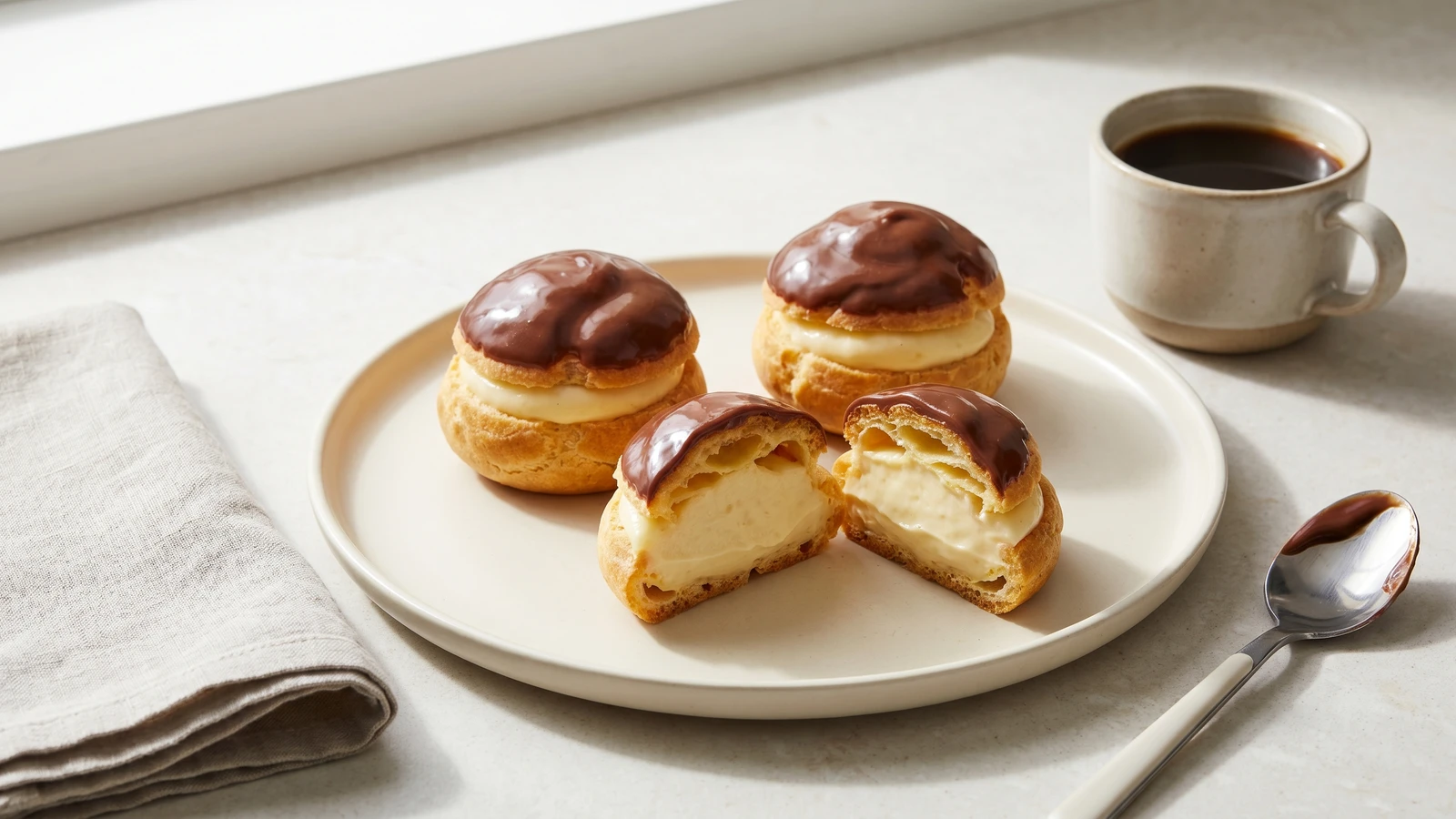
By the end you'll have bombas with a crisp, golden case, real pastry cream inside, and a chocolate glaze that sets soft and glossy. Not bakery magic. Receita que funciona. The kind that gets you back into the kitchen because now you know the thing was learnable all along.
Bomba de chocolate is the Brazilian padaria version of the French éclair, built from pâte à choux, a dough developed in European pastry kitchens and carried into Brazil through Portuguese and French baking influence. In Brazil it became less salon pastry and more counter food: long, filled, chocolate-topped, sold beside pão francês, sonhos, and coffee. The name bomba is practical and funny, because the pastry is hollow and filled until it feels like it might burst.
Quantity
1 cup
Quantity
1/2 cup
Quantity
1/2 cup
Quantity
1 tablespoon
Quantity
1/2 teaspoon
Quantity
1 1/4 cups
Quantity
4, plus 1 more if needed
room temperature
Quantity
2 cups
for the pastry cream
Quantity
1/2 cup
for the pastry cream
Quantity
3 tablespoons
Quantity
4
Quantity
1 tablespoon
for the pastry cream
Quantity
1 teaspoon
Quantity
1 pinch
for the pastry cream
Quantity
3/4 cup
chopped
Quantity
1/3 cup
Quantity
1 tablespoon
for the glaze
| Ingredient | Quantity |
|---|---|
| water | 1 cup |
| whole milk | 1/2 cup |
| unsalted butter | 1/2 cup |
| sugar | 1 tablespoon |
| salt | 1/2 teaspoon |
| all-purpose flour | 1 1/4 cups |
| large eggsroom temperature | 4, plus 1 more if needed |
| whole milkfor the pastry cream | 2 cups |
| sugarfor the pastry cream | 1/2 cup |
| cornstarch | 3 tablespoons |
| large egg yolks | 4 |
| unsalted butterfor the pastry cream | 1 tablespoon |
| vanilla extract | 1 teaspoon |
| saltfor the pastry cream | 1 pinch |
| semisweet chocolatechopped | 3/4 cup |
| heavy cream | 1/3 cup |
| unsalted butterfor the glaze | 1 tablespoon |
Put the 2 cups milk in a saucepan and warm it over medium heat until small bubbles gather at the edge. Don't boil it hard. Hot milk thickens the cream faster and more evenly, while boiling milk tries to climb out of the pan like it pays rent there.
In a bowl, whisk the yolks, 1/2 cup sugar, cornstarch, and pinch of salt until pale and smooth. Whisk for a full minute, until no dry cornstarch hides at the bottom. This matters because lumps start here, not later, and a smooth base gives you cream instead of sweet scrambled regret.
Pour the hot milk into the yolk mixture slowly, whisking the whole time, then return everything to the saucepan. Cook over medium heat, whisking without drama but without stopping, until it thickens and leaves heavy ribbons on the surface, about 3 to 5 minutes. Let it bubble for 30 seconds so the cornstarch cooks through and loses its raw taste.
Take the pan off the heat and whisk in 1 tablespoon butter and the vanilla. Scrape the cream into a shallow bowl, press plastic wrap directly on the surface, and chill until cold and firm, at least 1 hour. The wrap touches the cream so a skin doesn't form, because nobody asked for plastic-looking pudding inside a bomba.
Heat the oven to 200°C (400°F) and line two baking sheets with parchment. In a heavy saucepan, combine the water, 1/2 cup milk, 1/2 cup butter, 1 tablespoon sugar, and 1/2 teaspoon salt. Bring it to a full boil, with the butter completely melted, because the flour needs hot liquid all at once to swell and build the structure that will puff.
Add the flour all at once and stir hard with a wooden spoon. The dough will look rough, then come together into one smooth ball that pulls away from the sides. Keep stirring over medium heat for 2 minutes, until a thin film sticks to the bottom of the pan. That little film is your sign that extra moisture has cooked off, and dry enough dough makes hollow shells instead of flat pancakes.
Move the dough to a bowl and let it cool for 5 minutes, until warm but not hot. Beat in the eggs one at a time, mixing fully before the next. At first each egg will make the dough split and look ruined. Keep going. It comes back together. Stop when the dough is glossy and falls from the spoon in a thick V shape. If it's still stiff and breaks off in chunks, beat the extra egg in a small bowl and add it 1 tablespoon at a time.
Spoon the dough into a piping bag with a 1 to 1.5 cm round or open star tip. Pipe 12 strips, each about 10 cm long, leaving space between them. Smooth any sharp peaks with a damp fingertip. Peaks burn before the rest browns, and space matters because these little things grow bigger than they look.
Bake for 15 minutes at 200°C (400°F), then lower the oven to 180°C (350°F) and bake 20 to 25 minutes more, until the shells are deeply golden, firm, and light when lifted. Don't open the oven early. The dough puffs from trapped moisture turning to pressure, and a cold blast collapses it before the walls set.
Turn off the oven, poke a small hole in the side of each shell with a skewer, and return them to the warm oven with the door cracked for 10 minutes. That tiny hole lets trapped moisture escape, so the shell stays crisp instead of softening from the inside.
Whisk the chilled pastry cream until smooth, then spoon it into a clean piping bag. Pipe cream into each shell through the hole, stopping when the shell feels pleasantly heavy. Don't force it until it bursts. Full is good. Exploded is lunch for the cook, which is not tragic, but still.
Warm the heavy cream just until hot, then pour it over the chopped chocolate and wait 2 minutes. Stir from the center until glossy, then stir in 1 tablespoon butter. Dip the top of each filled bomba into the glaze and set it on a tray until the chocolate settles soft and shiny. If the glaze is too runny, wait a few minutes. If it's too thick, warm it gently for a few seconds.
1 serving (about 125g)
Culinary guides, cultural storytelling, and the editorial depth that makes cooking meaningful.
Discover Culinary ExplorerChef Juliana
You don't need the right grandmother or a festival oven to learn the logic: grate mandioca fine, squeeze it damp, mix in coconut, and bake thin. Two ingredients, no packet, real crunch.

Chef Juliana
You think tiny wrapped wedding sweets are for people with magic hands. They're not. They're sponge, filling, glaze, and patience, taught in plain steps until they behave.

Chef Juliana
You think this is bakery magic. It isn't. Scald sour cassava starch, beat in eggs, pipe rings, and let a hot oven crack them into crisp, hollow biscuits.

Chef Juliana
You don't need bakery courage for this. Polvilho, queijo Minas, milk, butter, and your hands make crisp little sticks for coffee, lunchboxes, or the snack that keeps dinner sane.