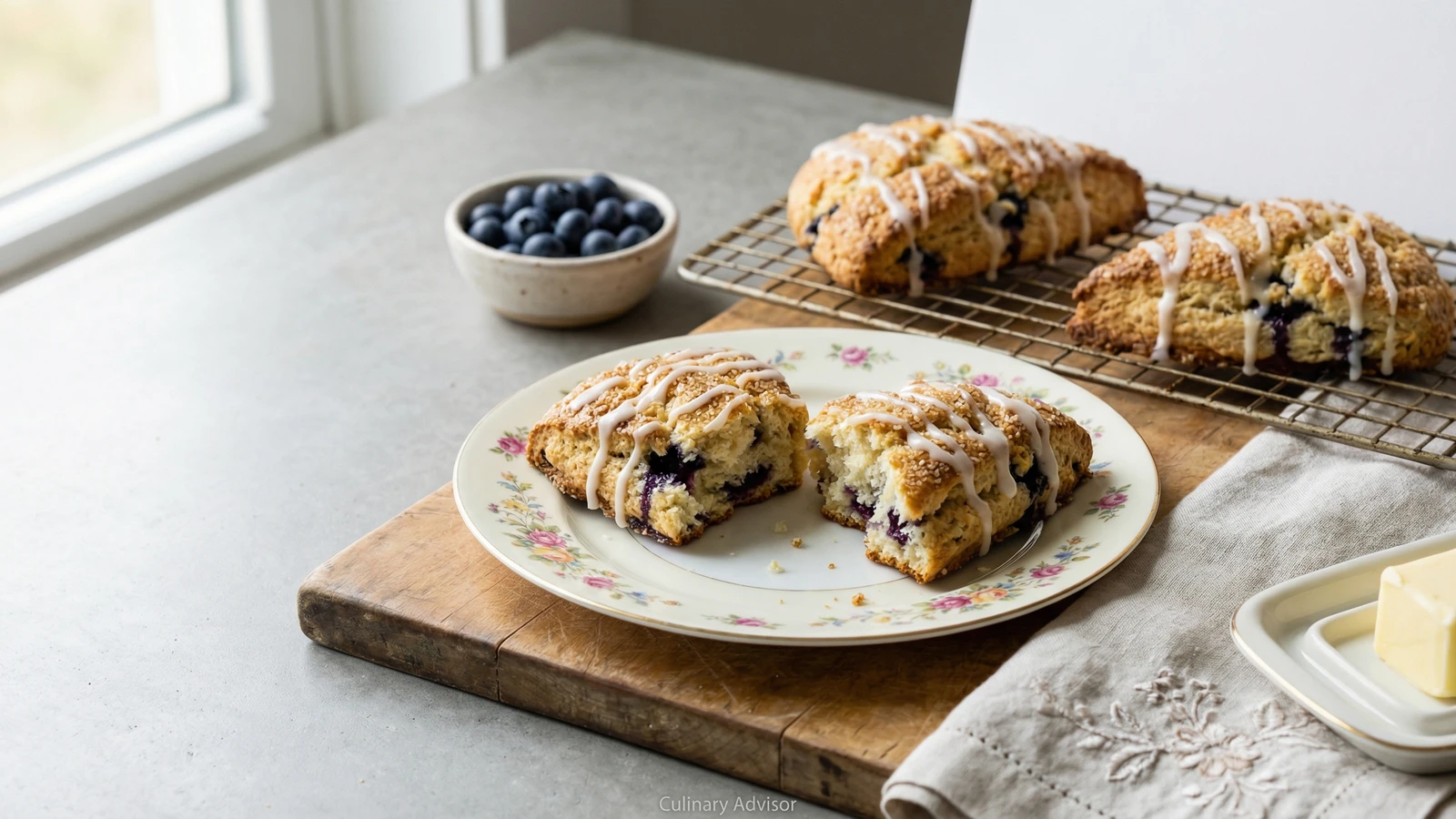
Golden-topped wedges with crisp sugared crusts giving way to tender, buttery interiors bursting with fresh blueberries and bright lemon, finished with a tangy glaze that pools in every craggy crevice.
Pastries & Cookies
American
Make Ahead
Bridal Shower
25 min
Active Time
22 min cook•47 min total
Yield8 scones
The scone came to America with British colonists and promptly improved. Our grandmothers made them richer, sweeter, and studded them with whatever fruit the season offered. This version belongs to late spring, when blueberries first appear at farmstands and lemons are still bright from winter groves.
The technique is old and simple. Cold butter, cut into flour, creates pockets that turn to steam in a hot oven. Those pockets become layers. The less you handle the dough, the more tender the result. Every grandmother knew this. Somewhere along the line, we forgot.
These scones taste like weekend mornings with no agenda. They're the kind of thing you make when family is visiting, when you want the house to smell like welcome. The lemon cuts through the richness, the blueberries burst against your teeth, and that crackly sugar top shatters with the first bite. This is breakfast worth setting the alarm for.
The technique, the tradition, and the story behind every dish.
Cut your cold butter into half-inch cubes and spread them on a small plate. Place in the freezer for fifteen minutes while you prepare the other components. The butter must be cold enough to shatter when you press it. This single detail determines whether you'll have flaky, tender scones or dense, bread-like disappointments.
2
Prepare dry ingredients
Whisk together the flour, granulated sugar, baking powder, and salt in a large, wide bowl. Add the lemon zest and rub it into the dry ingredients with your fingertips until the mixture is fragrant and the zest is evenly distributed. Your kitchen should smell like a lemon grove. That perfume tells you the oils are releasing.
Zest your lemons before juicing them for the glaze. A Microplane produces the finest zest with no bitter pith.
3
Cut in the butter
Retrieve your frozen butter cubes and scatter them over the flour mixture. Using a pastry blender or two knives, cut the butter into the flour with quick, decisive strokes. Work fast. You want pieces ranging from pea-sized to the size of small lima beans. Some larger flat pieces are desirable. They'll create those flaky layers when the scones hit the oven's heat.
If your kitchen runs warm, return the bowl to the refrigerator for five minutes if the butter begins to soften and smear.
4
Prepare wet ingredients
In a small bowl or measuring cup, whisk together the cold cream, egg, and vanilla until combined. The cream must be cold. Room temperature cream will begin warming that precious butter the moment it touches the flour.
5
Combine wet and dry
Make a well in the center of the flour mixture. Pour in the cream mixture all at once. Using a fork, stir from the center outward, gradually incorporating the dry ingredients. Stop when the dough is shaggy and just barely holds together. You should still see dry patches and loose flour. This is correct.
6
Fold in blueberries
Scatter the fresh blueberries over the shaggy dough. Using a large spatula or your hands, gently fold them in with three or four turns. Some berries will break. This is fine. The purple streaks they leave behind are honest and beautiful.
7
Shape the dough
Turn the dough out onto a lightly floured surface. With floured hands, gather it into a rough mass and pat it into a circle about one inch thick and eight inches across. The surface will be craggy and imperfect. Do not smooth it, do not knead it, do not fuss. Every unnecessary touch toughens your scones.
Scone dough rewards restraint. Handle it like something precious and fragile, because it is.
8
Cut into wedges
Using a sharp knife or bench scraper, cut the circle into eight equal wedges. Separate the wedges and place them on a parchment-lined baking sheet, spacing them two inches apart. They'll spread slightly as they bake.
9
Chill before baking
Place the baking sheet in the refrigerator for twenty minutes, or the freezer for ten. This rest firms the butter and relaxes the gluten. Cold scones rise higher and bake more evenly. Do not skip this step.
This is your make-ahead moment. Chilled scones can be covered and refrigerated overnight, or frozen for up to two months.
10
Prepare for the oven
While scones chill, preheat your oven to 400°F. Position a rack in the center. When ready to bake, brush the tops of each wedge with cream and sprinkle generously with turbinado sugar. The cream encourages browning. The sugar adds crunch and sparkle.
11
Bake until golden
Bake for 20 to 22 minutes, until the scones are golden brown on top and firm around the edges. The bottoms should be deep golden when you lift one with a spatula. The centers will feel set but give slightly when pressed. A toothpick inserted into the center should come out clean or with just a purple smear from a berry.
12
Cool properly
Transfer scones to a wire rack and let cool for at least fifteen minutes. They need time to set their structure. A scone cut too soon will crumble and steam will escape. Patience rewards you with clean breaks and proper texture.
13
Make the glaze
Whisk together the powdered sugar and two tablespoons of fresh lemon juice in a small bowl until smooth. The glaze should be thick enough to coat a spoon but thin enough to drizzle. Add more lemon juice by the teaspoon if needed. Stir in the remaining lemon zest for texture and visual appeal.
14
Glaze and serve
Using a fork or small spoon, drizzle the lemon glaze over the cooled scones in a zigzag pattern. Let the glaze set for five minutes until it loses its shine. Serve at room temperature with good butter and strong coffee. These scones announce that someone cared enough to bake for you.
Chef Tips
•Fresh blueberries hold their shape better than frozen. If you must use frozen, do not thaw them first. Toss them with a tablespoon of flour before folding in to prevent purple bleeding through the dough.
•For the tallest rise, cut scones with a single confident stroke. Sawing back and forth seals the edges and prevents proper lift.
•These are best within hours of baking, but day-old scones revive beautifully. Split in half, toast cut-side down in a buttered skillet until golden, then serve warm.
•The glaze should be thick enough to drape, not puddle. Too thin and it soaks in without visual impact. Too thick and it cracks unpleasantly. Test on a plate first.
Advance Preparation
•Shaped scones can be frozen on the baking sheet until solid, then transferred to a freezer bag. Bake directly from frozen, adding 3-4 minutes to the baking time.
•Refrigerated unbaked scones keep overnight. Brush with cream and sugar just before baking.
•The glaze can be made several hours ahead and covered. Whisk again before drizzling. If it has thickened, add lemon juice by the half-teaspoon.
•Baked and glazed scones keep in an airtight container at room temperature for two days, though they are incomparably better fresh.
Frequently Asked Questions
Nutrition Information
1 scone (about 95g)
Calories
325 calories
Total Fat
23 g
Saturated Fat
14 g
Trans Fat
0 g
Unsaturated Fat
8 g
Cholesterol
78 mg
Sodium
180 mg
Total Carbohydrates
54 g
Dietary Fiber
1 g
Sugars
32 g
Protein
7 g
Where cooking meets culture.
Culinary guides, cultural storytelling, and the editorial depth that makes cooking meaningful.