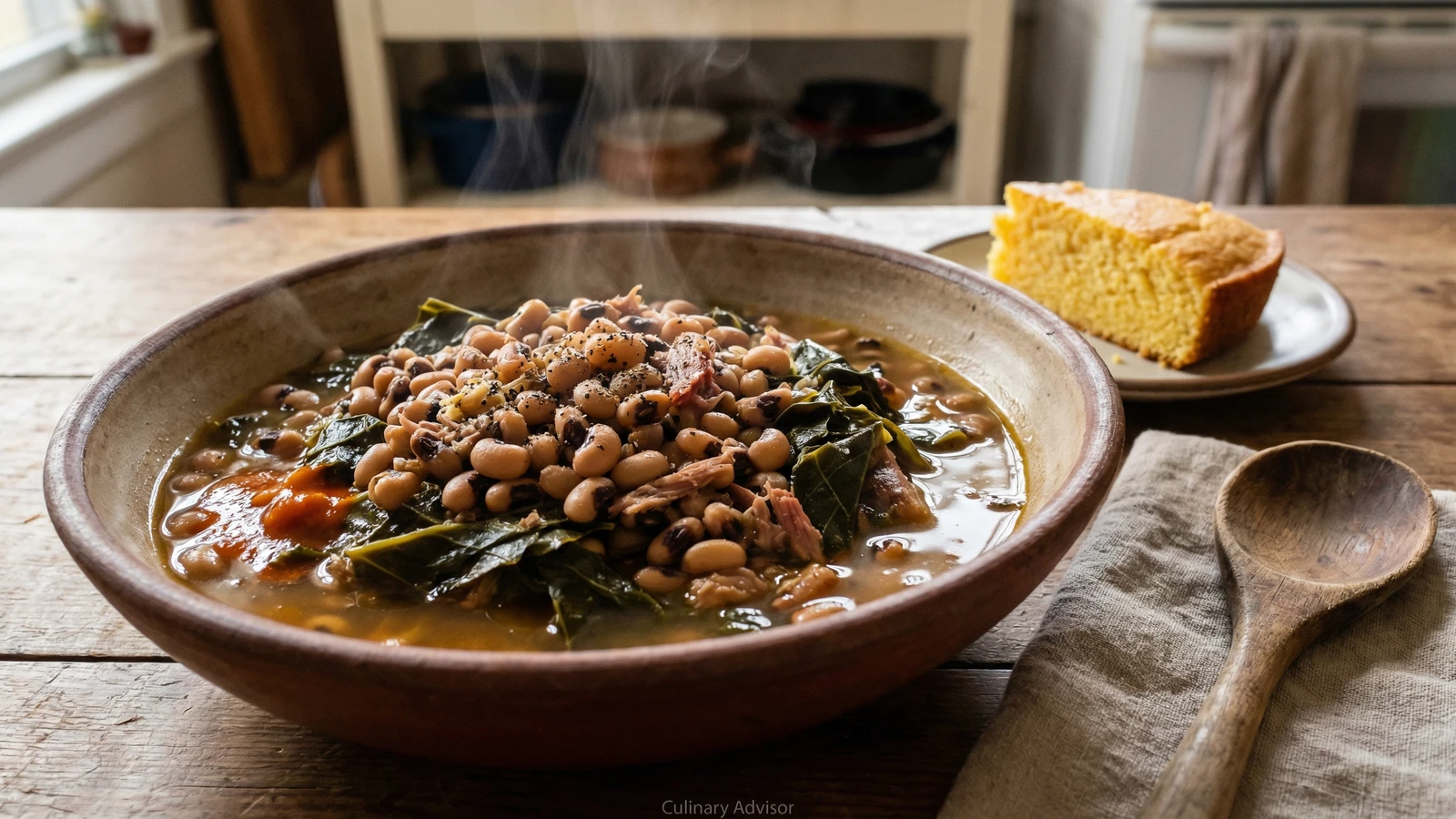
Field peas simmered slowly with a smoky ham hock, joined by ribbons of collard greens that melt into the pot liquor, a bowl of Southern tradition that nourishes body and spirit alike.
Side Dishes
Southern
New Years
Comfort Food
Make Ahead
30 min
Active Time
2 hr cook•2 hr 30 min total
Yield8 servings
Black-eyed peas and greens belong to winter. They arrive at the market when the cold settles in, when the fields lie fallow except for these hardy crops that thrive in the chill. This is food that understands its season.
The tradition of eating black-eyed peas on New Year's Day stretches back generations in the South. Peas for prosperity, greens for wealth, pork for progress. I do not know if the luck is real. I know the nourishment is. A pot of peas simmered with smoked pork and tender greens has sustained families through hard winters and lean times. It asks for almost nothing: dried legumes, a ham hock, whatever greens look alive at the market, time.
At the farmers' market, look for dried black-eyed peas from the current harvest. They should feel heavy in your hand, with smooth unblemished skins. Old peas, the ones that have sat on a shelf for years, take forever to soften and never taste quite right. For greens, choose bunches with leaves that spring back when touched, deep green without yellowing or wilting. Collards are traditional, but turnip greens bring a pleasant bite. Use what looks best.
The technique here is patience, nothing more. You build a pot of richly flavored liquid, cook the peas until they yield, add the greens until they surrender. The smoked pork does most of the work. Your job is to get out of the way and let time do what time does.
The technique, the tradition, and the story behind every dish.
•Large Dutch oven or heavy-bottomed pot (6-quart minimum)
•Rimmed baking sheet for sorting peas
•Large bowl for washing greens
Instructions
1
Sort and rinse the peas
Spread the dried peas on a rimmed baking sheet and pick through them. Look for small stones, shriveled peas, and any debris that does not belong. Rinse them in a colander under cold running water until the water runs clear. Dried peas from a farmer who grows them with care will need less sorting, but always check.
Unlike other dried beans, black-eyed peas do not require overnight soaking. Their thin skins allow them to cook through in a reasonable time.
2
Build the pot liquor
Place the ham hock in a large Dutch oven or heavy pot. Add the diced onion, smashed garlic, bay leaves, salt, black pepper, and red pepper flakes. Pour in the water or stock. The liquid should cover the ham hock by at least two inches. Bring everything to a boil over medium-high heat.
3
Simmer the ham hock
Reduce the heat to maintain a gentle simmer. Cook uncovered for 45 minutes to an hour, allowing the smoked pork to release its flavor into the liquid. The kitchen will smell of smoke and promise. This is pot liquor in the making, the foundation of Southern cooking.
4
Add the peas
Add the rinsed black-eyed peas to the pot. Stir once to distribute them evenly. Return to a gentle simmer and cook for 45 minutes to an hour, until the peas are tender but still hold their shape. They should yield easily when pressed between your fingers but not turn to mush.
Older dried peas take longer to cook. If your peas are from a recent harvest, they may be ready in 30 minutes. Taste early and often.
5
Prepare the greens
While the peas simmer, strip the collard or turnip greens from their tough center stems. Stack several leaves, roll them into a cigar shape, and slice crosswise into ribbons about an inch wide. Wash the ribbons in a large bowl of cold water, agitating them to release any grit. Lift the greens out and drain. Repeat until no sand settles at the bottom.
6
Cook down the greens
When the peas are nearly tender, add the greens to the pot in handfuls, pressing each batch down before adding the next. They will seem like far too much at first. They will cook down to almost nothing. Stir to submerge them in the pot liquor.
7
Finish and season
Continue simmering until the greens are silky and tender, another 20 to 30 minutes. Remove the ham hock and shred any meat from the bone, discarding the skin and fat. Return the meat to the pot. Stir in the apple cider vinegar. Taste. Adjust the salt. The vinegar brightens everything, cutting through the richness of the pork.
The pot liquor should be flavorful enough to drink on its own. If it tastes flat, it needs more salt.
8
Serve with intention
Ladle the peas and greens into deep bowls, making sure each serving gets plenty of pot liquor. The liquid is not waste; it is the soul of the dish. Serve with hot sauce at the table and cornbread alongside. Remove the bay leaves before serving or fish them out as you go.
Chef Tips
•Seek out a quality smoked ham hock from a farmer who raises pigs properly. The smoke flavor should be clean and deep, not acrid or artificial. A good ham hock transforms the whole pot.
•Fresh black-eyed peas appear at Southern farmers' markets in late summer. If you find them, use them immediately. They cook in half the time and taste of the field they came from.
•Save any leftover pot liquor. It freezes beautifully and can serve as the base for your next pot of greens, beans, or rice. Nothing should go to waste.
•If you do not eat pork, use a smoked turkey leg or wing. The dish will be different but still honest. Some cooks simply add a splash of liquid smoke and extra aromatics.
Advance Preparation
•The entire dish can be made two to three days ahead and refrigerated. The flavors deepen as it sits. Reheat gently, adding a splash of water if the pot liquor has thickened too much.
•Dried peas can be sorted and rinsed a day ahead, stored in the refrigerator covered with water.
•Greens can be stripped, washed, and refrigerated in a damp towel up to two days before cooking.
Frequently Asked Questions
Nutrition Information
1 serving (about 260g)
Calories
275 calories
Total Fat
5 g
Saturated Fat
2 g
Trans Fat
0 g
Unsaturated Fat
3 g
Cholesterol
20 mg
Sodium
550 mg
Total Carbohydrates
41 g
Dietary Fiber
10 g
Sugars
2 g
Protein
21 g
Where cooking meets culture.
Culinary guides, cultural storytelling, and the editorial depth that makes cooking meaningful.