
Chef Klaus
Allgäuer Krautkrapfen
The Allgäu pan dish that makes a meal from noodle dough, winter kraut, onion, and fat: brown the cut sides first, then cook gently so the rolls hold.
A cooking platform built around craft, culture, and the stories behind what we eat.
Created by
Bavaria took boeuf à la mode, put it into dialect, larded the beef with Speck, and made a Sunday roast that lives by its marinade.
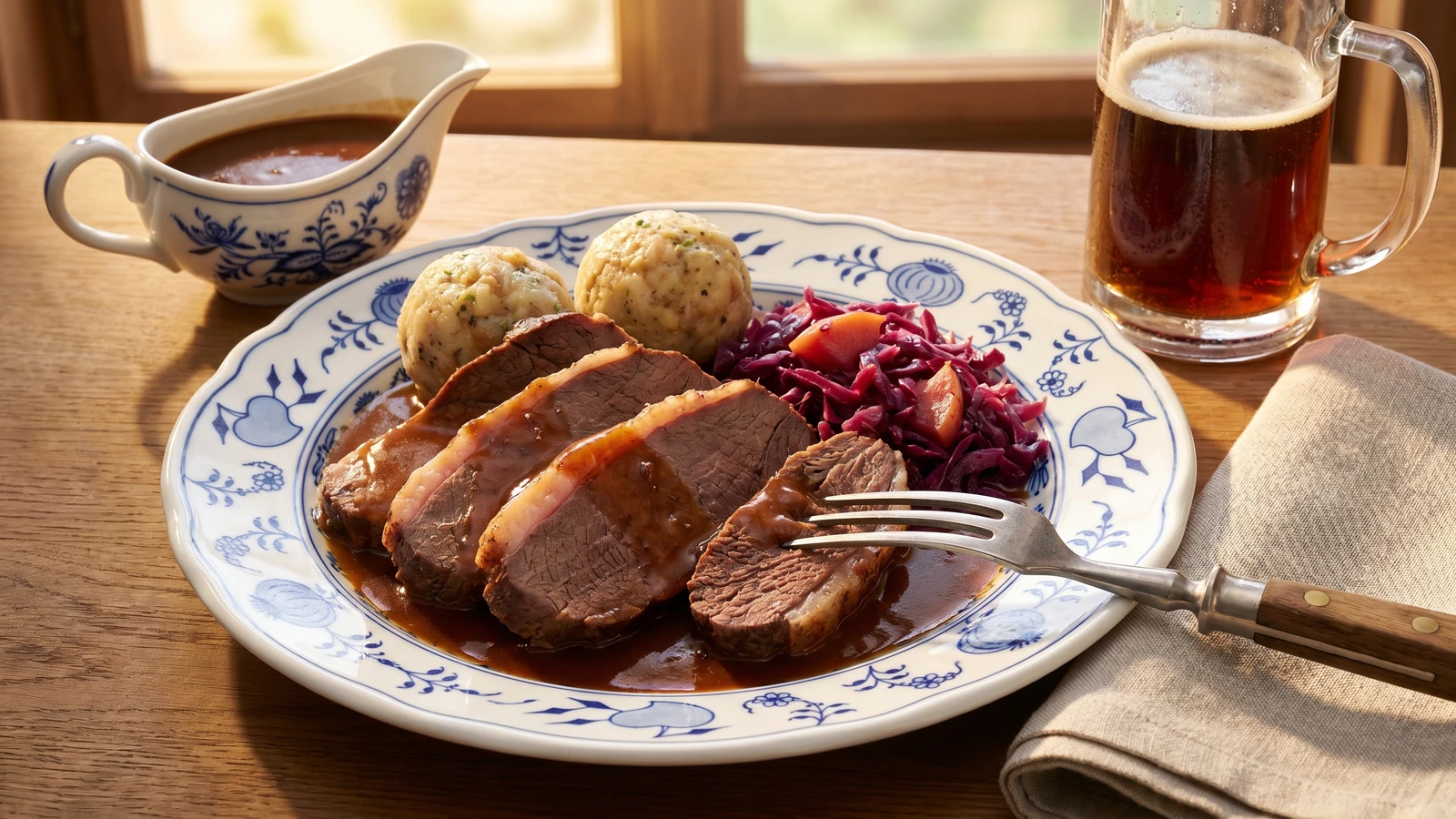
Böfflamott is Bavaria wearing a French coat and muddy boots. The name comes from boeuf à la mode, but what lands on the table is Bavarian Sunday food: a beef roast larded with Speck, marinated in red wine, vinegar, roots, and spices, then braised until the knife goes through without argument. It belongs to feast days and cold months, when the cellar has roots, cabbage, pickles, and time.
Im Norden anders, im Süden anders. In the Rhineland, a sour roast may go sweet with raisins and Lebkuchen. In Bavaria, Böfflamott stays darker, meatier, and more wine-led, with bacon inside the roast instead of sweetness in the sauce. Serve it with Semmelknödel, bread dumplings, or Kartoffelknödel, potato dumplings, and Blaukraut, braised red cabbage. Das ist kein Bierzelt. It's a braise with manners.
The technique that decides it is the cold marinade and the dry sear. Boil the wine mixture first to wake the roots and spices, then cool it completely before the beef goes in. Pour it warm and you start cooking the outside while the center stays plain. After two days, dry the meat hard with a towel before it hits the fat, because wet beef turns grey in the pan and gives you no brown base for the sauce.
Lard the beef before it marinates so the Speck seasons from the inside as the acid works from the outside. Then runter mit der Temperatur, down with the temperature, and let the pot do its slow work. Das braucht seine Zeit.
Böfflamott is the Bavarian dialect form of the French boeuf à la mode, a name that entered southern German kitchens when French court cooking carried prestige in the 18th and early 19th centuries. Bavaria's alliance with Napoleon and its elevation to a kingdom in 1806 under Maximilian I Joseph strengthened that French influence in court and bourgeois cooking, while the dialect turned the phrase into something local. The dish shows a Bavarian habit clearly: foreign name, local larder, Speck, roots, red wine, and a long braise.
Quantity
1.5kg
in one piece
Quantity
120g
cut into long thin larding strips
Quantity
750ml
Quantity
150ml
Quantity
2
sliced
Quantity
2
chopped
Quantity
1 small wedge
chopped
Quantity
1
sliced and well washed
Quantity
2
Quantity
8
lightly crushed
Quantity
6
Quantity
3
Quantity
1 teaspoon
Quantity
1 tablespoon
Quantity
2 tablespoons
Quantity
500ml
preferably from roasted bones
Quantity
1 teaspoon
Quantity
1 tablespoon
Quantity
to taste
| Ingredient | Quantity |
|---|---|
| beef shoulder, rump, or topsidein one piece | 1.5kg |
| smoked streaky bacon or Speckcut into long thin larding strips | 120g |
| dry red wine | 750ml |
| red wine vinegar | 150ml |
| onionssliced | 2 |
| carrotschopped | 2 |
| celeriacchopped | 1 small wedge |
| leeksliced and well washed | 1 |
| bay leaves | 2 |
| juniper berrieslightly crushed | 8 |
| black peppercorns | 6 |
| whole cloves | 3 |
| mustard seeds | 1 teaspoon |
| tomato paste | 1 tablespoon |
| lard or neutral oil | 2 tablespoons |
| beef stockpreferably from roasted bones | 500ml |
| sugar | 1 teaspoon |
| cold butter | 1 tablespoon |
| salt and black pepper | to taste |
Cut the Speck into long strips and push them through the beef with a larding needle, or make narrow cuts with a thin knife and feed the strips through. The bacon belongs inside before the marinade starts, because the fat seasons the lean beef from within while the wine and vinegar work from outside. Tie the roast with kitchen string so it keeps its shape in the pot.
Put the wine, vinegar, onions, carrots, celeriac, leek, bay, juniper, peppercorns, cloves, and mustard seeds in a pot and bring it just to a boil. Simmer five minutes, then take it off the heat and let it cool completely. Cool means cold to the touch. Warm marinade tightens the meat at the surface, and then the center never takes the flavour properly.
Lay the larded beef in a glass or ceramic dish, pour the cold marinade over it, cover it, and refrigerate for 48 hours, turning the meat morning and evening. The acid needs time to move through the cut, and the turning keeps one side from becoming sharp while the other stays plain. Das braucht seine Zeit.
Lift the beef from the marinade and pat it very dry. Strain the marinade and keep both the liquid and the vegetables. Heat the lard in a heavy braiser and brown the beef on all sides until the surface is dark and crusted; dry meat browns, wet meat stews grey. Take the beef out and keep it nearby.
Add the drained marinade vegetables to the same pot and cook them until the edges colour. Stir in the tomato paste and let it darken for a minute, because raw tomato paste tastes tinny and browned tomato paste gives the sauce backbone. Sprinkle in the sugar and let it catch lightly, only enough to round the vinegar.
Return the beef to the pot, pour in the strained marinade and enough beef stock to come halfway up the meat, then bring it to a gentle simmer. Cover the pot and braise at 150C for about 3 hours, turning the roast once halfway through. Runter mit der Temperatur: a hard boil squeezes the meat dry, while a low braise lets the collagen soften into the sauce.
Lift the beef out, tent it loosely, and let it rest 20 minutes so the juices settle before slicing. Strain the braising liquid, pressing the vegetables well because Weggeworfen wird nichts, then reduce the sauce until it coats a spoon. Whisk in the cold butter off the boil for gloss, then season with salt and pepper at the end. Würzen, Fett, Salz zum Schluss.
Cut the roast across the grain into thick slices, spoon the dark wine sauce over, and serve with Semmelknödel or Kartoffelknödel and ruby Blaukraut. The dumpling is not decoration. It is there to catch the sauce, which is why you made the sauce properly. Nicht aus dem Glas.
1 serving (about 350g)
Culinary guides, cultural storytelling, and the editorial depth that makes cooking meaningful.
Discover Culinary ExplorerChef Klaus
The Allgäu pan dish that makes a meal from noodle dough, winter kraut, onion, and fat: brown the cut sides first, then cook gently so the rolls hold.

Chef Klaus
Swabian egg pasta turned toward the apple cellar: fresh Spätzle tossed with browned butter, tart apples, cinnamon, and enough restraint to stay supper, not cake.

Chef Klaus
Hesse's pork goulash belongs to Apfelwein country: shoulder, onions, and tart cider cooked low until the cheap cut turns soft and the sauce lands sweet-sour, not sour-sweet.

Chef Klaus
The old sweet supper that saves yesterday's loaf: stale bread drinks eggy milk, the pan stays moderate, and butter browns the outside only after the centre has set.