
Chef Lupita
Agua de Alfalfa
Ciudad de México's highland market agua fresca, fresh alfalfa blended with pineapple and lime until bright green, strained clean, and poured cold from the vitrolero.
A cooking platform built around craft, culture, and the stories behind what we eat.
Created by
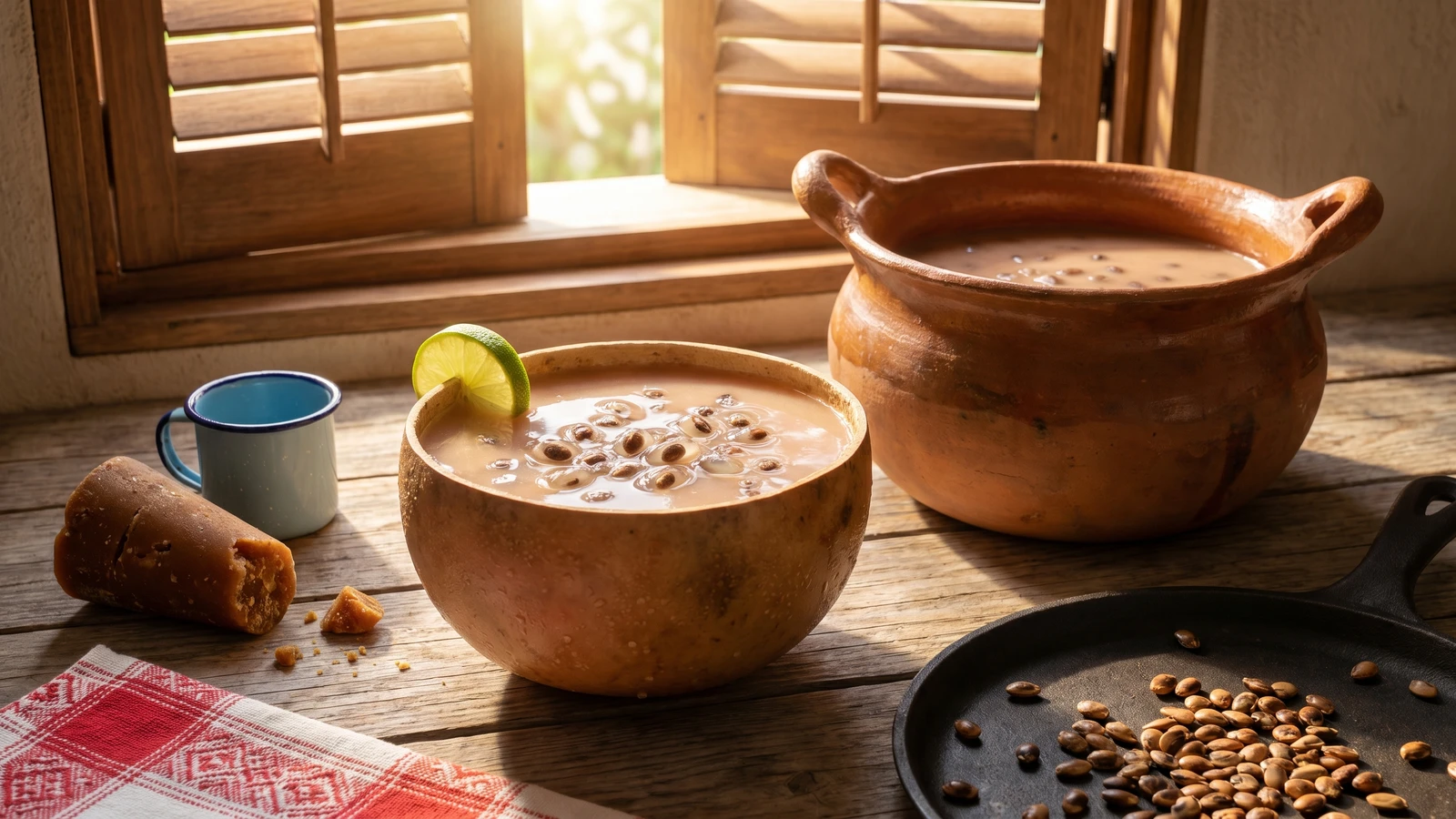
Sinaloa's Yoreme heritage refresher: toasted chan seeds bloomed in cold water with piloncillo and lime, served in a jicara gourd. The drink of the northwest summer.
This is from Sinaloa. From the lowland country between the sierra and the Pacific where the Yoreme people, the Mayo, have been drinking bate de chan since long before anyone called this region Mexico. The drink belongs to them. The seed belongs to them. Anything I write about it is a record of what they taught the rest of us.
Chan is not chia. I will say it once and I will say it again because the confusion is everywhere. Chia is Salvia hispanica, grown commercially across the country and now the world. Chan is Hyptis suaveolens, a wild aromatic herb of the Sinaloan and Sonoran lowlands, and the seed has an herbal, faintly minty bitterness that chia does not have. When you toast chan on a comal, your kitchen fills with the smell of the monte after a summer rain. That smell is the drink. Substitute chia and you have a sweetened lime water with seeds in it. You do not have bate.
The technique is simple and unforgiving. You toast the seed gently. You bloom it in cold water until each one is wrapped in its own clear gel. You sweeten with piloncillo, not refined sugar, because piloncillo carries the molasses depth that holds up under the lime. You finish with a pinch of salt because every senora in Mocorito knows that the salt is what makes the sweet taste sweet and the sour taste sour. You serve it in a jicara because that is what you serve it in. Cada estado, su propia cocina, and the gourd belongs to this one.
My mother did not know bate de chan. She was from Jalisco and Jalisco does not have this drink. I learned it in Los Mochis in 2009 from a woman named Dona Catalina who sold it from a folding table outside the central market, three pesos a jicara. She watched me drink the first one too fast and told me to slow down, that bate is for the heat, that you sip it and let the gel sit on your tongue. She was right about that and she was right about a lot of other things. Saber cocinar es saber vivir.
Bate de chan is a pre-Columbian beverage of the Yoreme (Mayo) and Yoreme-Yaqui peoples of what is now Sinaloa and southern Sonora, where Hyptis suaveolens has grown wild for millennia and the seeds were used both as a food and as a medicinal cooling agent during the brutal lowland summers. Spanish colonial records from the 17th century note the use of 'chan' as distinct from 'chia' in northwest Mexico, though the two names have been conflated in modern commerce, leading to widespread mis-labeling of Salvia hispanica seeds as chan. The jicara gourd, made from the dried fruit of Crescentia cujete, was the original drinking vessel and remains the traditional one in Sinaloan ferias and home kitchens, particularly during the Yoreme Lenten observances when bate is offered to dancers and pilgrims as a ceremonial refreshment.
Quantity
1/2 cup
not chia, sourced from a Sinaloa or northwest Mexico vendor
Quantity
6 cups
divided
Quantity
6 ounces (about 1 cone)
chopped
Quantity
1 cup
for dissolving the piloncillo
Quantity
1/2 cup (about 6 Mexican limes)
Quantity
1 stick
Quantity
a pinch
Quantity
for serving
Quantity
for serving
| Ingredient | Quantity |
|---|---|
| chan seeds (Hyptis suaveolens)not chia, sourced from a Sinaloa or northwest Mexico vendor | 1/2 cup |
| cold waterdivided | 6 cups |
| piloncillochopped | 6 ounces (about 1 cone) |
| hot waterfor dissolving the piloncillo | 1 cup |
| fresh lime juice | 1/2 cup (about 6 Mexican limes) |
| Mexican canela (Ceylon cinnamon) (optional) | 1 stick |
| sea salt | a pinch |
| ice (optional) | for serving |
| lime wedges (optional) | for serving |
Heat a dry comal or heavy skillet over medium-low. Add the chan seeds in a single layer. Toast them gently for about 5 to 7 minutes, stirring constantly with a wooden spoon. They will release an herbal, minty aroma, the smell of the Sinaloan monte where the plant grows wild. The seeds should darken one shade, not blacken. Burned chan tastes bitter and the whole bate is lost.
Chop the piloncillo cone into small pieces with a heavy knife or smash it inside a folded towel with a mallet. Place it in a small saucepan with the one cup of hot water and the canela stick if using. Simmer over low heat for 5 to 8 minutes, stirring until the piloncillo dissolves completely into a dark, syrupy liquid. Take it off the heat and let it cool to room temperature. La canela is optional, but the senoras in Mocorito and El Fuerte will tell you it rounds the piloncillo's edge.
Place the toasted chan seeds in a wide ceramic bowl or a jicara gourd if you have one. Pour in 4 cups of the cold water. Stir with a wooden spoon. Within seconds you will see the seeds bloom: each one wraps itself in a clear gelatinous coat, the way a frog's egg sits in water. Let the mixture rest at room temperature for 15 minutes, stirring once halfway through, until the seeds are fully suspended and the water has thickened slightly.
Pour the cooled piloncillo syrup into the chan mixture. Add the remaining 2 cups of cold water, the lime juice, and the pinch of salt. Stir well. Taste. The bate should be sweet but not cloying, with a clean lime brightness and the herbal pull of the chan underneath. The salt is small but it sharpens the whole thing. Adjust with more lime or a touch more water until it tastes balanced to you.
Cover the bowl and refrigerate for at least 4 hours, or overnight. This rest is not optional. The chan continues to bloom, the piloncillo settles into the water, and the lime softens. A bate served right after mixing tastes raw and disjointed. A bate that has rested tastes like one thing, not three.
Stir the bate from the bottom because the chan settles. Pour into jicara gourds if you have them, or into heavy glass tumblers over a single ice cube. Add a lime wedge on the rim. Drink it while the heat of the Sinaloan afternoon is still hanging over the patio. Asi se hace y punto.
1 serving (about 340g)
Culinary guides, cultural storytelling, and the editorial depth that makes cooking meaningful.
Discover Culinary ExplorerChef Lupita
Ciudad de México's highland market agua fresca, fresh alfalfa blended with pineapple and lime until bright green, strained clean, and poured cold from the vitrolero.

Chef Lupita
Aguascalientes' Lenten agua fresca, jewel-red from cooked beet and full of apple, banana, orange, lettuce, and ground peanuts, served cold when Holy Week meets the Feria de San Marcos.

Chef Lupita
Sonora and Sinaloa's creamy malted barley water, built on toasted cebada perla, Mexican canela, vanilla from Papantla, and evaporated milk. Pink-beige, rich, and served cold over heavy ice in a heavy glass tumbler. Liquid cookie comfort the northwest way.

Chef Lupita
Yucatán's everyday tonic of boiled chaya leaves blended with lima agria, sugar, and ice. The bright green jarra that sits on every Peninsula table from Mérida to Valladolid.