
Chef Lupita
Agua de Alfalfa
Ciudad de México's highland market agua fresca, fresh alfalfa blended with pineapple and lime until bright green, strained clean, and poured cold from the vitrolero.
A cooking platform built around craft, culture, and the stories behind what we eat.
Created by
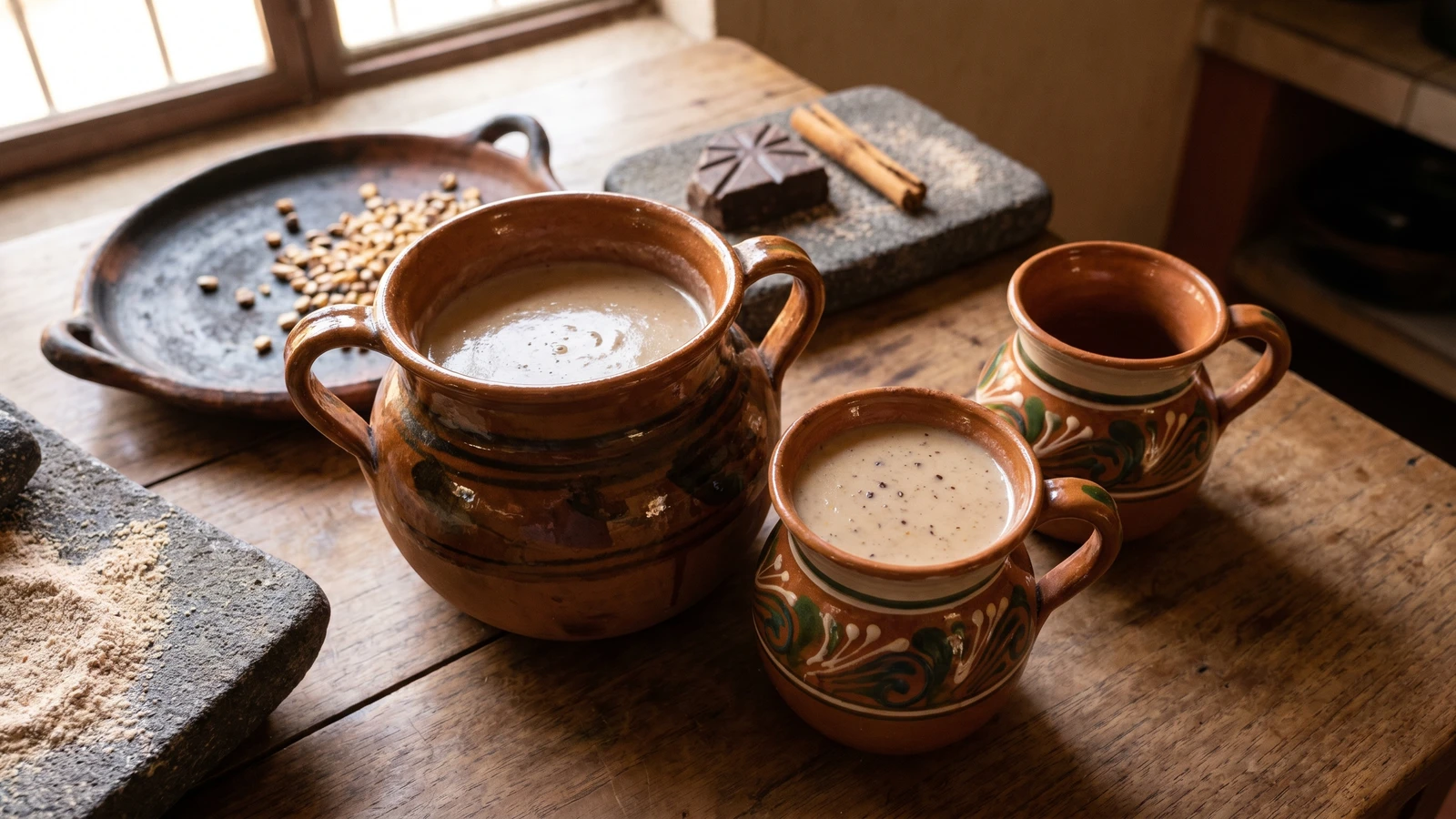
Guanajuato's rainy-season atole turns toasted field corn into pinole, then thickens it with piloncillo, canela, and chocolate de metate until the spoon leaves a clean path.
Guanajuato, in the Bajío, owns this atole in the rainy months, when the fields around Irapuato, Celaya, and Salamanca smell of wet earth and the market women sell sacks of dry maíz criollo for pinole. This is not a drink built on chile. It is corn, toasted until it smells like the comal after tortillas, ground fine, then simmered with piloncillo, canela, and chocolate de metate.
The ingredient that defines it is pinole, not masa harina. Pinole is dry corn toasted first, then ground. That order matters. Toasting gives the drink its nutty backbone; grinding it fine keeps the atole from feeling sandy in the mouth. If you buy pinole already ground, buy it unsweetened from a molino or a mercado stall. The cereal aisle powders are for people who forgot where corn comes from.
I learned this version in a Guanajuato kitchen where the clay olla lived on the back burner all July. The señora who taught me did not measure thickness with a thermometer. She dragged a wooden spoon through the pot and watched whether the atole closed over itself slowly. That is the test. Serve it in jarros de barro vidriado from Dolores Hidalgo, not in a thin café mug that makes the drink look like an apology.
No me vengas con atajos. If the corn is not toasted, it is not pinole. If the pinole goes straight into hot milk, it will clump. Cold slurry first, low simmer after. Saber cocinar es saber vivir.
Pinole comes from the Nahuatl pinolli, toasted and ground maize eaten dry, mixed with water, or cooked as atole long before the conquest. The Bajío became one of New Spain's major grain regions after the 16th-century silver boom in Guanajuato, and maize drinks like this fed mining towns, ranch kitchens, and market mornings. Piloncillo reflects colonial sugar production, while chocolate de metate carries the older Mesoamerican practice of stone-ground cacao into a Central Mexican home drink.
Quantity
1 1/2 cups
picked over; or use 1 1/4 cups unsweetened pinole from a molino
Quantity
5 cups
divided
Quantity
2 cups
Quantity
1 (3-inch) stick
Quantity
3 to 4 ounces
chopped
Quantity
1/4 teaspoon
Quantity
2 ounces
chopped
| Ingredient | Quantity |
|---|---|
| whole dried maíz amarillo criollo or white field cornpicked over; or use 1 1/4 cups unsweetened pinole from a molino | 1 1/2 cups |
| waterdivided | 5 cups |
| whole milk | 2 cups |
| Mexican canela | 1 (3-inch) stick |
| piloncillochopped | 3 to 4 ounces |
| fine sea salt | 1/4 teaspoon |
| chocolate de metatechopped | 2 ounces |
Pick through the dried corn and remove any stones, husk bits, or cracked black kernels. Wipe dusty kernels with a dry towel. Do not rinse unless you dry the corn completely afterward. Wet corn toasts badly, and pinole begins with dry heat.
Heat a dry comal or heavy skillet over medium-low heat. Toast the corn in a single layer, working in batches if needed, for 12 to 15 minutes, stirring constantly. The kernels should turn golden in spots, smell nutty, and crackle a little. Do not blacken them. Burned corn makes bitter atole, and no amount of piloncillo fixes that.
Let the toasted corn cool for 5 minutes. Grind it in a molino, grain mill, metate, or strong spice grinder in small batches. Sift through a fine-mesh sieve and grind the coarse pieces again. You need a fine powder, not gravel. Pinole that is too coarse will sit in the bottom of the cup like wet sand.
In a 3-quart clay olla or heavy saucepan, combine 4 cups water, the whole milk, canela, piloncillo, and salt. Bring to a gentle simmer over medium-low heat, stirring until the piloncillo dissolves. Keep the heat controlled. Milk scorches when the cook gets lazy.
Whisk the ground pinole with the remaining 1 cup cold water in a bowl until smooth. Cold slurry first. Always. If you throw dry pinole straight into hot milk, it clumps, and then you spend the rest of the evening chasing lumps around the pot. Así se hace y punto.
Pour the pinole slurry slowly into the simmering canela liquid while whisking. Lower the heat and cook 10 to 12 minutes, scraping the bottom with a wooden spoon. The atole should thicken enough that a line dragged through the spoon closes slowly. Taste it. The corn should be soft and toasted, with no raw edge.
Add the chopped chocolate de metate and stir until it melts fully, 3 to 4 minutes. The color should turn café con leche, with tiny dark cacao flecks from the stone-ground chocolate. Remove the canela stick. Let the atole rest 5 minutes off the heat so the corn settles into its proper body.
Ladle the atole into jarros de barro vidriado while it is thick and glossy. If it sits and tightens, loosen it with a splash of water or milk over low heat. Serve with pan dulce, a plain bolillo, or nothing at all. The corn is enough. Recetas probadas y garantizadas.
1 serving (about 320g)
Culinary guides, cultural storytelling, and the editorial depth that makes cooking meaningful.
Discover Culinary ExplorerChef Lupita
Ciudad de México's highland market agua fresca, fresh alfalfa blended with pineapple and lime until bright green, strained clean, and poured cold from the vitrolero.

Chef Lupita
Aguascalientes' Lenten agua fresca, jewel-red from cooked beet and full of apple, banana, orange, lettuce, and ground peanuts, served cold when Holy Week meets the Feria de San Marcos.

Chef Lupita
Sonora and Sinaloa's creamy malted barley water, built on toasted cebada perla, Mexican canela, vanilla from Papantla, and evaporated milk. Pink-beige, rich, and served cold over heavy ice in a heavy glass tumbler. Liquid cookie comfort the northwest way.

Chef Lupita
Yucatán's everyday tonic of boiled chaya leaves blended with lima agria, sugar, and ice. The bright green jarra that sits on every Peninsula table from Mérida to Valladolid.