
Chef Lupita
Agua de Alfalfa
Ciudad de México's highland market agua fresca, fresh alfalfa blended with pineapple and lime until bright green, strained clean, and poured cold from the vitrolero.
A cooking platform built around craft, culture, and the stories behind what we eat.
Created by
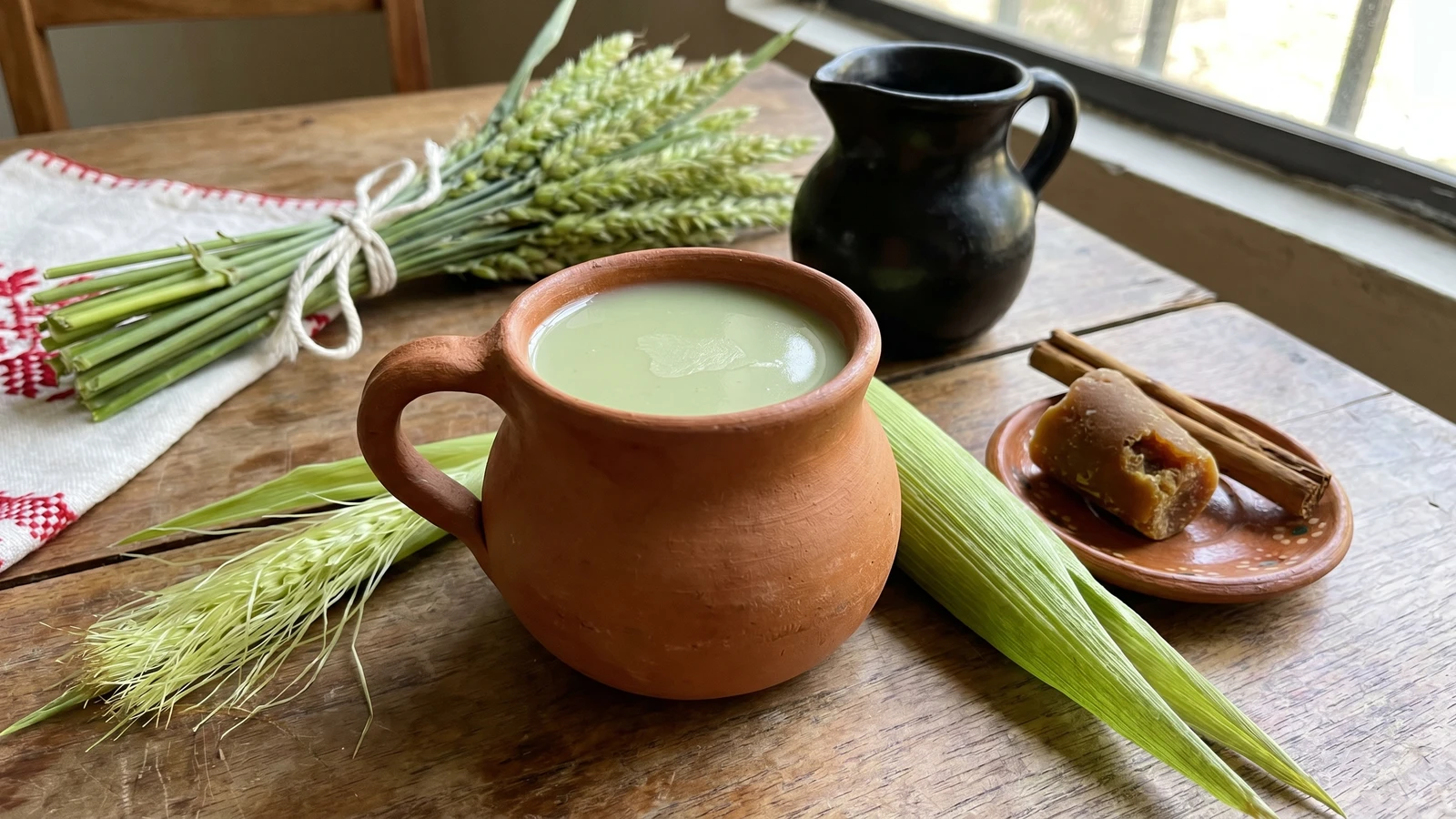
Oaxaca's seasonal atole built on fresh corn tassels and masa, grassy and faintly sweet, tied to a single fleeting moment in the agricultural year when the milpa flowers and the cooks of the Sierra Norte get to work.
This is from Oaxaca. Specifically from the Sierra Norte and the Mixteca, where families farm milpa the old way and the corn plant gives more than just grain. The espiga is the tassel, the male flower at the top of the cornstalk, and it has a window of maybe three weeks a year when it is tender enough to cook. Miss the window and you wait twelve months. Cada estado, su propia cocina, and this is one of those dishes that explains why I spent three years driving to small towns instead of staying in Mexico City.
The flavor is not what people expect. It is grassy, almost like the smell of a cornfield in summer pressed into a cup. The sweetness from the piloncillo sits behind the corn, not on top of it. This is not a chocolate atole, not a champurrado, not the sweet pink atole de fresa they sell on street corners. This is older and quieter. The women who make it learned it from their mothers and they make it for the milpa harvest, for Day of the Dead in some communities, for early mornings when the air is cold and the work has not started yet.
The technique is honest. You boil the espigas. You strain them hard. You whisk the masa in cold water so it does not lump. You cook it slowly. You sweeten it with piloncillo, not white sugar, because piloncillo is what the kitchen has. Asi se hace y punto. If you cannot find fresh espigas, you cannot make this dish today. Wait for the season. Mexican grandmothers cook with what the milpa is giving, not with what looks good on a Pinterest board.
Atole predates the Spanish conquest by thousands of years and is referenced extensively in the Florentine Codex of Bernardino de Sahagun, where it appears as a foundational Mesoamerican drink prepared in dozens of variations using nixtamalized corn, chia, amaranth, and seasonal additions from the milpa. Atole de espiga belongs to a family of milpa-cycle atoles, drinks tied to specific moments in the corn plant's growth, alongside atole de elote (made from young green corn kernels) and atole agrio (fermented), each marking a different stage of the agricultural year. The dish remains most strongly preserved in the Sierra Norte de Oaxaca, parts of the Mixteca Alta, and Zapotec communities of the Valles Centrales, where the milpa system, corn intercropped with beans and squash, is still farmed at smallholder scale and the espigas are gathered by hand during the brief flowering window in late summer.
Quantity
12
green and tender, freshly cut from young milpa corn
Quantity
10 cups
divided
Quantity
1 cup
or 1 cup masa harina hydrated with 1 cup warm water
Quantity
1 cup (about 6 ounces)
or packed dark brown sugar
Quantity
1 stick, about 3 inches
Quantity
1/2 teaspoon
Quantity
1 cup
for a softer finish
| Ingredient | Quantity |
|---|---|
| fresh corn tassels (espigas)green and tender, freshly cut from young milpa corn | 12 |
| waterdivided | 10 cups |
| fresh masa for tortillasor 1 cup masa harina hydrated with 1 cup warm water | 1 cup |
| grated piloncilloor packed dark brown sugar | 1 cup (about 6 ounces) |
| Mexican cinnamon (canela de Ceylan) | 1 stick, about 3 inches |
| kosher salt | 1/2 teaspoon |
| whole milk (optional)for a softer finish | 1 cup |
Rinse the corn tassels under cold water and shake them dry. Pull off any hardened stem at the base, you want only the soft green-and-cream flowering tops. Smell them. They should smell like raw corn silk and cut grass. If they smell musty or look brown, they were cut too late. The espiga is the male flower of the corn plant and it is in its window for only a few weeks each year. This is not a dish you make in October.
Place the cleaned espigas in a heavy pot with 6 cups of the water and the cinnamon stick. Bring to a simmer over medium heat and cook for 20 minutes, until the water turns a pale yellow-green and smells distinctly of fresh corn. Do not boil it hard. A rolling boil cooks the grass out of them and leaves you with flat water.
Pull out the cinnamon stick and set it aside. Transfer the espigas with their cooking liquid to a blender in batches. Blend on high for a full minute per batch, until the tassels break down into a fibrous green pulp. Pass the puree through a fine-mesh sieve back into the pot, pressing hard on the solids with the back of a wooden spoon. Discard what stays in the sieve. The strained liquid should be the color of jade and smell like a cornfield in August.
In a separate bowl, whisk the masa with the remaining 4 cups of water until completely smooth, with no lumps. If you are using masa harina, hydrate it first with warm water and let it sit for 10 minutes before whisking it into the rest. Pour the masa mixture through the sieve into the pot of espiga liquid. This is the body of the atole. No me vengas con atajos, masa is what makes it atole and not flavored water.
Return the cinnamon stick to the pot. Set over medium-low heat. Whisk constantly. The atole will thicken slowly over 15 to 20 minutes as the masa cooks out its raw flavor. Do not stop stirring or the masa will catch on the bottom of the pot and scorch. Burned masa ruins atole. The texture you want is the back of a spoon coats and a slow line drawn through it holds for a moment before closing.
Stir in the grated piloncillo and the salt. Continue to whisk over low heat until the piloncillo dissolves completely, about 5 minutes. Taste it. Atole de espiga is not a dessert. The sweetness should sit behind the grassy corn flavor, not in front of it. If you want a softer, rounder finish, stir in the cup of warm milk now and bring it back just to a gentle simmer. Many cooks in the Sierra Norte make it without milk. Some add it. Cada cocinera, su propia mano.
Pull out the cinnamon stick. Ladle the atole into clay jarros, the small handled mugs, or into ceramic cups. Serve it warm, never scalding. Atole de espiga is the kind of drink you hold in two hands while you stand in a kitchen at six in the morning and watch the light come up. Saber cocinar es saber vivir.
1 serving (about 270g)
Culinary guides, cultural storytelling, and the editorial depth that makes cooking meaningful.
Discover Culinary ExplorerChef Lupita
Ciudad de México's highland market agua fresca, fresh alfalfa blended with pineapple and lime until bright green, strained clean, and poured cold from the vitrolero.

Chef Lupita
Aguascalientes' Lenten agua fresca, jewel-red from cooked beet and full of apple, banana, orange, lettuce, and ground peanuts, served cold when Holy Week meets the Feria de San Marcos.

Chef Lupita
Sonora and Sinaloa's creamy malted barley water, built on toasted cebada perla, Mexican canela, vanilla from Papantla, and evaporated milk. Pink-beige, rich, and served cold over heavy ice in a heavy glass tumbler. Liquid cookie comfort the northwest way.

Chef Lupita
Yucatán's everyday tonic of boiled chaya leaves blended with lima agria, sugar, and ice. The bright green jarra that sits on every Peninsula table from Mérida to Valladolid.