
Chef Lupita
Agua de Alfalfa
Ciudad de México's highland market agua fresca, fresh alfalfa blended with pineapple and lime until bright green, strained clean, and poured cold from the vitrolero.
A cooking platform built around craft, culture, and the stories behind what we eat.
Created by
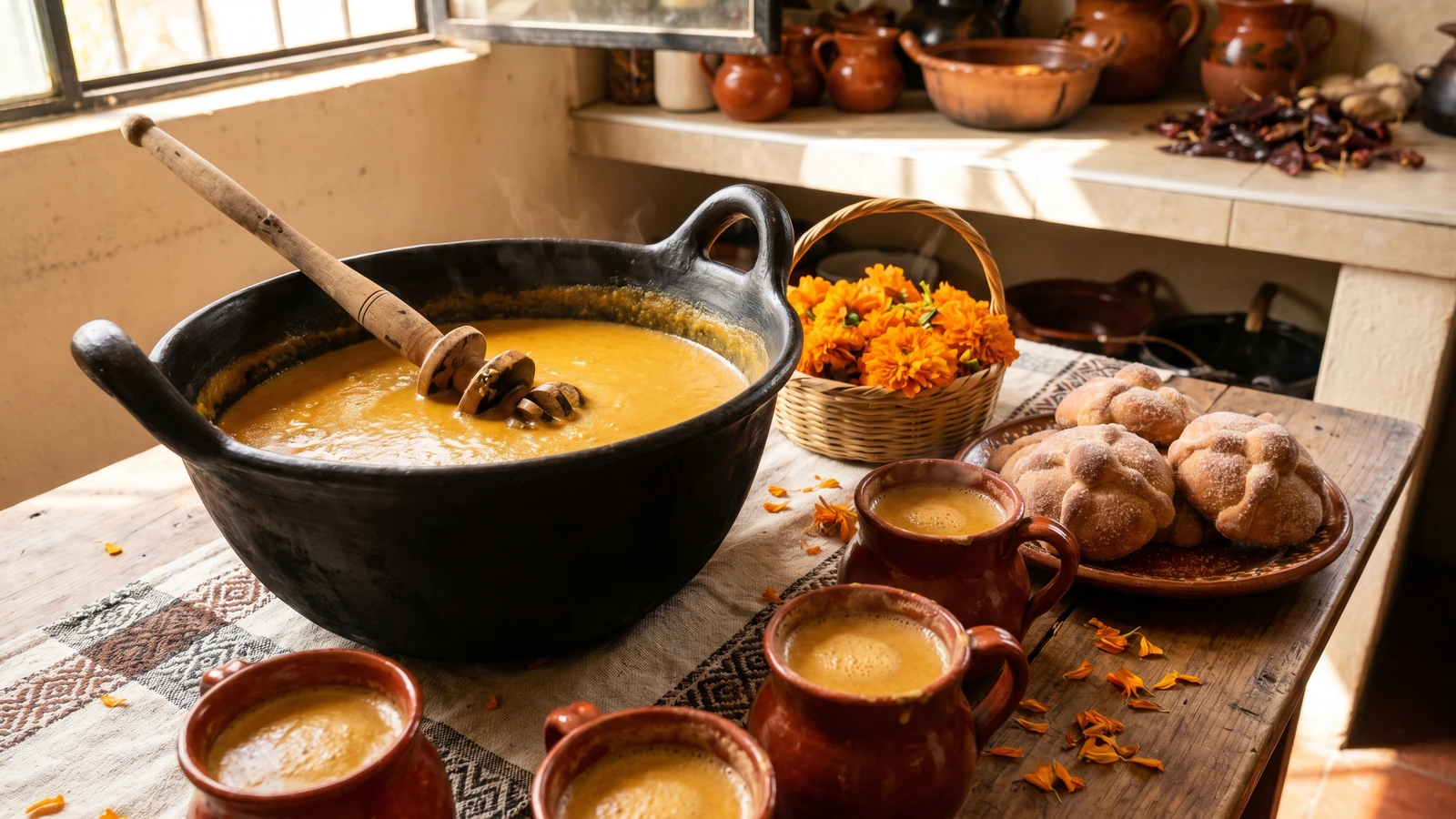
Michoacán's Meseta P'urhépecha kamáta for Día de Muertos, thickened with fresh nixtamal masa and perfumed with food-grade cempasúchil petals, served from a clay olla into jarros beside pan de muerto.
Michoacán, the Meseta P'urhépecha around Cherán, Paracho, and Nahuatzen, is where I place this atole. The P'urhépecha word kamáta tells you what it is before any Spanish menu does: a corn drink, thickened with nixtamal masa and beaten in a clay olla until it carries a little foam.
Do not call this Halloween atole. It belongs to Día de Muertos, when cempasúchil marks the road between the cemetery, the altar, and the kitchen. The flower gives color and a bitter-citrus perfume, but the masa is what makes it food. Without corn, you have tea. With nixtamal, you have something that can warm a family standing in the night air at the panteón.
I learned this version from Meseta women who cook by the rule of leña even when the stove is gas: low heat, clay if it is lead-free, constant movement with the molinillo. They add the cempasúchil near the end because hard boiling turns the flower harsh. That is not romance. That is technique. La cocina no es decoración, es trabajo.
Use flowers grown for eating. Ask the women at the market, pregúntale a las señoras del mercado, and do not buy florist marigolds sprayed for color and shelf life. The dead deserve their flowers on the altar. The living deserve clean petals in the olla. Saber cocinar es saber vivir.
In Michoacán, Día de Muertos practices around the Lago de Pátzcuaro and the Meseta P'urhépecha developed from P'urhépecha ancestor observances and Catholic All Souls' traditions introduced after the Spanish conquest in the 16th century. Cempasúchil, Tagetes erecta, is native to Mexico and Central America; its Nahuatl name cempohualxochitl means 'twenty flower,' and its bright petals became tied to ofrendas, cemetery paths, and grave arches. Corn atoles, called kamáta in P'urhépecha communities, belong to the older maize-drink family that predates European coffee and colonial chocolate houses by centuries.
Quantity
1 packed cup
from 10 to 12 unsprayed Tagetes erecta blossoms, yellow-orange petals only, green calyx discarded
Quantity
7 cups
divided
Quantity
1
Quantity
4 ounces
chopped
Quantity
1 cup
preferably from a molino or tortillería, crumbled
Quantity
1/4 teaspoon
Quantity
for serving
| Ingredient | Quantity |
|---|---|
| fresh food-grade cempasúchil petalsfrom 10 to 12 unsprayed Tagetes erecta blossoms, yellow-orange petals only, green calyx discarded | 1 packed cup |
| waterdivided | 7 cups |
| Mexican cinnamon stick (canela) | 1 |
| piloncillochopped | 4 ounces |
| fresh nixtamal masapreferably from a molino or tortillería, crumbled | 1 cup |
| fine sea salt | 1/4 teaspoon |
| pan de muerto or corundas (optional) | for serving |
Pull the yellow-orange petals from the cempasúchil heads and discard the green calyx. Rinse the petals gently in cool water and spread them on a clean towel. Use only flowers grown for eating or cut from your own unsprayed plants. Do not cook with cemetery flowers, florist flowers, or petals already used on the ofrenda. Those are for the dead and for the path, not for the pot.
In a lead-free clay olla or heavy pot, combine 3 cups of the water and the canela. Bring it to a gentle simmer over medium-low heat. Add the cempasúchil petals, stir once, then turn off the heat and let them sit for 5 minutes. The water should turn deep gold and smell floral, a little bitter, a little citrus. Do not boil the petals hard. That is how you make medicine, not atole.
Remove the canela and save it. Transfer the flower infusion and softened petals to a blender. Blend until smooth, then strain through a fine-mesh sieve into a bowl, pressing lightly. You want color and perfume, not shredded petals stuck between the teeth. Set the golden liquid aside.
In a separate bowl, crumble the fresh nixtamal masa with your fingers. Add 2 cups room-temperature water little by little, whisking or rubbing with your hand until there are no lumps. Strain this masa slurry back into the olla. Fresh masa smells like wet corn and cal. That smell is the spine of the drink. Without it, the flower has nothing to stand on.
Add the remaining 2 cups water, the chopped piloncillo, the saved canela, and the salt to the olla with the masa slurry. Cook over medium-low heat, stirring constantly with a molinillo or wooden spoon. After 10 to 12 minutes, the atole will thicken enough to coat the spoon and the raw masa taste will disappear. Keep the heat steady. A clay olla rewards patience and punishes hurry.
Lower the heat. Stir in the strained cempasúchil infusion and cook for 3 to 4 minutes more, beating with the molinillo so the drink turns smooth and lightly foamy on the surface. The color should be golden-orange, not brown. Taste for sweetness. The piloncillo should support the flower, not bury it.
Remove the canela. Ladle the atole into warm clay jarros from Patamban, Tzintzuntzan, or Capula if you have them. Serve with pan de muerto or corundas on a manta-covered table. This is Noche de Muertos cooking: corn for the living, flowers for memory, clay in the hand. Cada estado, su propia cocina.
1 serving (about 315g)
Culinary guides, cultural storytelling, and the editorial depth that makes cooking meaningful.
Discover Culinary ExplorerChef Lupita
Ciudad de México's highland market agua fresca, fresh alfalfa blended with pineapple and lime until bright green, strained clean, and poured cold from the vitrolero.

Chef Lupita
Aguascalientes' Lenten agua fresca, jewel-red from cooked beet and full of apple, banana, orange, lettuce, and ground peanuts, served cold when Holy Week meets the Feria de San Marcos.

Chef Lupita
Sonora and Sinaloa's creamy malted barley water, built on toasted cebada perla, Mexican canela, vanilla from Papantla, and evaporated milk. Pink-beige, rich, and served cold over heavy ice in a heavy glass tumbler. Liquid cookie comfort the northwest way.

Chef Lupita
Yucatán's everyday tonic of boiled chaya leaves blended with lima agria, sugar, and ice. The bright green jarra that sits on every Peninsula table from Mérida to Valladolid.