
Chef Joost
Acar Ketimun (Indo-Dutch Cucumber Pickle)
Acar means pickle, ketimun means cucumber, and this little bowl of sweet vinegar, chilli, and crunch is the cool note that lets an Indo-Dutch rijsttafel keep its balance.
A cooking platform built around craft, culture, and the stories behind what we eat.
Created by
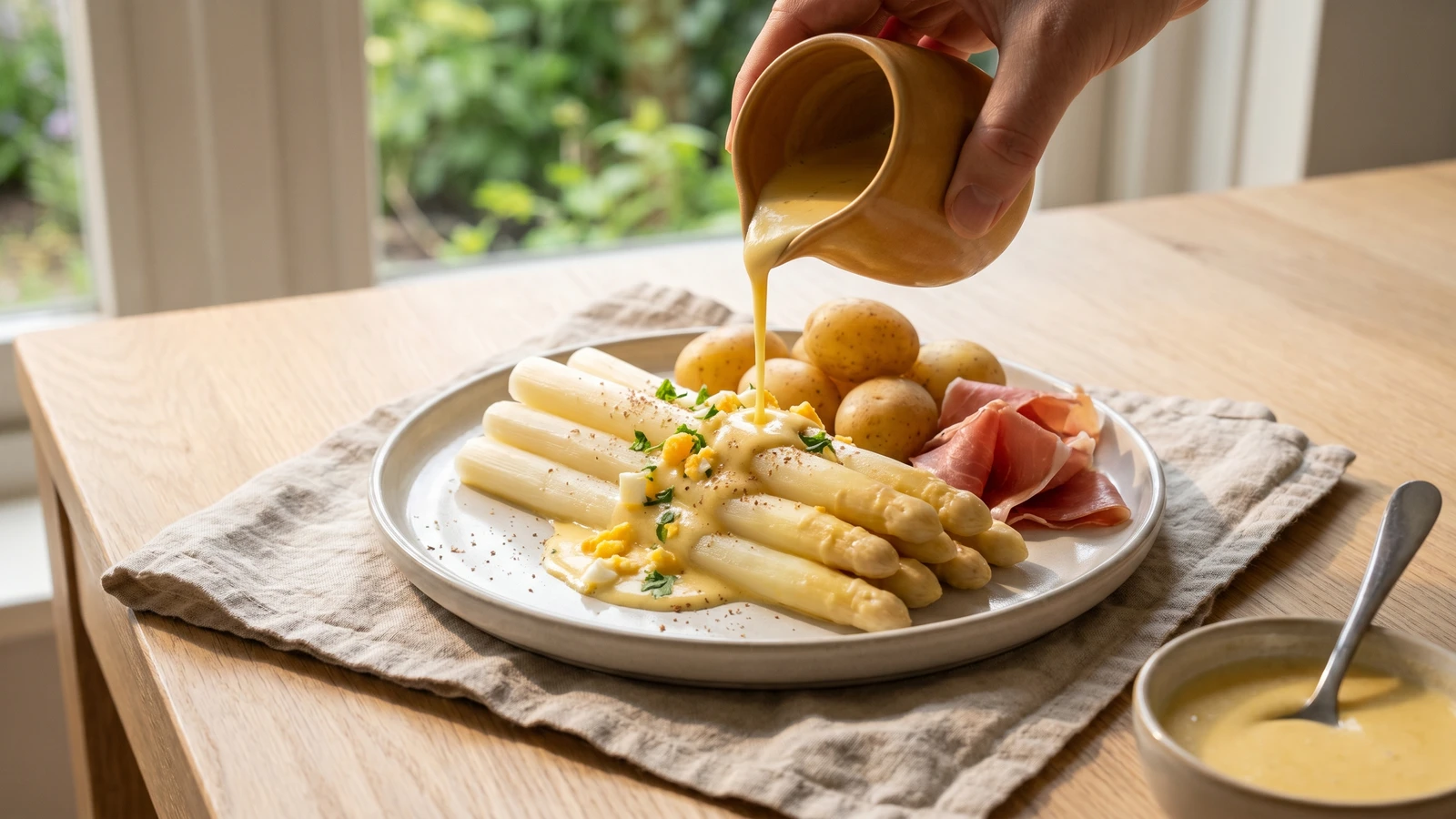
Spring on a Dutch plate: the gentle butter-and-egg sauce that catches the first white asparagus, carries a whisper of nutmeg, and makes dinner feel properly seasonal.
White asparagus is the Dutch spring vegetable that arrives with rules. Not fussy rules, proper ones. You eat it when the calendar says yes, roughly from April until Sint Jan, Saint John's Day on 24 June, and then you stop. The tide sets the menu, and so does the calendar; asparagus in November is just a pale rumor of itself.
In Limburg and Brabant they call white asparagus het witte goud, the white gold, and for once the Dutch are not exaggerating. The spears grow underground, hidden from light so they stay ivory and tender, and the cook's first duty is not to smother them. But let me tell you a secret: the sauce is where many people lose their nerve. They reach for hollandaise, because French names have been bullying Dutch tables for centuries. Aspergesaus is quieter and, for this dish, better behaved.
The name is plain because the work is plain: asperge, asparagus, and saus, sauce. No false etymology hiding in the cupboard. What matters is the cooking water. It holds the faint bitterness and sweetness of the peeled stalks, so we borrow it back, thicken it with butter and flour, round it with egg and cream, and finish with parsley and nutmeg. History and cookery, they cannot be separated; even the nutmeg is an old Dutch habit from the spice ships, used here with restraint, which is the only polite way to use it.
Hou het altijd simpel, always keep it simple. Make the sauce while the asparagus rests, keep the heat gentle after the egg goes in, and pour it warmly over white asparagus, boiled potatoes, and ham. A dish without its story is half a meal, but a good aspergesaus is the other half.
White asparagus became a strong regional marker in the sandy soils of Limburg and North Brabant, where cultivation expanded in the nineteenth and twentieth centuries and the vegetable earned the nickname het witte goud, the white gold. The traditional Dutch serving of asparagus with ham, boiled egg, potatoes, melted butter, parsley, and nutmeg reflects a spring table built around local produce and pantry richness rather than restaurant ceremony. The season traditionally ends around Sint Jan on 24 June, after which the plants are left to recover for the following year.
Quantity
40g
Quantity
35g
Quantity
300ml
warm
Quantity
100ml
Quantity
2
finely chopped
Quantity
1 tablespoon
finely chopped
Quantity
1/4 teaspoon
plus more to taste
Quantity
1 teaspoon
Quantity
to taste
| Ingredient | Quantity |
|---|---|
| unsalted butter | 40g |
| plain flour | 35g |
| white asparagus cooking waterwarm | 300ml |
| whole milk or light cream | 100ml |
| hard-boiled eggsfinely chopped | 2 |
| flat-leaf parsleyfinely chopped | 1 tablespoon |
| freshly grated nutmegplus more to taste | 1/4 teaspoon |
| lemon juice (optional) | 1 teaspoon |
| salt and white pepper | to taste |
Cook your peeled white asparagus first, then lift the spears out and keep 300ml of the cooking water warm. This is not bathwater to throw away. It carries the asparagus back into the sauce, which is why the finished dish tastes of spring rather than just butter.
Melt the butter in a small saucepan over medium-low heat. Stir in the flour and cook for two minutes, stirring steadily, until it smells gently nutty but has taken on no real colour. A brown roux belongs elsewhere; this sauce should stay pale and quiet.
Add the warm asparagus water a little at a time, whisking after each addition until the sauce is smooth before adding more. Whisk in the milk or cream, then let the sauce murmur gently for four to five minutes until it coats the back of a spoon. If it thickens too much, loosen it with another splash of asparagus water.
Turn the heat low and stir in the chopped hard-boiled eggs, parsley, nutmeg, salt, and white pepper. Add the lemon juice if the sauce tastes too rounded and needs a small bright edge. Do not boil it now; egg is a patient guest but a poor swimmer.
Spoon the warm sauce over white asparagus laid beside boiled potatoes and thin slices of ham, or pass it in a small jug at the table. Finish with the faintest extra grating of nutmeg. You should taste butter first, asparagus second, and nutmeg only as the thing you notice when it is missing.
1 serving (about 140g)
Culinary guides, cultural storytelling, and the editorial depth that makes cooking meaningful.
Discover Culinary ExplorerChef Joost
Acar means pickle, ketimun means cucumber, and this little bowl of sweet vinegar, chilli, and crunch is the cool note that lets an Indo-Dutch rijsttafel keep its balance.

Chef Joost
Appelcompote is the apple left with its dignity: soft enough to spoon beside pork or potatoes, still chunky enough to remind you autumn did the real work.

Chef Joost
The little bowl beside the plate is never decoration: appelmoes is the Dutch treaty between sweet and savoury, spooned beside sausage, potatoes, pancakes, and childhood itself.

Chef Joost
Appelstroop is the orchard made patient: apples, pears, and beet syrup boiled down until morning bread, farmhouse cheese, and zuurvlees taste of Limburg in autumn.